

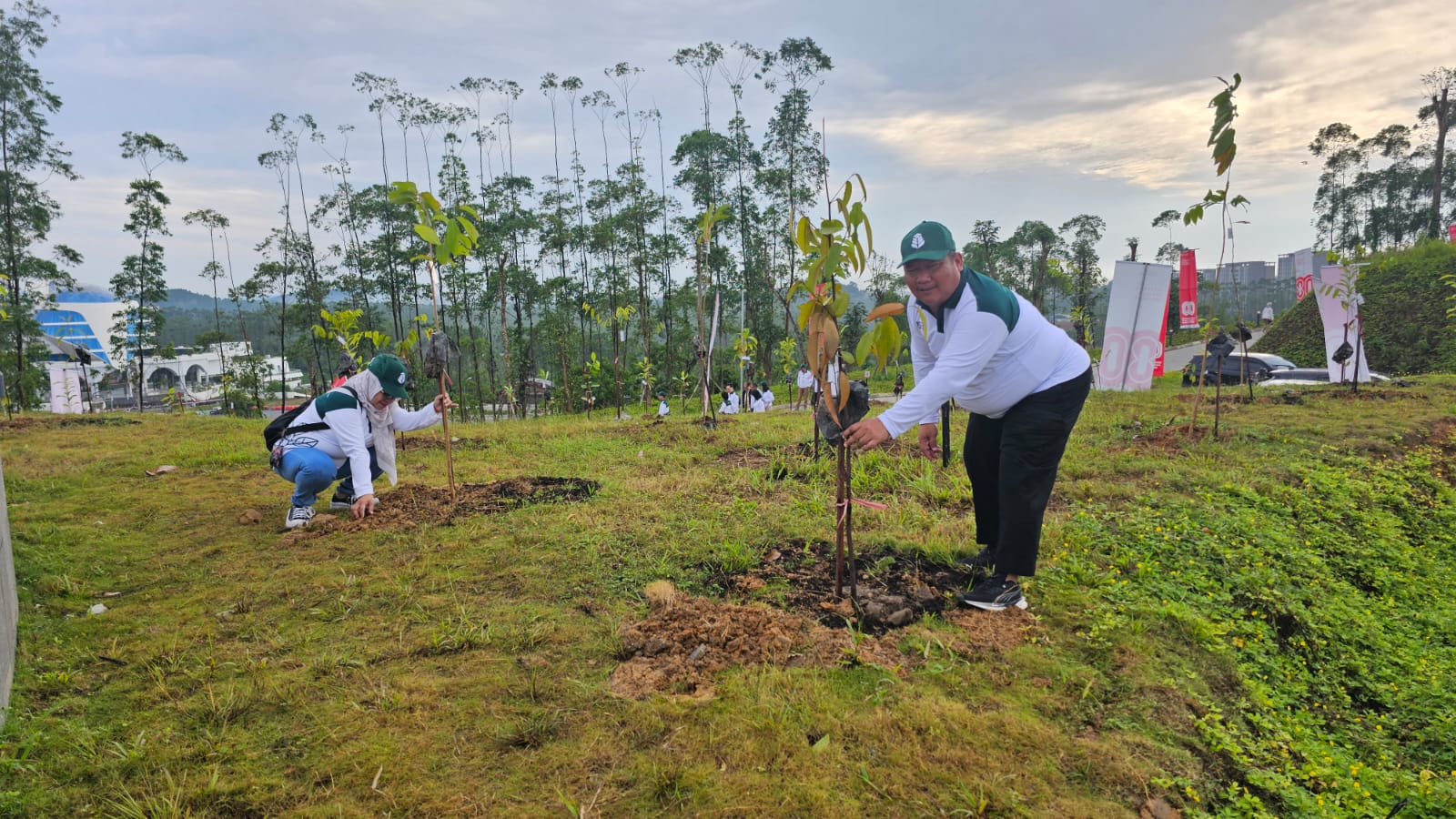
The leadership of the Faculty of Social and Political Sciences (FISIP) of Universitas Negeri Semarang (UNNES) participated in a tree planting event in the Indonesian capital city (IKN), East Kalimantan, on Tuesday (August 26th).
This event was part of a series of events for the Council of University Presidents of Thailand – Council of Rectors of Indonesia State Universities (CUPT-CRISU Conference 2025), held in the IKN area. The event carried the theme “Green and Inclusive Campuses: A Governance Approach to Sustainability and Social Responsibility.” This event served as a crucial opportunity to strengthen international collaboration in creating an environmentally friendly and inclusive campus environment.
This prestigious event was hosted by the Kalimantan Institute of Technology (ITK) and supported by several universities in Kalimantan, including Mulawarman University, Borneo Tarakan University, Tanjungpura University, Palangkaraya University, and Lambung Mangkurat University. The presence of the FISIP UNNES leadership, along with university leaders from Thailand and Indonesia, demonstrated a shared commitment to supporting green campus governance and sustainability-oriented social responsibility.
The CUPT-CRISU Conference 2025 series of activities encompassed a variety of important events, including the Rector/Director Forum, Dean Forum, Student Forum, cultural performances at the gala dinner, and environmental excursions focused on nature conservation. The planting of tree seedlings in the National Capital City (IKN) served as a tangible symbol of commitment to green and sustainable development, while also supporting the Indonesian government’s mission to realize the IKN as a modern, environmentally friendly, and inclusive city.
This activity is also closely linked to efforts to achieve the Sustainable Development Goals (SDGs), particularly goals 13 (Climate Action) and 15 (Life on Land), which emphasize the importance of climate change mitigation and terrestrial ecosystem conservation. By planting trees in nationally strategic areas, it is hoped that concrete contributions from the academic world will support carbon emission reduction, maintain environmental quality, and create a sustainable city of the future.
Through this participation, FISIP UNNES not only demonstrates its role in the academic field but also as an agent of change in issues of sustainability and social responsibility. Planting tree seedlings in the IKN is a manifestation of the synergy between higher education and national development, which is expected to inspire the younger generation to care more about the environment while also encouraging the achievement of the vision of Golden Indonesia 2045.