

UNNES Student Team Proposes “CAKRAWANA” for Biodiversity Protection in Mount Leuser

Universitas Negeri Semarang > Faculty of Engineering > Fakultas Teknik-eng > UNNES Student Team Proposes “CAKRAWANA” for Biodiversity Protection in Mount Leuser

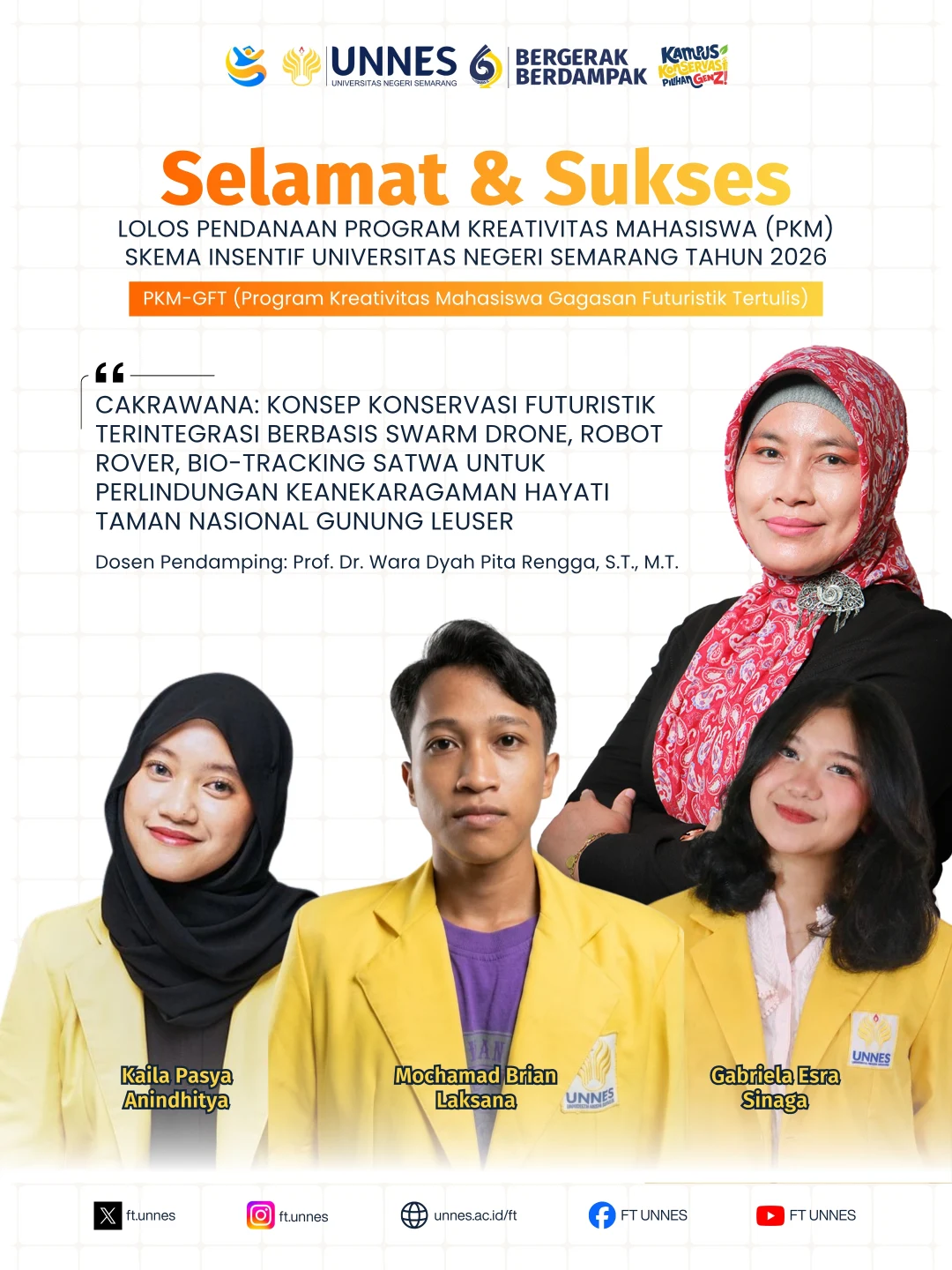
A team of students from Universitas Negeri Semarang (UNNES) has developed a futuristic concept titled “CAKRAWANA: An Integrated, Futuristic Conservation Concept Based on Swarm Drones, Robot Rovers, and Wildlife Bio-Tracking for the Protection of Biodiversity in Mount Leuser National Park,” as part of the 2026 Student Creativity Program for Written Futuristic Ideas (PKM-GFT).

The CAKRAWANA team is led by Mochamad Brian Laksana (2305070049) from the Chemical Engineering study program. Other team members include Gabriela Esra Sinaga (2408010648) from the Law study program and Kaila Pasya Anindhitya (2505070009) from the Chemical Engineering study program. The development of this concept was supervised by Prof. Dr. Wara Dyah Pita Rengga, S.T., M.T.

CAKRAWANA is designed as a conservation framework that integrates swarm drone technology, robot rovers, and wildlife bio-tracking systems. This technological integration is intended to assist in monitoring the area, tracking animal movements, and assessing the state of biodiversity within Mount Leuser National Park.

The proposal is rooted in the critical importance of protecting ecosystems and biodiversity within conservation areas. By leveraging technology, the team aims to facilitate more comprehensive, integrated, and sustainable monitoring, while simultaneously providing essential data to support conservation efforts.

Through the collaboration between students from the fields of Chemical Engineering and Law, the team seeks to synthesize technological, environmental, and regulatory perspectives to design future-oriented conservation solutions. Participation in the PKM-GFT also serves as a platform for students to cultivate creativity, critical thinking, interdisciplinary collaboration, and the ability to articulate scientific concepts. The CAKRAWANA initiative supports the achievement of SDG 9 (Industry, Innovation, and Infrastructure) and SDG 15 (Life on Land) through the use of technology for the protection of wildlife and biodiversity.
Related Posts

Leave a Reply

* Kode Akses Komentar:

* Tuliskan kode akses komentar diatas:

GDPR

  • Privacy Policy

Privacy Policy

At unnes.ac.id, the privacy of our visitors is of extreme importance to us. This privacy policy document outlines the types of personal information that is received and collected by unnes.ac.id and how it is used.

Log Files

Like many other Web sites, unnes.ac.id makes use of log files. The information inside the log files includes internet protocol (IP) addresses, type of browser, Internet Service Provider (ISP), date/time stamp, referring/exit pages, and number of clicks to analyze trends, administer the site, track user’s movement around the site, and gather demographic information. IP addresses and other such information are not linked to any information that is personally identifiable.

Cookies

unnes.ac.id uses cookies to store information about visitors’ preferences, to record user-specific information on which pages the site visitor accesses or visits, and to personalize or customize our web page content based upon visitors’ browser type or other information that the visitor sends via their browser.

Third-party ad servers or ad networks use technology in their respective advertisements and links that appear on unnes.ac.id and which are sent directly to your browser. They automatically receive your IP address when this occurs. Other technologies (such as cookies, JavaScript, or Web Beacons) may also be used by our site’s third-party ad networks to measure the effectiveness of their advertising campaigns and/or to personalize the advertising content that you see on the site.

unnes.ac.id has no access to or control over these cookies that are used by third-party advertisers.

You should consult the respective privacy policies of these third-party ad servers for more detailed information on their practices as well as for instructions about how to opt-out of certain practices. unnes.ac.id’s privacy policy does not apply to, and we cannot control the activities of, such other advertisers or web sites.

If you wish to disable cookies, you may do so through your individual browser options. More detailed information about cookie management with specific web browsers can be found at the browsers’ respective websites.

Consent

By using our website, you hereby consent to our privacy policy and agree to its terms.

Update

This Privacy Policy was last updated on: 2023-02-14. Should we update, amend or make any changes to our privacy policy, those changes will be posted here.

Contact Us

If you have any questions, comments, or concerns about our Privacy Policy or our practices with regards to your personal information, please feel free to contact us through the contact form on our website or by emailing us at humas[at]mail.unnes.ac.id.

This Privacy Policy is intended as a general guide to our practices in collecting and using information. If there is any inconsistency between this Privacy Policy and the terms of the Service Agreement or any other terms that may apply to specific services you use, then those specific service terms shall apply.

Terms of Use

By using our website, you agree to abide by this Privacy Policy. If you do not agree with this Privacy Policy, please do not use our website. We reserve the right to update this Privacy Policy from time to time without prior notice. Please review our Privacy Policy periodically to check for changes. Your continued use of our website following the posting of changes to this Privacy Policy means that you accept the changes.

Thank you for reading our Privacy Policy. We are committed to protecting the privacy of our website visitors and will continue to update our Privacy Policy to ensure optimal protection.