
Inovasi E-LKPD Flipbook Berbasis Kearifan Lokal pada Topik Besaran dan Satuan Meningkatkan Keterampilan Problem Solving Siswa

Universitas Negeri Semarang/Faculty of Mathematics and Natural Sciences/Berita/Inovasi E-LKPD Flipbook Berbasis Kearifan Lokal pada Topik Besaran dan Satuan Meningkatkan Keterampilan Problem Solving Siswa

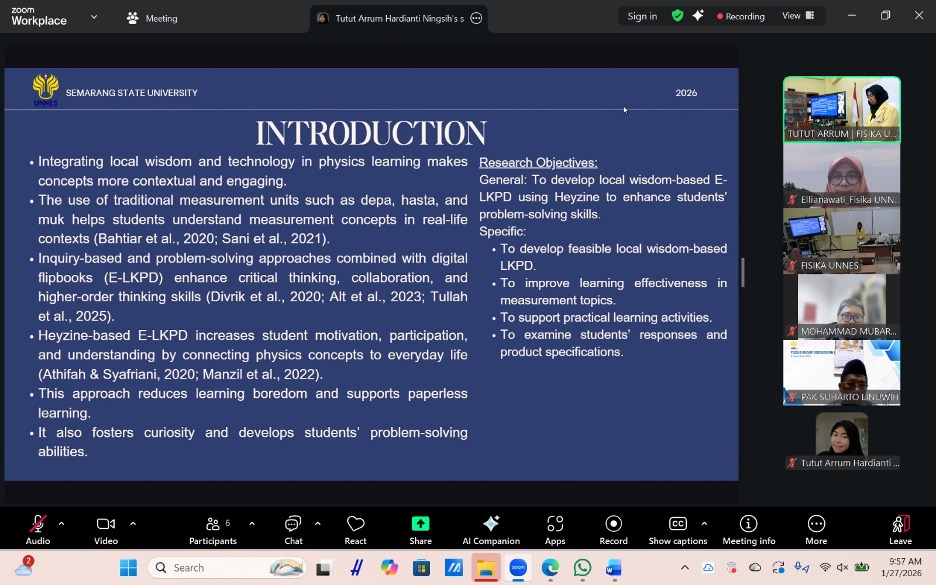
Semarang, 27 Januari 2026 — Tutut Arum, mahasiswa semester tujuh Program Studi Pendidikan Fisika, Fakultas Matematika dan Ilmu Pengetahuan Alam (FMIPA), Universitas Negeri Semarang (UNNES), yang saat ini mengikuti Program Fast Track Magister Pendidikan IPA, berhasil melaksanakan ujian skripsi secara hybrid pada Selasa, 27 Januari 2026. Penelitiannya yang berjudul “Development of Local Wisdom-Based E-LKPD Flipbooks on the Topic of Quantities, Units, and Measurement to Improve Problem-Solving Skills” berfokus pada pengembangan bahan ajar digital inovatif pada topik dasar fisika besaran, satuan, dan pengukuran untuk meningkatkan keterampilan pemecahan masalah siswa. Penelitian ini dibimbing oleh Dr. Ellianawati dan merupakan bagian dari luaran skema penelitian Matching Grant 2025 yang didanai melalui DPA Universitas Negeri Semarang (UNNES), yang mencerminkan dukungan institusi terhadap inovasi pembelajaran berbasis riset.

Dalam penelitian ini, Tutut Arum mengintegrasikan praktik pengukuran tradisional dan satuan lokal dari wilayah Purbalingga sebagai konteks pembelajaran fisika. Satuan tradisional seperti hasta, jengkal, dan depa digunakan sebagai jembatan konseptual untuk membantu siswa memahami konsep besaran dan satuan dalam Sistem Internasional (SI). Pendekatan kontekstual ini menjadikan pembelajaran fisika lebih bermakna dan relevan secara budaya, sekaligus meningkatkan motivasi belajar siswa dalam aktivitas pembelajaran STEM.

Temuan empiris menunjukkan adanya peningkatan signifikan pada keterampilan problem solving siswa setelah penerapan E-LKPD flipbook berbasis kearifan lokal. Analisis statistik menunjukkan perbedaan yang signifikan antara skor pretest dan posttest (p < 0,001), dengan hasil N-Gain berada pada kategori rendah hingga sedang, serta beberapa siswa mencapai peningkatan tinggi. Hasil ini menegaskan potensi lingkungan pembelajaran STEM yang responsif terhadap budaya dalam menumbuhkan kemampuan berpikir tingkat tinggi dan keterampilan pemecahan masalah. Respon siswa terhadap media pembelajaran juga sangat positif, yang menunjukkan bahwa media pembelajaran digital ini menarik, mudah diakses, dan relevan secara kontekstual.
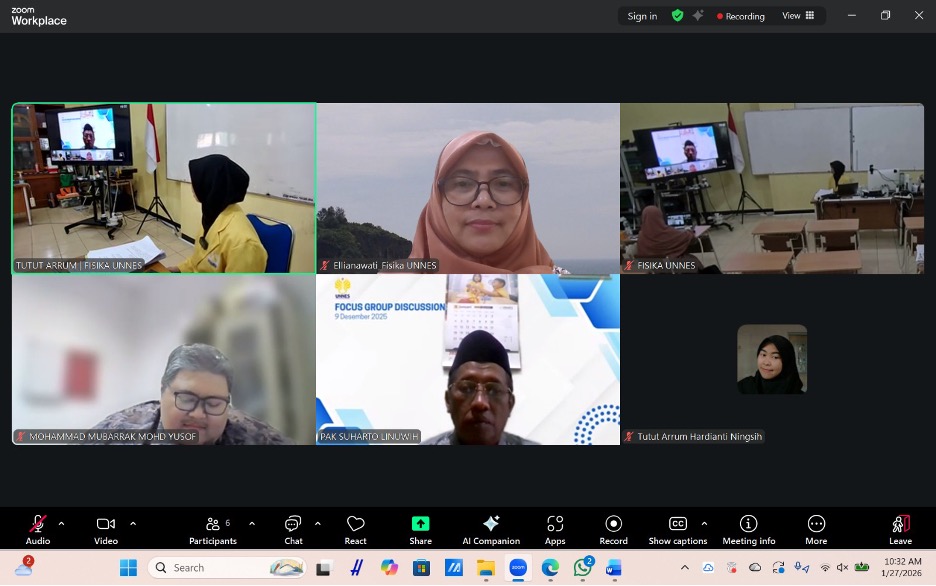
Ujian skripsi ini melibatkan penguji luar internasional, Mr. Mohammad Mubarrak Mohd. Yusof, M.Ed. dari Universiti Teknologi MARA (UiTM), Malaysia, serta penguji dalam, Dr. Suharto Linuwih, M.Si. dari Program Studi Pendidikan Fisika UNNES. Keterlibatan penguji internasional ini mencerminkan komitmen kuat UNNES terhadap internasionalisasi akademik dan pencapaian Indikator Kinerja Utama (IKU) melalui kolaborasi global, peningkatan kualitas riset, dan penguatan jejaring internasional.

Pelaksanaan ujian secara hybrid juga menunjukkan komitmen UNNES terhadap transformasi digital dalam pendidikan tinggi serta membuka peluang kolaborasi akademik lintas negara. Program Fast Track menjadi salah satu inisiatif strategis UNNES untuk mempercepat pengembangan sumber daya manusia unggul dan mendukung visi universitas menuju World Class University (WCU).

Penelitian ini juga selaras dengan Tujuan Pembangunan Berkelanjutan (SDGs), khususnya SDG 4 (Quality Education), melalui pengembangan pembelajaran yang inklusif, kontekstual, dan berbasis teknologi. Integrasi kearifan lokal dalam pendidikan STEM berkontribusi pada pengembangan keterampilan abad ke-21, termasuk berpikir kritis, problem solving, literasi digital, dan kesadaran budaya. Secara keseluruhan, temuan penelitian ini menegaskan bahwa integrasi kearifan lokal dalam topik dasar fisika mampu meningkatkan pemahaman konsep, motivasi belajar, dan keterampilan pemecahan masalah siswa, serta memberikan kontribusi signifikan terhadap inovasi pembelajaran sains berbasis riset di tingkat nasional dan internasional.
Related Posts

Leave a Reply

* Kode Akses Komentar:

* Tuliskan kode akses komentar diatas:

GDPR

  • Privacy Policy

Privacy Policy

At unnes.ac.id, the privacy of our visitors is of extreme importance to us. This privacy policy document outlines the types of personal information that is received and collected by unnes.ac.id and how it is used.

Log Files

Like many other Web sites, unnes.ac.id makes use of log files. The information inside the log files includes internet protocol (IP) addresses, type of browser, Internet Service Provider (ISP), date/time stamp, referring/exit pages, and number of clicks to analyze trends, administer the site, track user’s movement around the site, and gather demographic information. IP addresses and other such information are not linked to any information that is personally identifiable.

Cookies

unnes.ac.id uses cookies to store information about visitors’ preferences, to record user-specific information on which pages the site visitor accesses or visits, and to personalize or customize our web page content based upon visitors’ browser type or other information that the visitor sends via their browser.

Third-party ad servers or ad networks use technology in their respective advertisements and links that appear on unnes.ac.id and which are sent directly to your browser. They automatically receive your IP address when this occurs. Other technologies (such as cookies, JavaScript, or Web Beacons) may also be used by our site’s third-party ad networks to measure the effectiveness of their advertising campaigns and/or to personalize the advertising content that you see on the site.

unnes.ac.id has no access to or control over these cookies that are used by third-party advertisers.

You should consult the respective privacy policies of these third-party ad servers for more detailed information on their practices as well as for instructions about how to opt-out of certain practices. unnes.ac.id’s privacy policy does not apply to, and we cannot control the activities of, such other advertisers or web sites.

If you wish to disable cookies, you may do so through your individual browser options. More detailed information about cookie management with specific web browsers can be found at the browsers’ respective websites.

Consent

By using our website, you hereby consent to our privacy policy and agree to its terms.

Update

This Privacy Policy was last updated on: 2023-02-14. Should we update, amend or make any changes to our privacy policy, those changes will be posted here.

Contact Us

If you have any questions, comments, or concerns about our Privacy Policy or our practices with regards to your personal information, please feel free to contact us through the contact form on our website or by emailing us at humas[at]mail.unnes.ac.id.

This Privacy Policy is intended as a general guide to our practices in collecting and using information. If there is any inconsistency between this Privacy Policy and the terms of the Service Agreement or any other terms that may apply to specific services you use, then those specific service terms shall apply.

Terms of Use

By using our website, you agree to abide by this Privacy Policy. If you do not agree with this Privacy Policy, please do not use our website. We reserve the right to update this Privacy Policy from time to time without prior notice. Please review our Privacy Policy periodically to check for changes. Your continued use of our website following the posting of changes to this Privacy Policy means that you accept the changes.

Thank you for reading our Privacy Policy. We are committed to protecting the privacy of our website visitors and will continue to update our Privacy Policy to ensure optimal protection.