

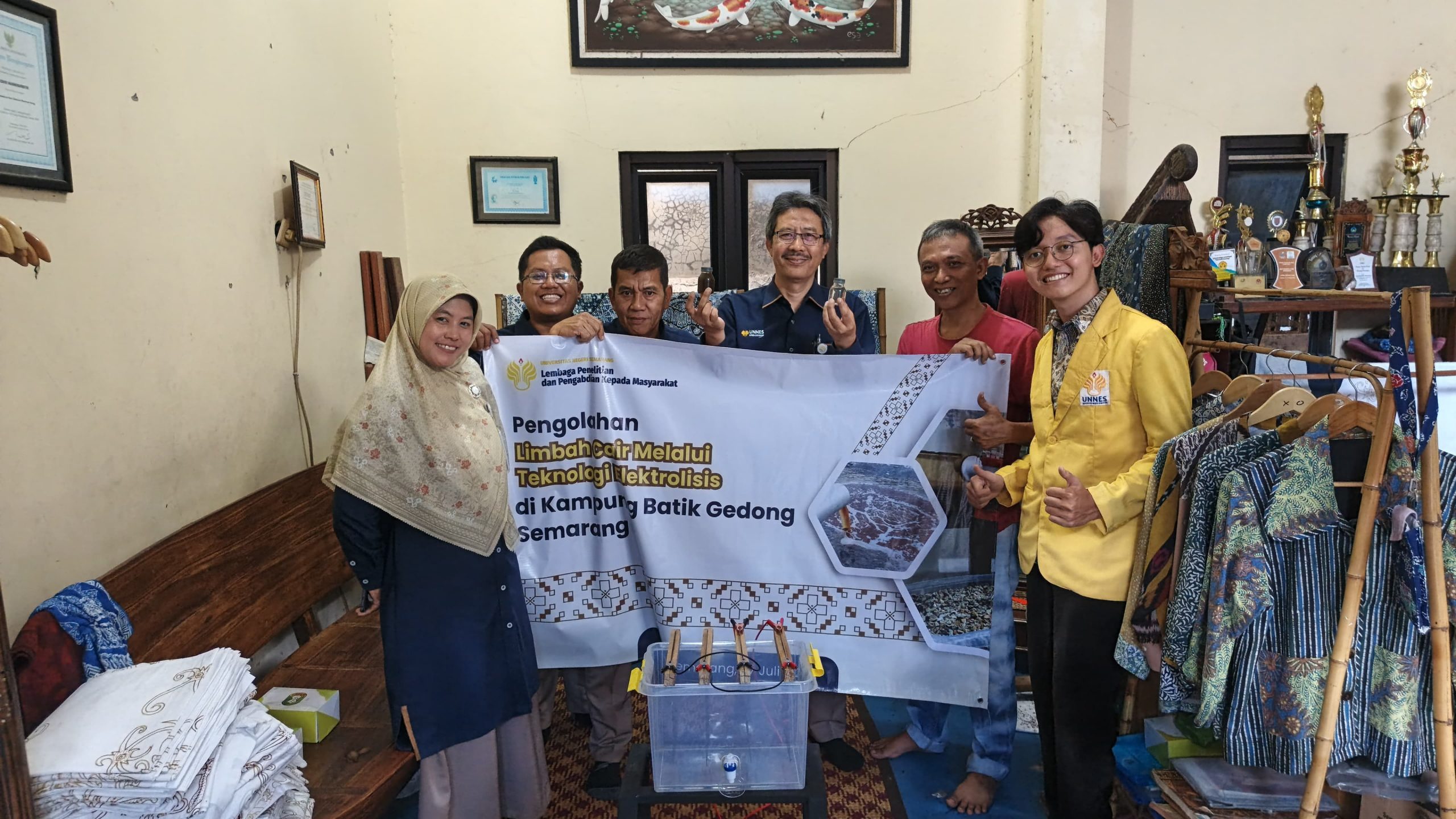
Semarang, July 7, 2025 — A community service team from Semarang State University (UNNES) conducted a community service activity in Kampung Batik, Semarang. This activity was part of a lecturer community service program funded by the UNNES Institute for Research and Community Service (LPPM) and aimed to introduce appropriate technology for batik waste processing.
Held at the residence of Mr. Eko Haryanto, a hand-drawn batik artisan in the area, the activity featured an innovative household-scale electrolysis device. This device is designed to purify liquid batik waste through a particle separation process using electric current and electrodes, significantly reducing the color and turbidity of the wastewater.
The community service team was led by Prof. Dr. Nur Qudus, M.T., IPM., and involved several interdisciplinary lecturers, namely Dr. Harianingsih, S.T., M.T. from Chemical Engineering, Drs. Bambang Sugiyarto, M.T. from Civil Engineering, and Virgiawan Adi Kristianto, S.Pd., M.Ed. from the Department of Building Engineering Education. This activity was also supported by three students from the Chemical Engineering Department: Indra Sakti Pangestu, Isnina Noor Ubay, and Savira Rinda Erliana.
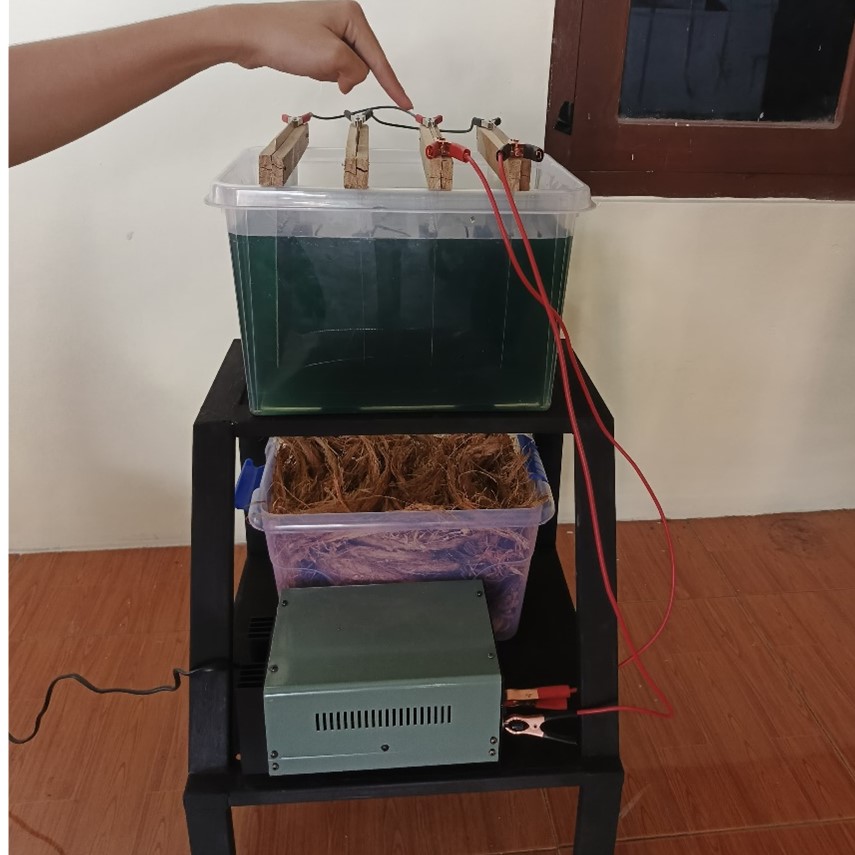
The activity began with an explanation of the concept and working principles of the electrolysis device, followed by hands-on practice using the device the team had designed. This one-gallon capacity device demonstrated promising results in purifying batik waste, transforming it from a dark, tea-like color to a cleaner, clearer color. Due to its small scale and ease of operation, this device is highly suitable for use by home industries.
The partner evaluation revealed that Mr. Eko Haryanto’s knowledge of the waste treatment process increased from 60% to 80%, and his skill in operating the device increased from 50% to 75%. He also expressed strong interest in implementing the device into his existing batik waste processing process. “I fully understand the concept of how this device works. We will try to apply and develop it further, and we will collaborate with our existing waste treatment techniques. We are very grateful for this activity,” he said.
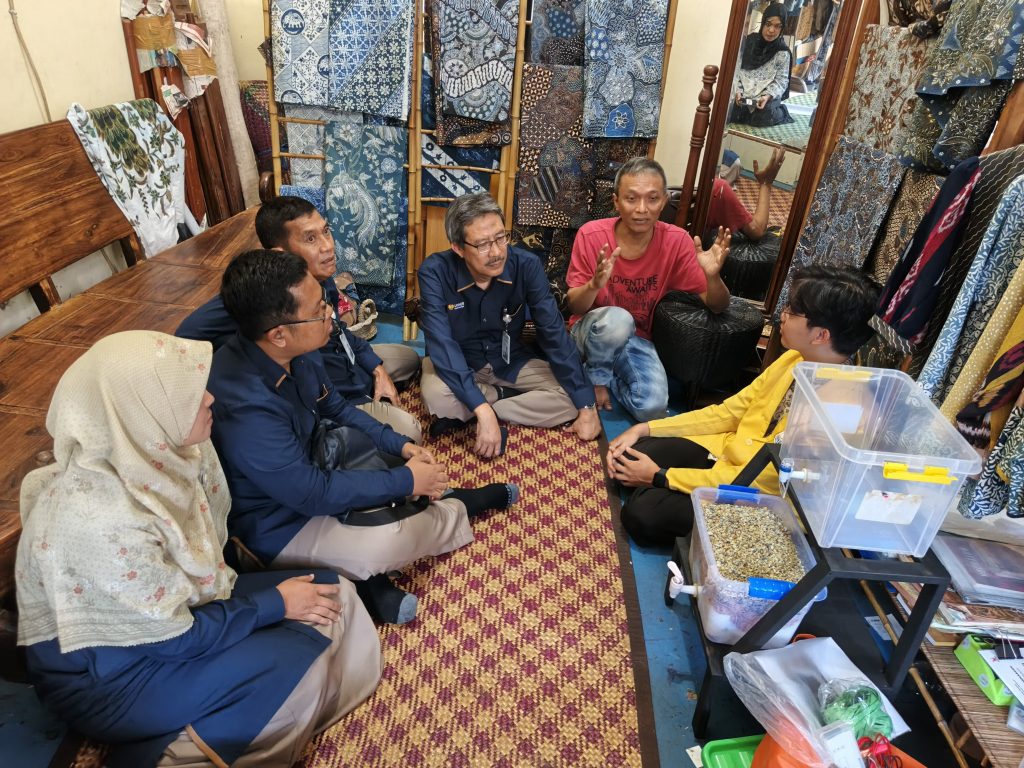
On this occasion, Prof. Dr. Nur Qudus also expressed his hope that this community service activity would not be merely a short-term academic activity, but could be continuously developed and implemented in the field to address real environmental challenges. Innovations such as this electrolysis device are expected to provide a practical and affordable solution for batik MSMEs that currently lack adequate waste management systems.
This activity also supports the achievement of the Sustainable Development Goals (SDGs), specifically SDG 6 (clean water and sanitation), SDG 12 (responsible consumption and production), SDG 13 (addressing climate change), and SDG 14 (marine ecosystems). It is hoped that this community service will be the beginning of a long-term collaboration between academia and the community to create a more environmentally friendly batik industry.