Encourage Early Technological Literacy: UNNES FT Community Service Team Trains Junior High School Students to Use 3D Printers from Plastic Bottle Waste

Universitas Negeri Semarang > Faculty of Engineering > Fakultas Teknik > Encourage Early Technological Literacy: UNNES FT Community Service Team Trains Junior High School Students to Use 3D Printers from Plastic Bottle Waste

Tegal, June 28, 2025 – The rapid development of digital technology demands introduction and literacy from an early age, including for Junior High School (SMP) students. One of the modern manufacturing technologies that is now being introduced to elementary education is the 3D Printer, also known as three-dimensional printing technology.

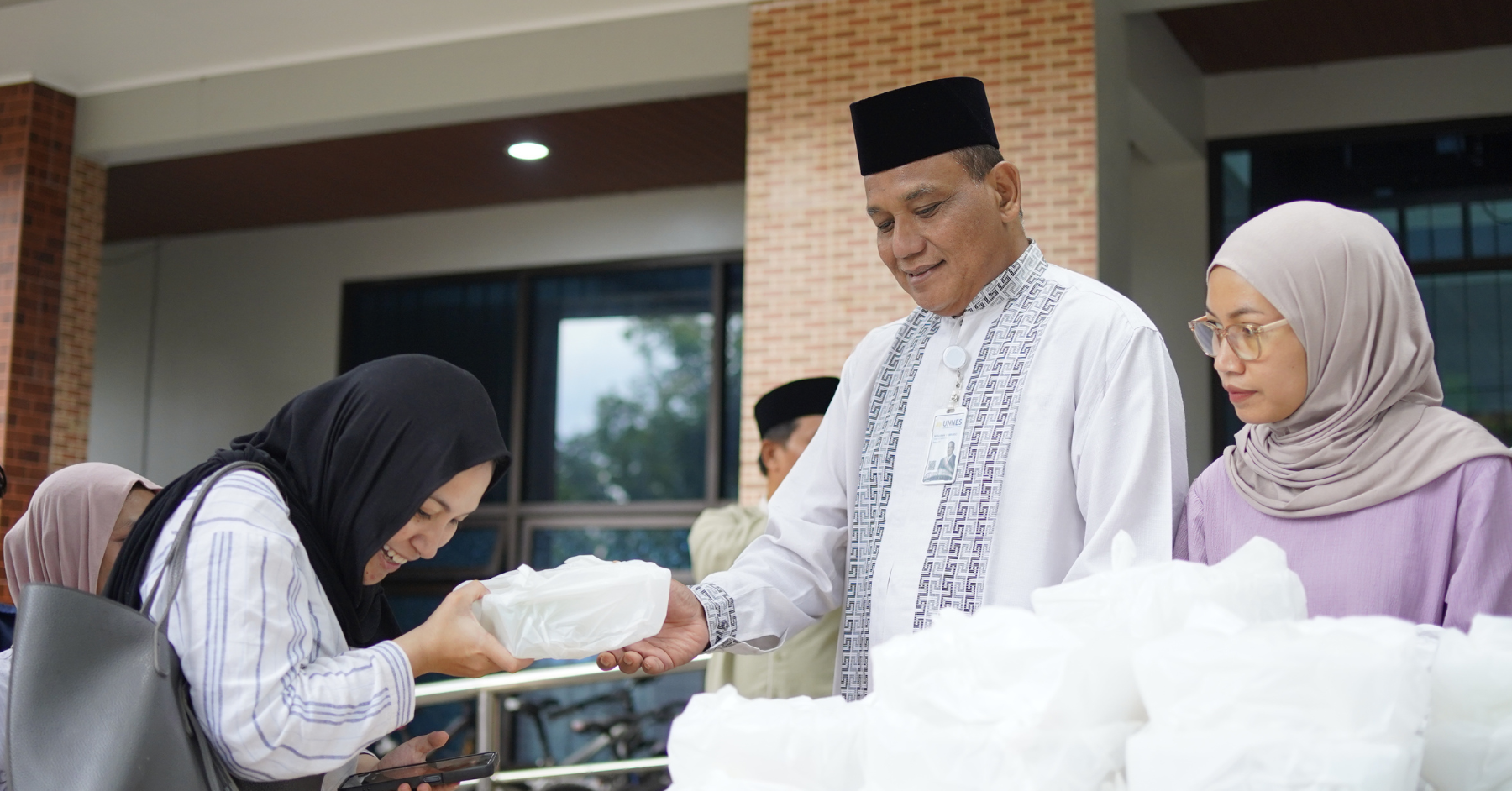
This is the focus of the community service program carried out by the Semarang State University Faculty of Engineering (FT UNNES) Team at SMP Negeri 1 Margasari, Tegal Regency. In the opening ceremony, the Dean of FT UNNES, Prof. Dr. Wirawan Sumbodo, M.T., who is also an alumnus of the junior high school, expressed his hope that every technological development—especially those related to digital manufacturing—can be introduced since junior high school.

“Technological literacy such as 3D Printers needs to be introduced since junior high school. This is important to build students’ enthusiasm for learning and foster innovative and technology-based entrepreneurship skills in the future,” said Prof. Wirawan.
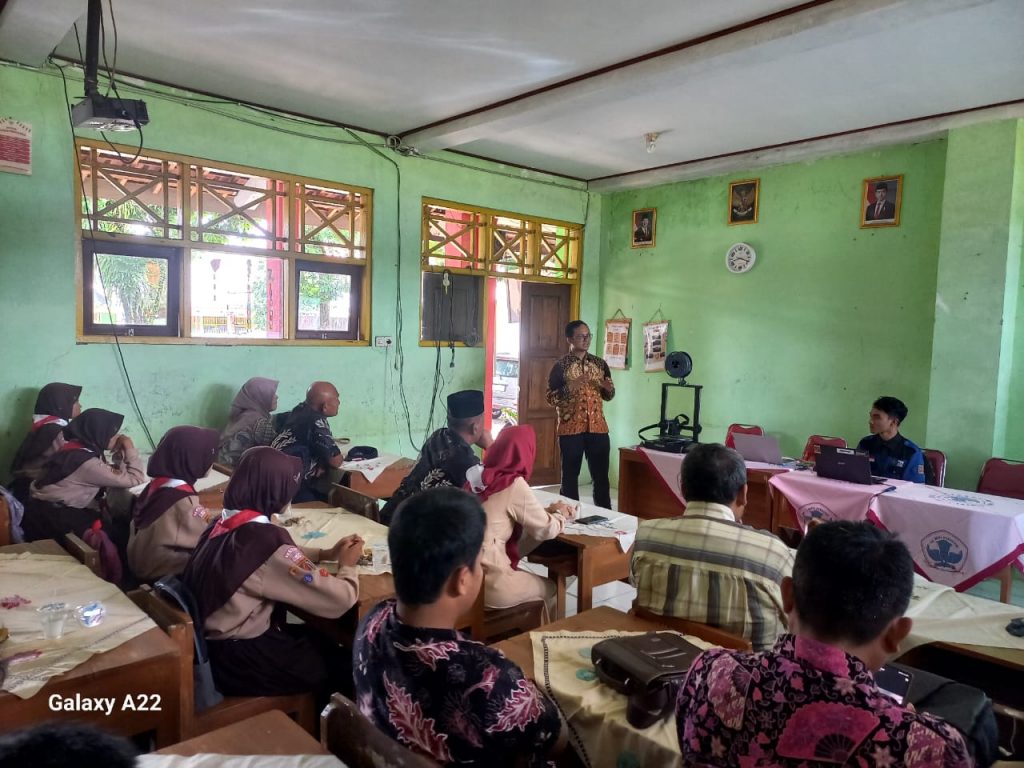
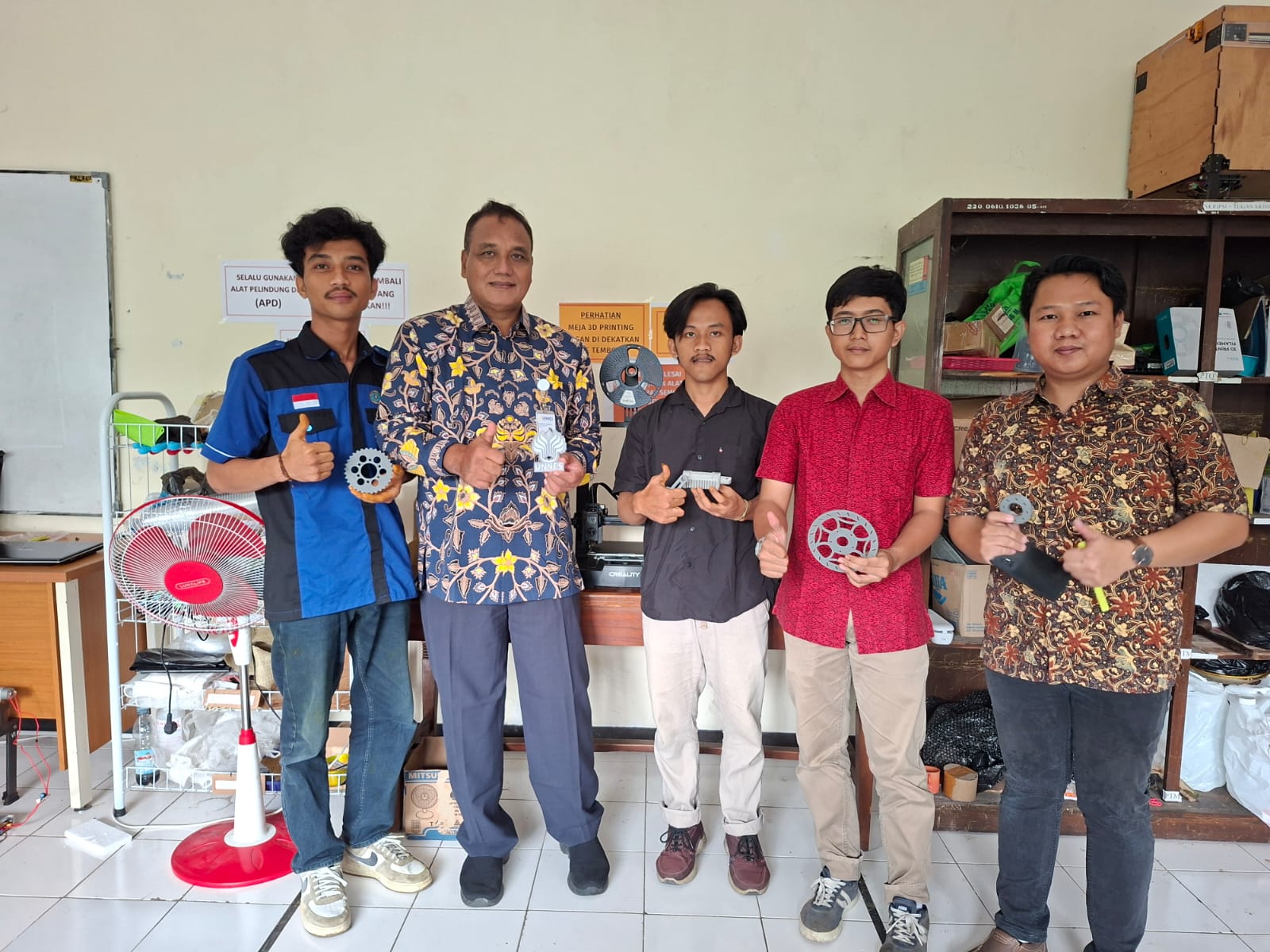
The training activities at SMP N 1 Margasari were filled with practical materials on operating a 3D Printer machine of the FDM (Fused Deposition Modeling) type, involving students, teachers, and alumni. The training was led by Rizki Setiadi, S.Pd., M.T., a lecturer from FT UNNES, and a supporting team of students, namely Habib Bunajar (Automotive Engineering Education Study Program), Muhammad Khoirul Anam, and Rofex Pambudi (Mechanical Engineering Education Study Program).

The training began with an introduction to the 3D Printer device, followed by a demonstration of its use, and direct practice by participants. One of the products made by participants was a key chain using recycled filament from used plastic bottle waste.

This environmentally friendly filament technology was developed by FT UNNES researcher, M. Irfan Nuryanta, M.Eng., who succeeded in converting plastic bottle waste (rPET) into functional 3D printing materials. This process involves shredding, melting, and extruding plastic bottles into filaments, thus becoming a real example of circular economy innovation in education.

The principal of SMP N 1 Margasari, Drs. Winarko, M.Pd., welcomed this activity positively. In his speech, he expressed his gratitude for the training and handover of 1 unit of 3D Printer machine from the FT UNNES team. He hopes that this device can be used in learning crafts and student work, as well as encouraging the birth of technopreneurship products in the school environment.

“We hope that students can utilize this technology to create original works, and make plastic waste into materials that have economic and educational value,” he said.

This program also received support from alumni, including Sugeng Triyono, SE, MM, and his team, who participated in this collaborative initiative as a form of concern for the development of technology-based education in their home regions.

This program aligns with the following Sustainable Development Goals (SDGs):SDG 4-Quality Education: Enhancing inclusive and equitable quality education by integrating digital literacy and technology into early education, SDG 9-Industry, Innovation, and Infrastructure: Promoting inclusive and sustainable industrialization and fostering innovation through the use of advanced manufacturing technologies like 3D printing, and SDG 12-Responsible Consumption and Production: Encouraging the recycling of plastic waste and demonstrating principles of the circular economy through educational practices.

With this activity, FT UNNES hopes that the technology-based learning approach will not only be the domain of higher education, but can also be applied sustainably at the secondary school level to equip the younger generation to face the challenges of the future industry.

Related Posts

Leave a Reply

* Kode Akses Komentar:

* Tuliskan kode akses komentar diatas:

GDPR

  • Privacy Policy

Privacy Policy

At unnes.ac.id, the privacy of our visitors is of extreme importance to us. This privacy policy document outlines the types of personal information that is received and collected by unnes.ac.id and how it is used.

Log Files

Like many other Web sites, unnes.ac.id makes use of log files. The information inside the log files includes internet protocol (IP) addresses, type of browser, Internet Service Provider (ISP), date/time stamp, referring/exit pages, and number of clicks to analyze trends, administer the site, track user’s movement around the site, and gather demographic information. IP addresses and other such information are not linked to any information that is personally identifiable.

Cookies

unnes.ac.id uses cookies to store information about visitors’ preferences, to record user-specific information on which pages the site visitor accesses or visits, and to personalize or customize our web page content based upon visitors’ browser type or other information that the visitor sends via their browser.

Third-party ad servers or ad networks use technology in their respective advertisements and links that appear on unnes.ac.id and which are sent directly to your browser. They automatically receive your IP address when this occurs. Other technologies (such as cookies, JavaScript, or Web Beacons) may also be used by our site’s third-party ad networks to measure the effectiveness of their advertising campaigns and/or to personalize the advertising content that you see on the site.

unnes.ac.id has no access to or control over these cookies that are used by third-party advertisers.

You should consult the respective privacy policies of these third-party ad servers for more detailed information on their practices as well as for instructions about how to opt-out of certain practices. unnes.ac.id’s privacy policy does not apply to, and we cannot control the activities of, such other advertisers or web sites.

If you wish to disable cookies, you may do so through your individual browser options. More detailed information about cookie management with specific web browsers can be found at the browsers’ respective websites.

Consent

By using our website, you hereby consent to our privacy policy and agree to its terms.

Update

This Privacy Policy was last updated on: 2023-02-14. Should we update, amend or make any changes to our privacy policy, those changes will be posted here.

Contact Us

If you have any questions, comments, or concerns about our Privacy Policy or our practices with regards to your personal information, please feel free to contact us through the contact form on our website or by emailing us at humas[at]mail.unnes.ac.id.

This Privacy Policy is intended as a general guide to our practices in collecting and using information. If there is any inconsistency between this Privacy Policy and the terms of the Service Agreement or any other terms that may apply to specific services you use, then those specific service terms shall apply.

Terms of Use

By using our website, you agree to abide by this Privacy Policy. If you do not agree with this Privacy Policy, please do not use our website. We reserve the right to update this Privacy Policy from time to time without prior notice. Please review our Privacy Policy periodically to check for changes. Your continued use of our website following the posting of changes to this Privacy Policy means that you accept the changes.

Thank you for reading our Privacy Policy. We are committed to protecting the privacy of our website visitors and will continue to update our Privacy Policy to ensure optimal protection.