

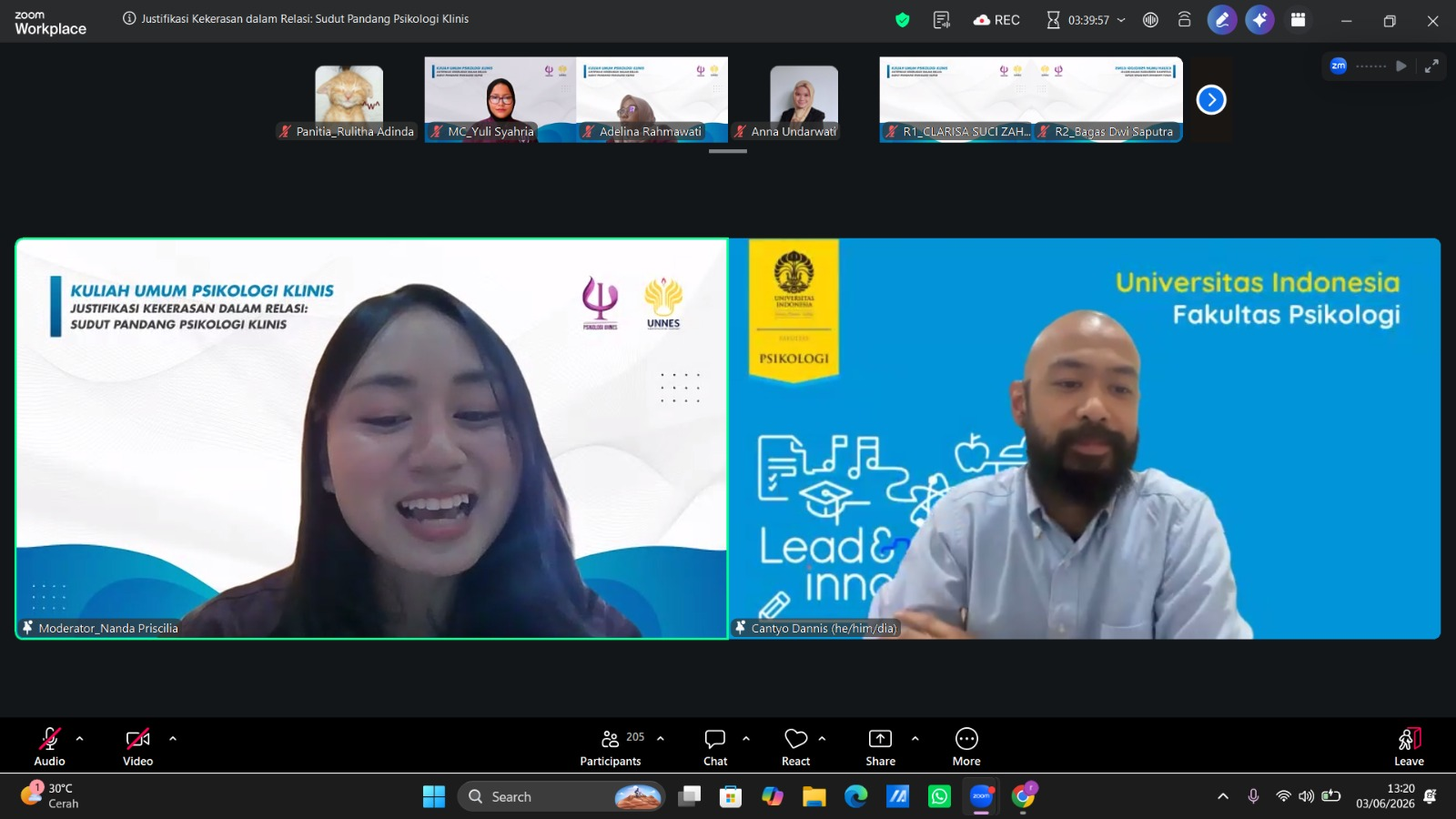
Semarang, June 3, 2026 – The Psychology Program at Semarang State University (UNNES) is hosting a public lecture titled “Justification of Violence in Relationships: A Clinical Psychology Perspective” on Wednesday, June 3, 2026, at 1:00 p.m. WIB via Zoom Meeting. This event, open to all UNNES Psychology students, featured Cantyo Atindriyo Dannisworo, Ph.D., Psychologist, and Lecturer at the Faculty of Psychology, University of Indonesia, as the keynote speaker.
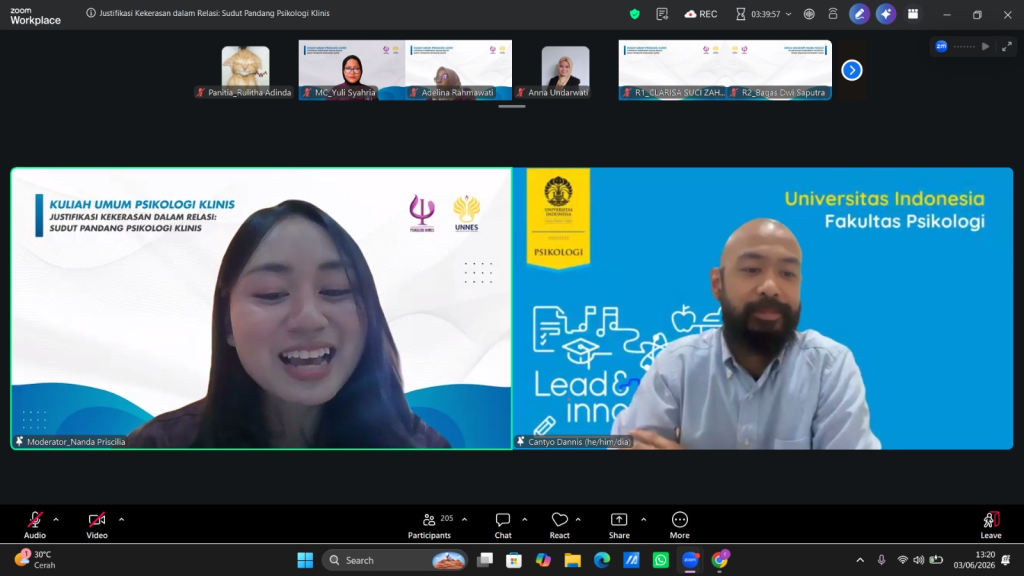
In his presentation, the speaker explained that violence in intimate relationships, or Intimate Partner Violence (IPV), takes not only the form of physical acts but also includes verbal, psychological, emotional, sexual, and economic violence. The main focus of this lecture was the phenomenon of Justification of Violence (JoV), a cognitive strategy used by individuals to minimize, tolerate, or justify violent behavior in intimate relationships. This justification can arise from both the victim and the perpetrator as an attempt to reduce cognitive dissonance, which is psychological discomfort resulting from two conflicting beliefs.
The presenter discussed the findings of a study using the JoV-Slider paradigm, in which participants rated violent videos in real time using a slider recorded every second. This study, which included participants from the Netherlands, Indonesia, and other countries, found that individuals in abusive relationships tend to rate acts of violence as more acceptable. Furthermore, victims who rationalize the violence are more likely to be blamed by those around them (victim blaming) and receive less social support—a situation that makes it harder for them to break free from the cycle of violence.
This public lecture left a profound impression on the participants. Karina, one of the student attendees, shared that the material transformed her understanding of violence. “Until now, I understood violence only as clearly visible physical acts. Now I realize that violence can also manifest in verbal, psychological, or controlling forms toward a partner and doesn’t have to appear severe to still be considered dangerous,” she said.
Mutiara, another participant, highlighted a paradox that feels painful yet is crucial to understand. “On one hand, victims justify violence as a way to survive psychologically, but on the other hand, that attitude isolates them further from the help they need most,” she said. She added that this lecture encouraged her to be more critical of social norms that unconsciously condone violence and make it difficult for victims to seek help.
Salsa, another participant, hopes this understanding will help her become a more sensitive aspiring psychologist. “Empathy alone isn’t enough. We need to understand the psychological mechanisms behind the victim’s behavior so we can provide the right support, rather than just making assumptions,” she said. It is hoped that this activity will equip UNNES psychology students to respond to cases of relationship violence in a wiser, more empathetic manner, grounded in a deep psychological understanding.