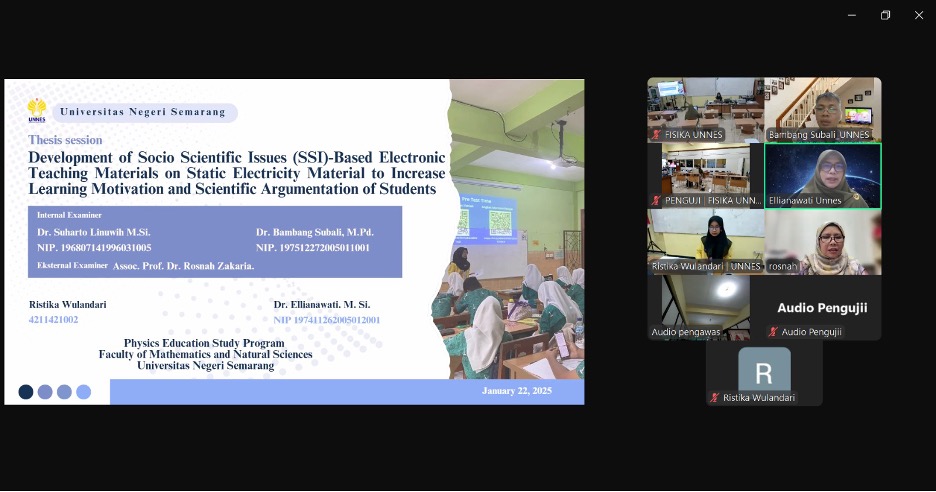
This morning, Wednesday, January 22, 2025, Physics Education Study Program student Ristika Wulandari defended her research results entitled Development of Digital Teaching Materials Based on Socio-Scientific Issues (SSI) on Static Electricity Material to Improve Students’ Learning Motivation and Scientific Argumentation in front of the panelists. Under the supervision of Dr. Ellianawati, M.Sc., Ristika conducted her research at SMA N 4 Semarang involving 130 grade XII students.
Assoc. Prof. Dr. Rosnah Zakaria from the UiTM Applied Physics Study Program, who has been collaborating with the UNNES Physics Education Study Program since 2022, served as the external examiner in this thesis defense. This reflects the consistency of academic cooperation between UNNES and UiTM. Dr. Ros expressed her appreciation for Ristika’s performance, highlighting her success in integrating SSI into physics learning. Controversial real-life applications of static electricity such as electric shocks from capacitors, the mechanisms of electric cars and power banks, and lightning arresters were well explored, significantly enhancing students’ learning motivation.
The study revealed that the scientific argumentation skills most optimally developed through this research were claim and warrant, while backing and rebuttal still need improvement. The internal examiner team, Dr. Bambang Subali, M.Pd. and Dr. Suharto Linuwih, M.Sc., also acknowledged the strong contribution of this research, which resulted in an IPR and manuscripts ready for submission to Sinta 2 and Sinta 3 journals.
Several constructive suggestions were provided at the end of the defense. Dr. Ros emphasized the importance of adding animations to visually demonstrate static electricity processes, while Dr. Bambang recommended deeper analysis of students’ levels of argumentation using the developed teaching materials. The defense session went dynamically, with Ristika confidently and satisfactorily answering all questions.
Importantly, this research aligns strongly with SDG 4: Quality Education, as it provides innovative teaching materials that improve not only the mastery of physics concepts but also critical thinking and scientific literacy among students. By empowering learners with argumentation skills and linking science to real-world issues, the study supports Target 4.4 (enhancing youth technical and scientific skills) and Target 4.7 (ensuring learners acquire the knowledge and skills needed to promote sustainable development). Furthermore, the international collaboration with UiTM strengthens the global dimension of educational quality improvement, in line with the vision of inclusive, equitable, and future-oriented education.
This milestone not only showcases the achievements of the Physics Education Study Program but also contributes to UNNES’s efforts in realizing IKU 3 and IKU 5 targets, while embodying the essence of SDG 4 in fostering high-quality education.