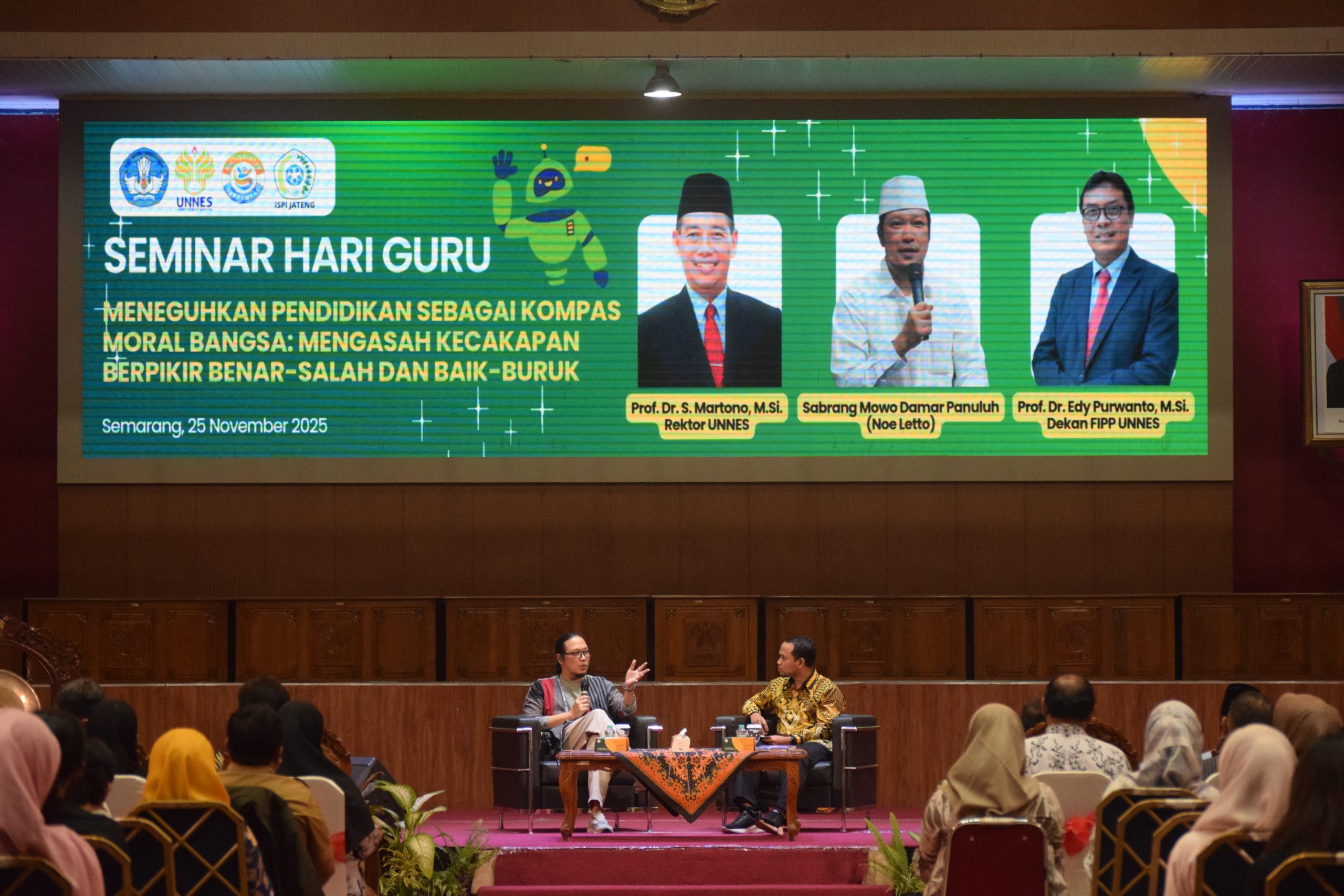
SEMINAR HARI GURU “Meneguhkan Pendidikan sebagai Kompas Moral Bangsa: Mengasah Kecakapan Berpikir Benar-Salah dan Baik-Buruk.”

Universitas Negeri Semarang/Fakultas Ilmu Pendidikan dan Psikologi/Berita/SEMINAR HARI GURU “Meneguhkan Pendidikan sebagai Kompas Moral Bangsa: Mengasah Kecakapan Berpikir Benar-Salah dan Baik-Buruk.”

Semarang, 25 November 2026 – Fakultas Ilmu Pendidikan dan Psikologi, Universitas Negeri Semarang (UNNES) menyelenggarakan seminar bertajuk “Meneguhkan Pendidikan sebagai Kompas Moral Bangsa: Mengasah Kecakapan Berpikir Benar-Salah dan Baik-Buruk.” Kegiatan yang digelar di Auditorium UNNES tersebut diselenggarakan dalam rangka memperingati Hari Guru Nasional yang diperingati setiap tanggal 25 November 2025.
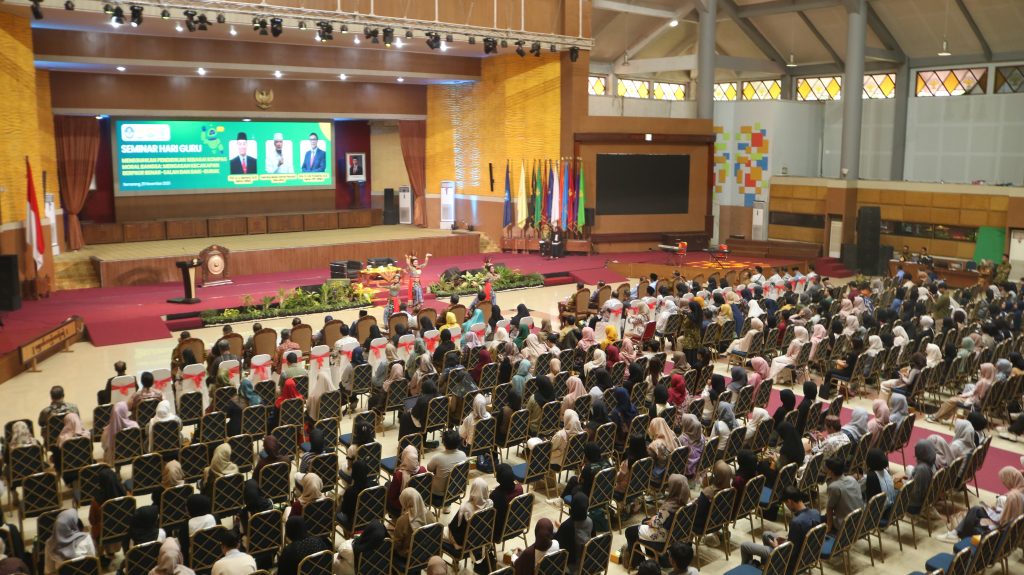
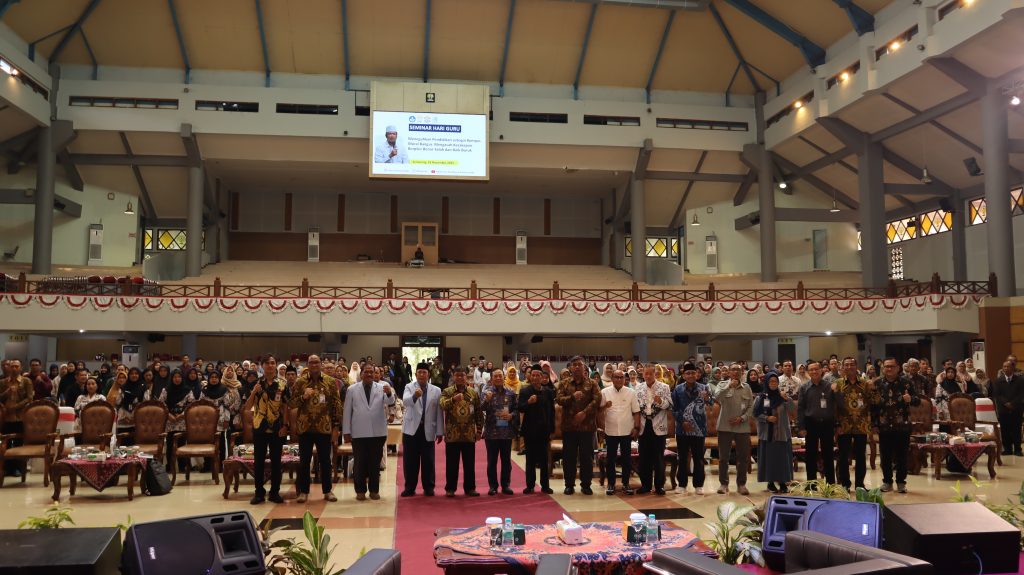
Seminar menghadirkan Sabrang Mowo Damar Panuluh atau yang lebih dikenal sebagai Noe Letto sebagai pembicara utama. Acara ini diikuti oleh berbagai kalangan, di antaranya pimpinan universitas, dosen UNNES, perwakilan Dinas Pendidikan Kota/Kabupaten di Jawa Tengah, ISPI (Ikatan Sarjana Pendidikan Indonesia), kepala sekolah dan guru se-Kota Semarang, para dekan FKIP se-Jawa Tengah, asosiasi kependidikan, serta mahasiswa program sarjana pendidikan.

Dalam paparannya, Sabrang menegaskan bahwa pendidikan merupakan aspek yang esensial dan kontekstual karena setiap bangsa memiliki konsep pendidikan masing-masing. Menurutnya, urusan pendidikan bukan hanya tanggung jawab pemerintah, melainkan tanggung jawab seluruh bangsa.

Sebuah bangsa melahirkan negara, dan negara kemudian membentuk pemerintah. Pendidikan tidak bisa dibebankan hanya kepada guru; keluarga dan komunitas juga merupakan ekosistem dari pendidikan itu sendiri” ujarnya.

Mengutip definisi pendidikan dalam Kamus Besar Bahasa Indonesia (KBBI), Sabrang menyatakan bahwa tujuan utama pendidikan adalah mengubah perilaku. Tugas ini, menurutnya, memiliki bobot moral yang besar sebagaimana tugas para nabi. Ia menekankan perlunya meninjau kembali peran guru dalam proses pendidikan.

Tugas guru adalah membuka cakrawala anak, sehingga mereka memiliki pandangan dan memahami konsekuensinya,” tegasnya. Ia menambahkan bahwa menjadi guru bukanlah perkara mudah karena setiap tindakan guru berpotensi ditiru oleh peserta didik. Tugas pendidikan, lanjutnya, adalah mengajarkan sebab–akibat, memberikan pengalaman sebab–akibat, serta membantu peserta didik memprediksi sebab–akibat.

Sabrang juga menyinggung sejarah panjang pendidikan di Indonesia. Ia menjelaskan bahwa sejak era Hindu, telah dikenal konsep pendidikan bernama Asram—sebuah tempat untuk “melelahkan diri”—yang kemudian menginspirasi model pendidikan pesantren di Nusantara.

Lebih lanjut, ia menekankan pentingnya peran universitas sebagai garda terdepan dalam memajukan pendidikan. Menurutnya, universitas merupakan pusat eksperimen yang memungkinkan perkembangan ilmu pengetahuan. Dengan kemajuan ilmu pengetahuan maka pendidikan juga akan semakin maju

Pada bagian akhir, Sabrang mengingatkan bahwa pendidikan semestinya tidak berhenti pada penguasaan aspek kognitif tapi juga perlu menyentuh ranah perilaku. Perubahan perilaku paling baik dilakukan dengan metode modelling. Secara naluriah, manusia pertama kali belajar melalui modeling sebelum melalui metode yang lain. Metode modeling, menurutnya, menjadi cara paling efektif untuk melakukan transfer value, sebab tujuan utama pendidikan bukan sekadar penyampaian informasi, melainkan penanaman nilai.

Pendidikan adalah metode terbaik dalam transfer ilmu dan value” tutupnya.
Related Posts

Leave a Reply

* Kode Akses Komentar:

* Tuliskan kode akses komentar diatas:

GDPR

  • Privacy Policy

Privacy Policy

At unnes.ac.id, the privacy of our visitors is of extreme importance to us. This privacy policy document outlines the types of personal information that is received and collected by unnes.ac.id and how it is used.

Log Files

Like many other Web sites, unnes.ac.id makes use of log files. The information inside the log files includes internet protocol (IP) addresses, type of browser, Internet Service Provider (ISP), date/time stamp, referring/exit pages, and number of clicks to analyze trends, administer the site, track user’s movement around the site, and gather demographic information. IP addresses and other such information are not linked to any information that is personally identifiable.

Cookies

unnes.ac.id uses cookies to store information about visitors’ preferences, to record user-specific information on which pages the site visitor accesses or visits, and to personalize or customize our web page content based upon visitors’ browser type or other information that the visitor sends via their browser.

Third-party ad servers or ad networks use technology in their respective advertisements and links that appear on unnes.ac.id and which are sent directly to your browser. They automatically receive your IP address when this occurs. Other technologies (such as cookies, JavaScript, or Web Beacons) may also be used by our site’s third-party ad networks to measure the effectiveness of their advertising campaigns and/or to personalize the advertising content that you see on the site.

unnes.ac.id has no access to or control over these cookies that are used by third-party advertisers.

You should consult the respective privacy policies of these third-party ad servers for more detailed information on their practices as well as for instructions about how to opt-out of certain practices. unnes.ac.id’s privacy policy does not apply to, and we cannot control the activities of, such other advertisers or web sites.

If you wish to disable cookies, you may do so through your individual browser options. More detailed information about cookie management with specific web browsers can be found at the browsers’ respective websites.

Consent

By using our website, you hereby consent to our privacy policy and agree to its terms.

Update

This Privacy Policy was last updated on: 2023-02-14. Should we update, amend or make any changes to our privacy policy, those changes will be posted here.

Contact Us

If you have any questions, comments, or concerns about our Privacy Policy or our practices with regards to your personal information, please feel free to contact us through the contact form on our website or by emailing us at humas[at]mail.unnes.ac.id.

This Privacy Policy is intended as a general guide to our practices in collecting and using information. If there is any inconsistency between this Privacy Policy and the terms of the Service Agreement or any other terms that may apply to specific services you use, then those specific service terms shall apply.

Terms of Use

By using our website, you agree to abide by this Privacy Policy. If you do not agree with this Privacy Policy, please do not use our website. We reserve the right to update this Privacy Policy from time to time without prior notice. Please review our Privacy Policy periodically to check for changes. Your continued use of our website following the posting of changes to this Privacy Policy means that you accept the changes.

Thank you for reading our Privacy Policy. We are committed to protecting the privacy of our website visitors and will continue to update our Privacy Policy to ensure optimal protection.