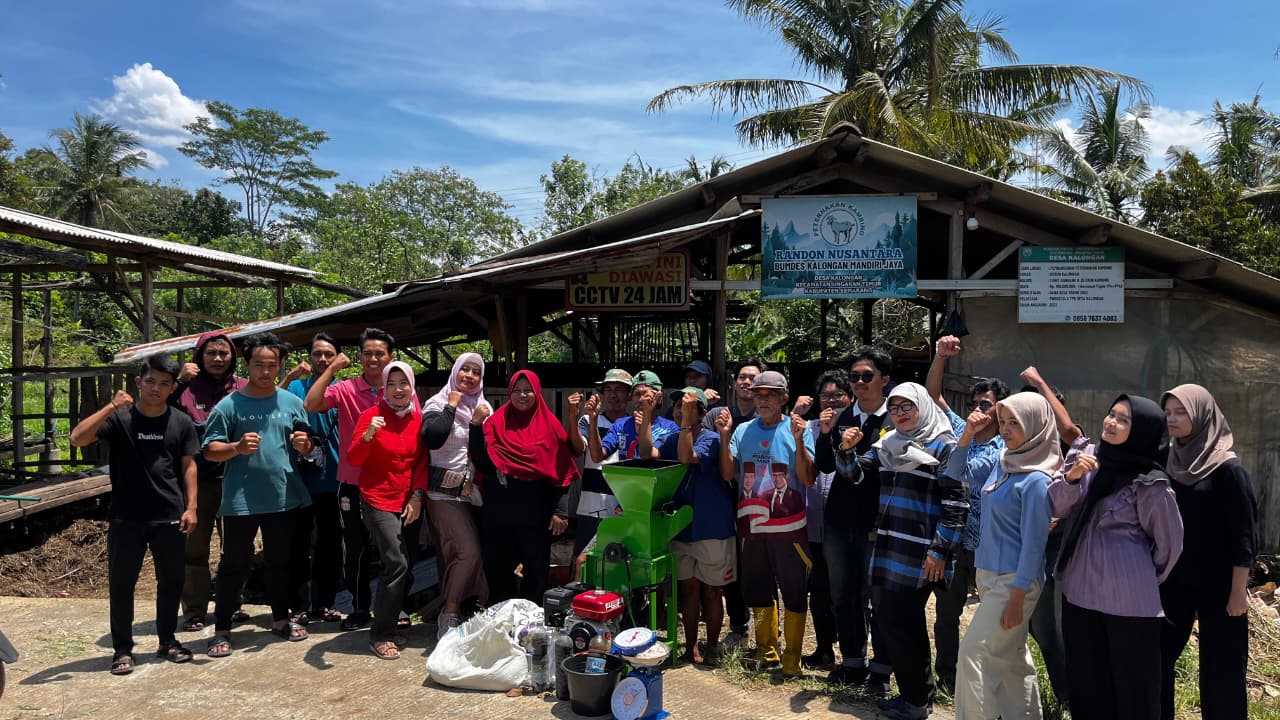
The community service team successfully assisted the Kalongan Village-Owned Enterprise (BUMN) in managing local grass resources into silage. The project, led by Amir Mahmud and colleagues, aimed to develop natural animal feed. The activity was carried out on Sunday, September 14, 2025 at the BUMDes farm.
The technology developed in this activity is silage production, an innovative way to preserve forage. Silage is produced through an anaerobic fermentation process involving lactic acid microbes, ensuring the forage’s nutritional quality is maintained even over long periods of storage. The main raw materials are elephant grass, corn, and other locally available forages. The silage processing process involves the addition of molasses and rice bran, which serve as energy sources for the fermentation microbes, as well as bioadditives to accelerate the fermentation process.
This innovation offers advantages over traditional methods. Silage does not require drying, preventing nutrient loss from heating. The resulting product has physical characteristics such as a yellowish-green color, a fresh, sour aroma, a clear leaf texture, and is free from mold and slime. It has a shelf life of more than one year if stored properly. This technology not only produces alternative feed during the dry season but also helps accommodate excess forage production during the rainy season, making it more efficient and sustainable.
Thus, silage is a relevant, adaptive, and applicable innovation product for livestock farmers, especially for the community and the Village-Owned Enterprise (BUMDes) of Kalongan Village. The community service activities ran smoothly with the participation and cooperation of the village government, BUMDes, and the village community. Furthermore, the activities supported sustainable development goals in the form of Climate Action, Life on Land, Partnerships for the Goals, and Responsible Consumption and Production.