Universitas Negeri Semarang (UNNES) continues to uphold transparency, participation, and accountability through the establishment of its Board of Trustees (Majelis Wali Amanat / MWA) for the 2022–2027 term. This governing body plays a crucial role in shaping non-academic policies, strategic planning, and financial oversight for the university.
The Board of Trustees consists of 17 members representing key university stakeholders — including the Ministry of Education, the Rector, the Chair of the Academic Senate, alumni, the community, lecturers, educational staff, and students.
This structure ensures democratic representation from all groups within the university.
The student representative on the Board is elected democratically through a process organized by the Student Executive Board (BEM KM UNNES), with participation from both undergraduate and postgraduate students. Three student candidates are proposed to the Academic Senate, which then recommends one to the Rector for official appointment.
The faculty representative is elected through the Academic Senate, whose members are themselves elected by lecturers from all faculties. Meanwhile, the staff representative is chosen through an internal election forum among non-academic employees, guaranteeing inclusivity across all levels.
Based on the Decree of the Minister of Education, Culture, Research, and Technology No. 74280/MPK.A/KP.08.06/2022, the appointment of Board members was conducted transparently, following the UNNES Board of Trustees Regulation No. 2 of 2023.
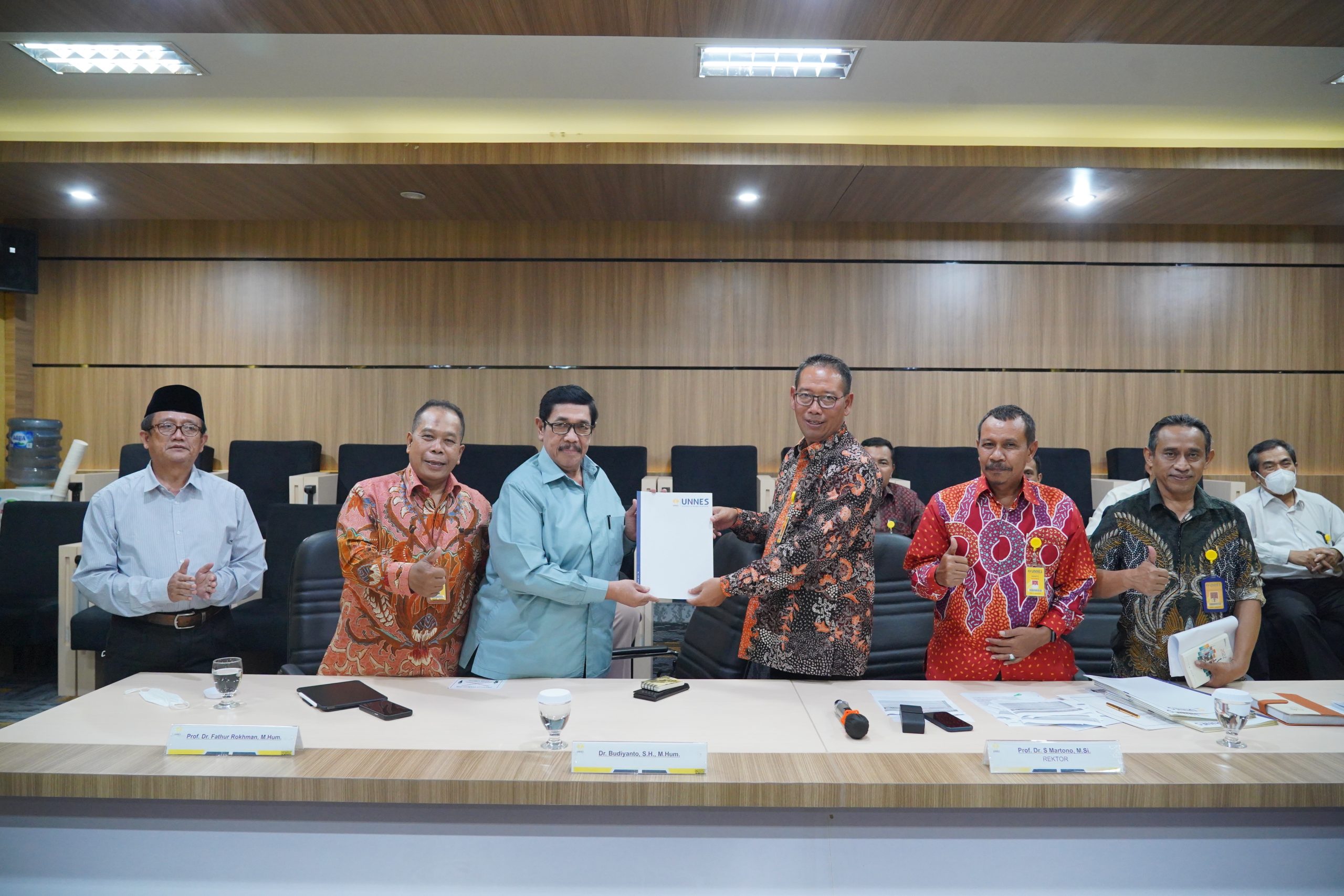
The election resulted in Dr. Hendrar Prihadi, S.E., M.M., Head of the National Public Procurement Agency (LKPP RI), being appointed as Chair of the Board of Trustees, and Prof. Dr. Fathur Rokhman, M.Hum. as Secretary. The election took place both online and offline at the Rectorate Building, UNNES, on December 30, 2022.
UNNES Rector Prof. Dr. S. Martono, M.Si. stated that UNNES now operates under a three-body governance structure consisting of the Board of Trustees, the Rector, and the Academic Senate.
“The Board of Trustees sets non-academic policies, approves strategic and financial plans, and supervises overall university management,” he said.
He emphasized that through democratic representation, UNNES ensures that every voice—students, faculty, and staff—is included in the decision-making process.
“With the new Legal Entity State University (PTNBH) status, UNNES is committed to becoming a World-Class Conservation University that embodies transparency, shared governance, and inclusivity,” he concluded.