Universitas Negeri Semarang (UNNES) continues to strengthen its academic promotion system by recognising research performance, including interdisciplinary research within applicable disciplines. This commitment is reflected in the university’s academic career framework, which values measurable scholarly contributions such as publications, funded research, collaborative outputs, innovation products, and other academic achievements as part of promotion and career advancement.
UNNES has academic promotion guidelines that are given by the Ministry of Higher Education, which provide the formal basis for assessing lecturer performance and advancement. These guidelines demonstrate that research output is an essential component of promotion, allowing interdisciplinary scholarly contributions to be considered within the broader academic evaluation system. (https://peraturan.go.id/files/permendikbudristek-no-44-tahun-2024.pdf)
UNNES also using lecturer performance assessment documents, including BKD, SKP, LKD, or equivalent institutional instruments. These documents show that research achievements are formally recorded and assessed as part of academic duties, creating a structured pathway through which interdisciplinary research contributions can be recognised in career progression.
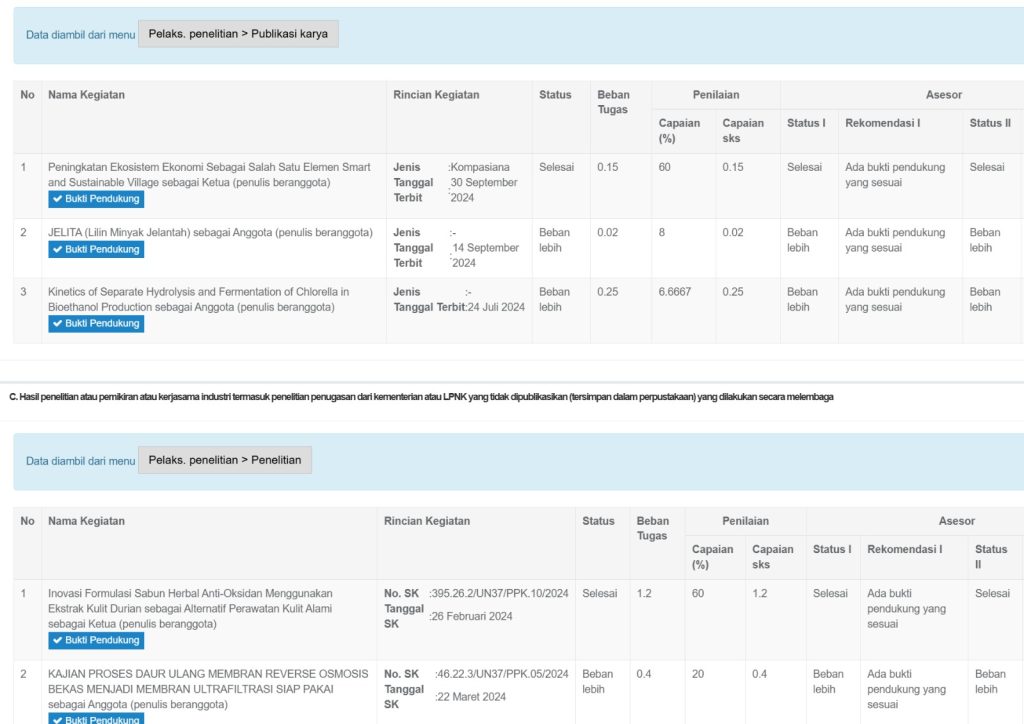
(picture of BKD that assessed and recognized interdisciplinary research)
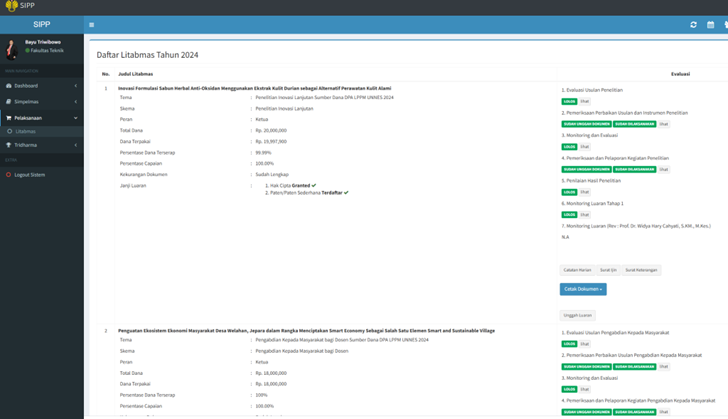
UNNES has research output records called SIPP, which document publications, scholarly articles, conference papers, and other academic works produced by lecturers. These records are important because they demonstrate that promotion decisions are supported by verifiable research outputs, including those developed through interdisciplinary collaboration. We also have internal research grants and funded collaborative projects. These records indicate that interdisciplinary research is not only encouraged but also institutionally supported through research funding schemes. When funded projects involve collaboration across fields, they provide clear evidence that interdisciplinary work forms part of the university’s recognised academic achievements.
A concrete example of this recognition can be seen in the use of the publication with DOI 10.1016/j.heliyon.2022.e08872 in Abdurrahman’s promotion to professor. The article, published in Heliyon in 2022, is titled Evaluation on the automotive skill competency test through ‘discontinuity’ model and the competency test management of vocational education school in Central Java, Indonesia, and lists Abdurrahman, Parmin, and Stefanus Muryanto as authors. This case shows that a peer-reviewed publication can serve as academic evidence in a promotion process and supports the claim that research outputs relevant to interdisciplinary work can be recognised within career advancement at UNNES.
Through these mechanisms, UNNES demonstrates that interdisciplinary research is not treated as a peripheral activity, but as a recognised part of academic performance and promotion. By aligning institutional regulations, performance assessments, publication records, funding support, innovation outputs, and documented promotion cases, the university continues to build a stronger academic culture that values collaboration across disciplines and rewards meaningful research contributions.