Universitas Negeri Semarang (UNNES) upholds a strong vision of equity and inclusivity in higher education. The university recognizes that many students from low-income families face financial constraints that can prevent them from pursuing or completing their studies. Therefore, UNNES positions itself not only as a provider of academic excellence but also as a facilitator of social mobility. This is reflected in its comprehensive financial aid system that combines government scholarships, institutional initiatives, and tuition relief programmes.
UNNES has set a clear target to admit at least 50% of its students from economically disadvantaged backgrounds. Beyond fulfilling a legal mandate, UNNES interprets this requirement as a moral responsibility to reduce poverty and promote equal opportunity. By addressing both tuition fees and students’ basic needs, the university demonstrates that financial barriers must not prevent students from achieving their full potential.
In 2024, a total of 8,708 students at UNNES benefited from scholarships, either from government sources (APBN) or through non-governmental funding. The most significant contributor was the Kartu Indonesia Pintar – Kuliah (KIP-Kuliah) programme, which supported 6,428 students, representing 79.52% of all scholarship recipients. This programme covers tuition fees and provides stipends, ensuring that students from low-income families can afford the costs of higher education.
Apart from KIP-Kuliah, other government and non-governmental scholarships supported 1,258 students, demonstrating the value of partnerships between the state and external organizations in widening educational access. These scholarships included various forms of tuition assistance, bursaries, and grants designed to ensure that talented students do not drop out due to financial hardship.
Institutional Innovations in Financial Aid
While government funding forms the backbone of student financial support, UNNES has taken proactive steps to design its own scholarship schemes. Two major innovations stand out:
- Rumah Amal UNNES Scholarship
Rumah Amal UNNES is a philanthropic body within the university, established to manage zakat and infaq contributions from the academic community. The funds collected are redistributed to students in three forms:- Living cost assistance: Regular stipends of IDR 400,000 per month for six months, helping students cover daily necessities such as food, transport, and housing.
- Tuition fee support (UKT assistance): Up to IDR 2,400,000 per semester, directly reducing the burden of tuition costs.
- Hafiz Scholarship: Designed for Qur’an memorizers, this scheme combines tuition coverage with monthly stipends ranging from IDR 400,000 to IDR 1,000,000 depending on the number of chapters memorized (20–30 juz).
In 2024, 624 students were supported by this programme, reflecting the importance of community-based philanthropy in complementing state scholarships. This initiative also emphasizes the integration of academic goals with cultural and spiritual values.
- UNNES Educational Patrons Board Scholarship (DPP UNNES)
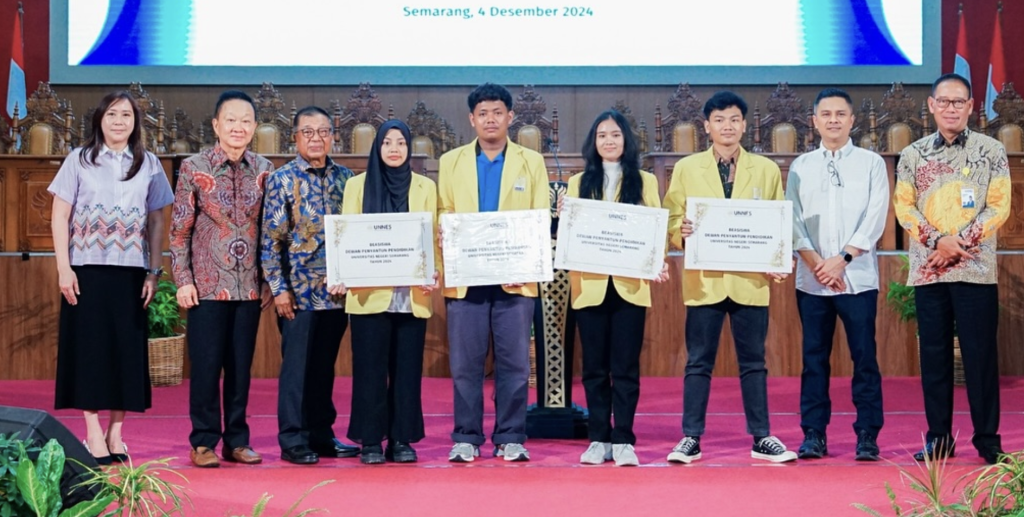
The second innovation is the establishment of the Educational Patrons Board (Dewan Penyantun Pendidikan UNNES), initiated by 14 prominent national figures who are part of the university’s Board of Trustees. Formalized by Rector’s Decree No. T/3309/UN37/HK.02/2024, the Board has become an institutional partner in advancing equity in higher education.
In 2024, the Patrons Board allocated IDR 2.4 billion in scholarships, enabling 398 students in the lowest tuition categories (UKT 1 and 2) to study free of charge. This innovation illustrates how external leadership and philanthropy can be mobilized to support equity in higher education at a large scale.
Tuition Fee Relief Programmes
Scholarships are not the only form of financial aid provided at UNNES. Recognizing that many students may not qualify for scholarships yet still face financial challenges, the university also implements tuition fee relief programmes. These include:
- 50% tuition fee reduction for 9,942 students, significantly lowering their financial burden.
- Downward reclassification of tuition categories for 495 students, aligning tuition costs more closely with actual family income levels.
These relief programmes ensure that assistance is available to a broader range of students, beyond those who receive scholarships. They also demonstrate UNNES’s responsiveness to students’ economic realities, particularly in times of crisis or unexpected financial hardship.
When combined, the scholarships, tuition relief programmes, and institutional innovations supported more than 20,000 students at UNNES in 2024. This figure represents a substantial portion of the student body and highlights the university’s holistic approach to financial aid.
The support provided is not limited to tuition fees alone but extends to living allowances, book vouchers, and recognition of students with unique contributions, such as Qur’an memorization. By adopting a broad definition of financial aid—covering tuition, living expenses, and personal development—UNNES ensures that its students can focus on their academic progress without being hindered by financial insecurity.
Importantly, the aid provided is also significant in scale. For instance, a 50% tuition discount or a monthly living stipend represents meaningful assistance that makes education possible for many students. The approach aligns with the principle that financial aid must enable attendance where it would otherwise be impossible.
UNNES’s approach to financial aid reflects a multi-dimensional strategy to promote equal access and social mobility. By leveraging government programmes, mobilizing community resources through Rumah Amal, and establishing innovative partnerships with national leaders through the Educational Patrons Board, the university has created a robust safety net for students from disadvantaged backgrounds.
In 2024, the combined efforts of these schemes benefited more than 20,000 students, ensuring that financial hardship did not prevent them from pursuing higher education. This outcome demonstrates both compliance with national policy and a deeper moral commitment to social justice. Through these initiatives, UNNES positions itself not only as an academic institution but also as a driver of poverty reduction and social transformation in Indonesia. The financial aid programmes exemplify how universities can play a critical role in achieving sustainable development goals, particularly in ensuring inclusive and equitable quality education for all.