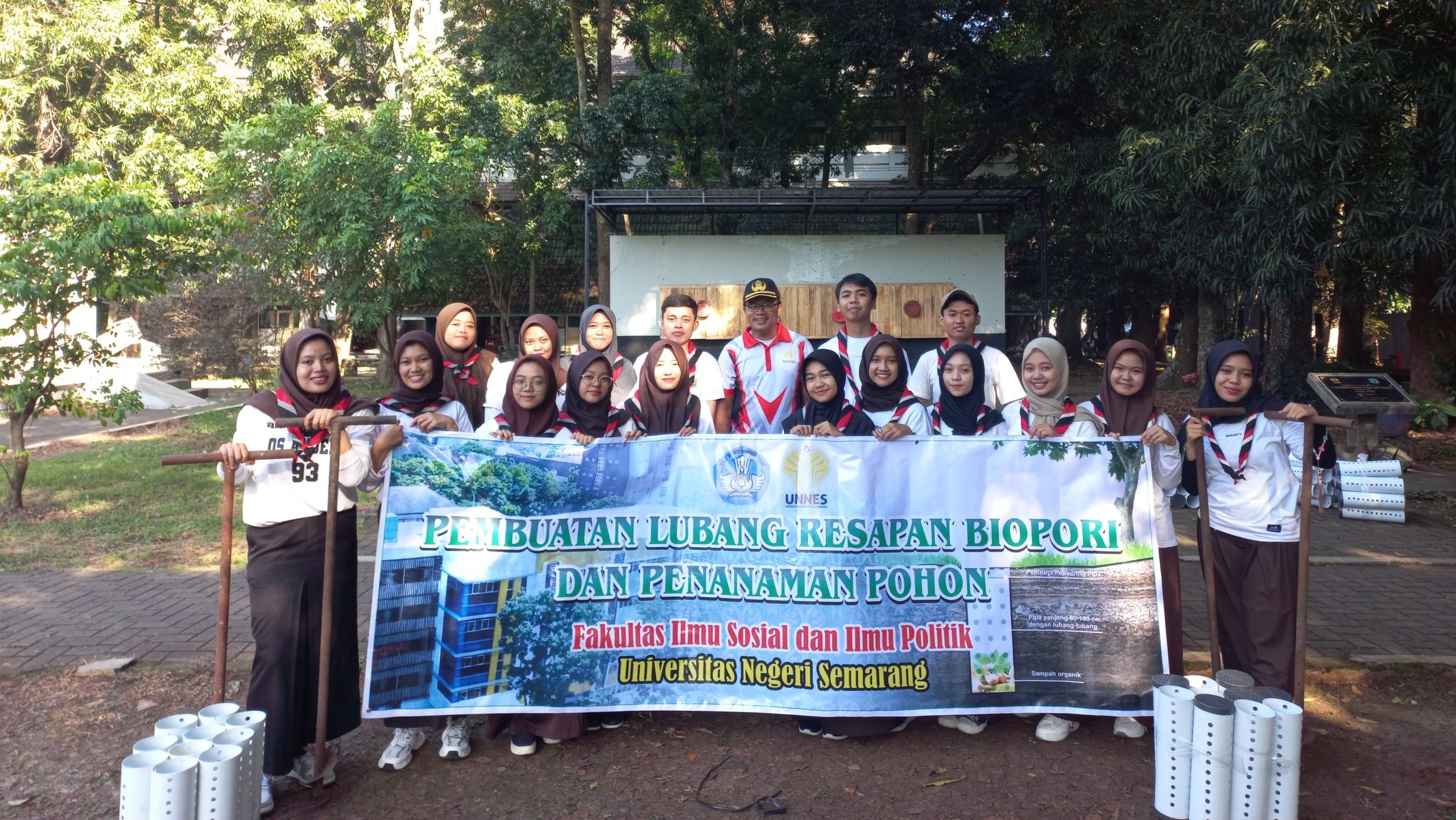
To support the achievement of the Sustainable Development Goals (SDGs), particularly Goal 6 (Clean Water and Sanitation), the Faculty of Social and Political Sciences of Universitas Negeri Semarang (FISIP UNNES), through its Conservation Task Force and in collaboration with Scout Students of Gugus Latih 3, carried out a biopore infiltration hole-making initiative on the FISIP UNNES campus in Sekaran, Gunungpati, on Saturday (June 14).
This initiative represents a concrete implementation of UNNES’s vision as a conservation university and an active contribution of FISIP UNNES to environmental preservation.
The Dean of FISIP UNNES, Prof. Dr. Arif Purnomo, S.Pd., S.S., M.Pd., who was directly involved in the activity, emphasized that creating biopores is a simple yet impactful environmental practice. The holes can be made at the base of drainage systems, flooded areas, or along the borders of gardens and paving blocks.
“Although the method is easy, not everyone is aware of the significant benefits of biopores,” he noted.
The event coordinator, Rudi Salam, explained that the theme of environmental conservation was chosen as it aligns with one of UNNES’s core pillars.
“Previously, we implemented the ‘one student, one tree’ program. Now, we are expanding it with a ‘one student, one biopore hole’ movement to maintain groundwater availability and process organic waste into compost,” said Rudi.
The Head of FISIP UNNES Scouts, Wazifun, added that biopore infiltration holes are an environmentally friendly, appropriate technology to address flooding and drought issues.
“During the rainy season, biopores enhance water absorption capacity, thereby reducing puddles. In the dry season, they help retain groundwater reserves,” he explained.
This initiative not only supports Goal 6 (Clean Water and Sanitation), but also contributes to Goal 13 (Climate Action) and Goal 15 (Life on Land). Through this activity, FISIP UNNES reaffirms its commitment to integrating environmental conservation into campus life and fostering student character that is mindful of planetary sustainability.