UNNES Promotes 100% Renewable Energy Awareness Through School Partnerships and Technological Innovation

Universitas Negeri Semarang > Sustainable Development Goals Universitas Negeri Semarang > News > News > UNNES Promotes 100% Renewable Energy Awareness Through School Partnerships and Technological Innovation

Universitas Negeri Semarang (UNNES) continues to strengthen its leadership in promoting renewable energy awareness and the national transition toward 100% clean energy. Through various education and community outreach initiatives, UNNES expands its influence beyond the university by engaging schools, teachers, and students in hands-on learning, public training, and collaborative innovation projects. These activities reflect UNNES’s role as a Conservation University committed to realizing the Sustainable Development Goals (SDGs), particularly SDG 7 (Affordable and Clean Energy) and SDG 13 (Climate Action).

One of the key programs was carried out in November 2024 by the Community Service Team (PPM) of the Electrical Engineering Education Program, Faculty of Engineering UNNES. The team held a training session titled “Trainer Kit Solar Cell Berbasis IoT (Internet of Things)” aimed at improving teachers’ technical and practical understanding of solar energy systems. The training was attended by vocational school teachers from across Central Java who received comprehensive materials and demonstrations on solar cell operation, energy conversion, IoT integration, and system efficiency analysis.
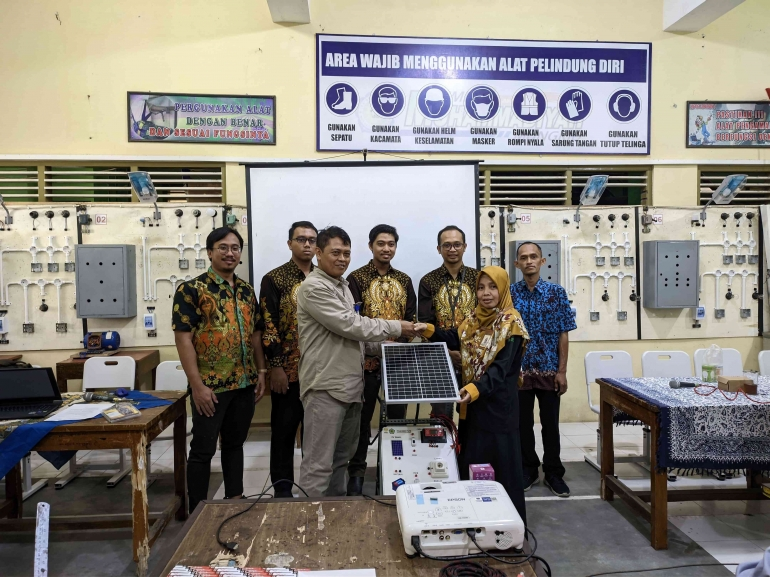
During the workshop, participants learned to design, assemble, and operate an IoT-based solar cell trainer kit that can monitor energy generation and usage in real time. This innovation allows users to evaluate solar panel performance and detect energy losses, promoting efficient energy use. The activity also included discussions on renewable energy policies, energy conservation strategies, and the importance of shifting away from fossil fuels to achieve national carbon reduction targets. According to the project leader, this program is part of UNNES’s long-term commitment to empowering educators as renewable energy ambassadors in their respective schools and communities.

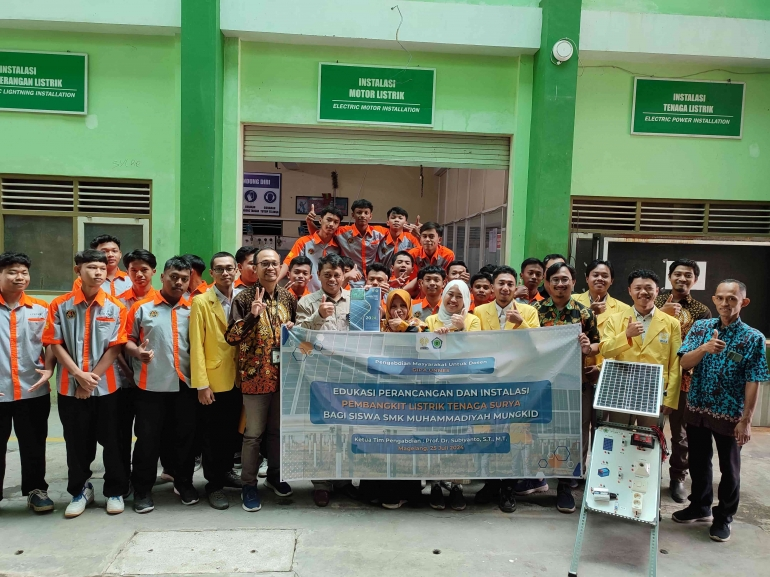
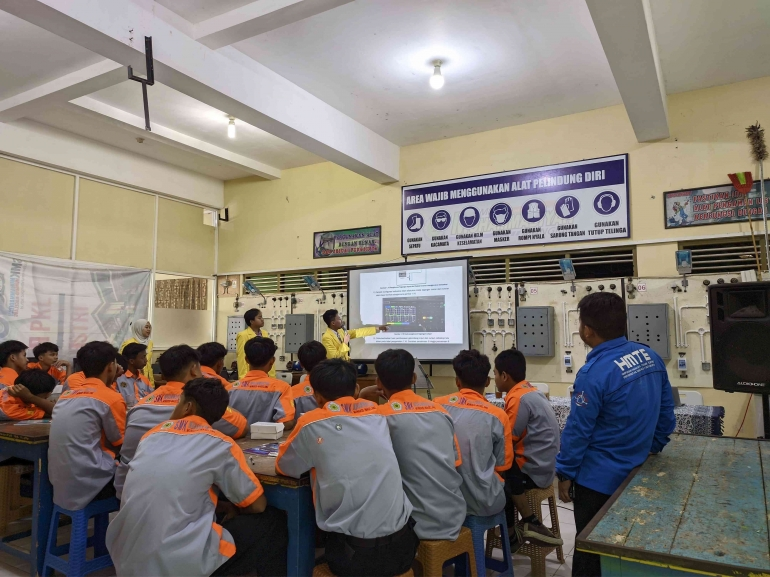
A similar initiative was implemented earlier in August 2024 by another UNNES team at SMK Muhammadiyah Mungkid, Magelang, through a project titled “UNNES Encourages Renewable Energy Innovation.” The team installed a solar panel trainer system and provided in-depth workshops for teachers and students to develop their own renewable energy learning modules. The goal was to cultivate technical skills in solar photovoltaic installation, maintenance, and energy monitoring, enabling vocational schools to serve as local centers for clean energy education. This collaboration aligns with UNNES’s effort to create a network of renewable energy learning hubs across Central Java.
The Dean of the Faculty of Engineering, UNNES, emphasized that these programs are not merely technical trainings but also part of a broader public pledge to accelerate Indonesia’s transition to renewable energy. By introducing renewable energy concepts and technologies at the school level, UNNES fosters public understanding of clean energy’s benefits and nurtures a generation that supports sustainable power solutions. These initiatives also demonstrate UNNES’s proactive engagement with communities outside the university, contributing to a wider societal shift toward energy efficiency and sustainability.

Through these partnerships, UNNES actively promotes the use of solar energy, energy-efficient technologies, and IoT-based monitoring systems to ensure the efficient management of renewable power. The initiatives have inspired several participating schools to integrate solar energy modules into their curriculum and explore on-campus solar installations. In doing so, UNNES not only extends its academic expertise but also strengthens its advocacy for a 100% renewable energy future.
By combining technological innovation, community engagement, and educational outreach, UNNES demonstrates that its commitment to renewable energy extends well beyond its campus borders. These efforts mark another milestone in the university’s journey toward achieving carbon neutrality by 2045 and reaffirm its role as a catalyst for sustainable transformation in Indonesia’s energy landscape.
Related Posts

Leave a Reply

* Kode Akses Komentar:

* Tuliskan kode akses komentar diatas:

GDPR

  • Privacy Policy

Privacy Policy

At unnes.ac.id, the privacy of our visitors is of extreme importance to us. This privacy policy document outlines the types of personal information that is received and collected by unnes.ac.id and how it is used.

Log Files

Like many other Web sites, unnes.ac.id makes use of log files. The information inside the log files includes internet protocol (IP) addresses, type of browser, Internet Service Provider (ISP), date/time stamp, referring/exit pages, and number of clicks to analyze trends, administer the site, track user’s movement around the site, and gather demographic information. IP addresses and other such information are not linked to any information that is personally identifiable.

Cookies

unnes.ac.id uses cookies to store information about visitors’ preferences, to record user-specific information on which pages the site visitor accesses or visits, and to personalize or customize our web page content based upon visitors’ browser type or other information that the visitor sends via their browser.

Third-party ad servers or ad networks use technology in their respective advertisements and links that appear on unnes.ac.id and which are sent directly to your browser. They automatically receive your IP address when this occurs. Other technologies (such as cookies, JavaScript, or Web Beacons) may also be used by our site’s third-party ad networks to measure the effectiveness of their advertising campaigns and/or to personalize the advertising content that you see on the site.

unnes.ac.id has no access to or control over these cookies that are used by third-party advertisers.

You should consult the respective privacy policies of these third-party ad servers for more detailed information on their practices as well as for instructions about how to opt-out of certain practices. unnes.ac.id’s privacy policy does not apply to, and we cannot control the activities of, such other advertisers or web sites.

If you wish to disable cookies, you may do so through your individual browser options. More detailed information about cookie management with specific web browsers can be found at the browsers’ respective websites.

Consent

By using our website, you hereby consent to our privacy policy and agree to its terms.

Update

This Privacy Policy was last updated on: 2023-02-14. Should we update, amend or make any changes to our privacy policy, those changes will be posted here.

Contact Us

If you have any questions, comments, or concerns about our Privacy Policy or our practices with regards to your personal information, please feel free to contact us through the contact form on our website or by emailing us at humas[at]mail.unnes.ac.id.

This Privacy Policy is intended as a general guide to our practices in collecting and using information. If there is any inconsistency between this Privacy Policy and the terms of the Service Agreement or any other terms that may apply to specific services you use, then those specific service terms shall apply.

Terms of Use

By using our website, you agree to abide by this Privacy Policy. If you do not agree with this Privacy Policy, please do not use our website. We reserve the right to update this Privacy Policy from time to time without prior notice. Please review our Privacy Policy periodically to check for changes. Your continued use of our website following the posting of changes to this Privacy Policy means that you accept the changes.

Thank you for reading our Privacy Policy. We are committed to protecting the privacy of our website visitors and will continue to update our Privacy Policy to ensure optimal protection.