UNNES PKM-RE Team Develops Hydrogel Wound Dressing Based on Alginate–Quaternary Chitosan Biocomposite and Propolis Extract

Universitas Negeri Semarang > Sustainable Development Goals Universitas Negeri Semarang > News > News > UNNES PKM-RE Team Develops Hydrogel Wound Dressing Based on Alginate–Quaternary Chitosan Biocomposite and Propolis Extract

Semarang – The Research and Exact Sciences Student Creativity Program (PKM-RE) Team from Universitas Negeri Semarang (UNNES) has successfully developed a hydrogel wound dressing based on an alginate–quaternary chitosan biocomposite with the addition of propolis extract. This innovation serves as a novel biomedical material designed to accelerate the healing process of second-degree burns. The research is a product of interdisciplinary collaboration among students from the Pharmacy Study Program, Faculty of Medicine; Chemistry Study Program; and Biology Education Study Program, Faculty of Mathematics and Natural Sciences.

The team, consisting of Iqbal Nugroho, Priskila Meliana Hutahaean, Melania Diu, and Aulya Indah Purwanty, received funding through the 2025 PKM grant from the Directorate of Learning and Student Affairs, Ministry of Education, Culture, Research, and Technology (Kemendikbudristek), under the supervision of apt. Annisa Aulia Savitri, M.Clin.Pharm. Through this research, the students aim to integrate pharmaceutical, chemical, and biological sciences to produce a natural-based biomedical solution that is more effective, safe, and environmentally friendly.

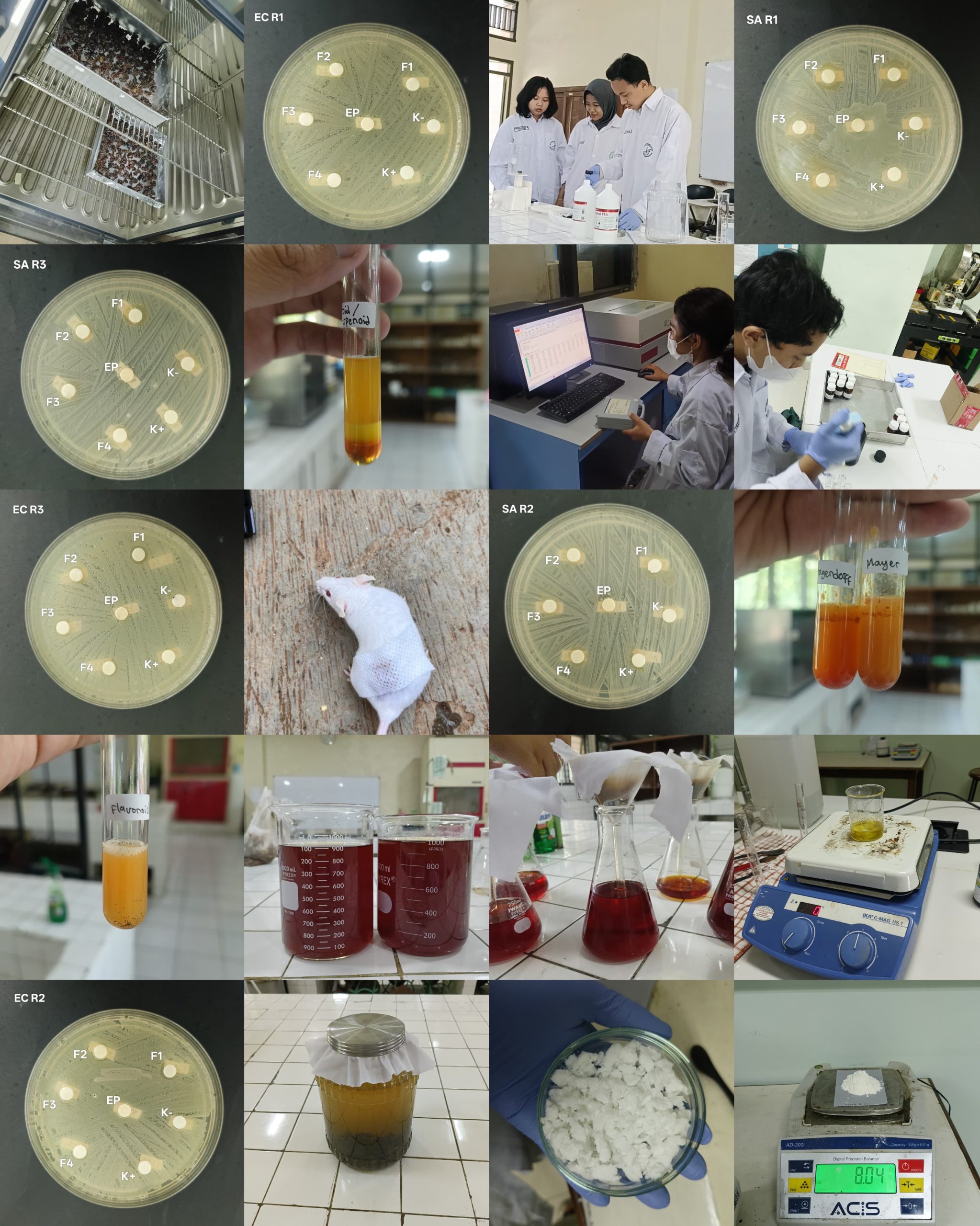
The research began in the twelfth week of the PKM implementation period and was conducted from 22 to 28 September 2025 in several laboratories within UNNES and its partner institutions. The study commenced with swelling and weight loss tests of the hydrogel at the FMIPA UNNES Research Laboratory, followed by mechanical property tests—tensile strength and elongation percentage—at the Pharmaceutical Formulation Technology Laboratory. These analyses served to determine the hydrogel’s physical stability and its capacity to maintain moisture at the wound site.

The research continued with antibacterial activity testing at the Microbiology Laboratory, Faculty of Medicine, Diponegoro University (UNDIP). This phase aimed to assess the hydrogel’s effectiveness in inhibiting the growth of infection-causing microbes. Preliminary results indicated that the combination of biocomposite materials and propolis extract exhibits promising antibacterial activity, suggesting that the formulation not only acts as a wound dressing but also actively promotes biological wound healing.

In the final stage, the team conducted in vivo testing involving second-degree burn induction in mice at the FMIPA UNNES Animal Testing Laboratory. This test aimed to directly evaluate the hydrogel’s effectiveness in supporting skin tissue regeneration. Early observations demonstrated favorable physical and biological properties of the hydrogel, with faster wound healing rates compared to the control group.

The supervising lecturer, apt. Annisa Aulia Savitri, M.Clin.Pharm., emphasized that the research exemplifies the innovative and collaborative spirit of UNNES students. “We aim to foster an applied research culture by integrating the strengths of pharmacy, biology, and chemistry to produce natural-based biomedical products that can benefit society,” she explained.

Through this collaborative endeavor, the UNNES PKM-RE Team not only demonstrates strong research competence but also embodies the university’s vision as a conservation-minded and internationally reputed institution. The outcomes of this study are expected to serve as a foundation for the development of modern biomedical materials that are effective, biocompatible, and sustainable—reinforcing UNNES’s contribution to health research and innovation based on Indonesia’s natural resources.

Related Posts

Leave a Reply

* Kode Akses Komentar:

* Tuliskan kode akses komentar diatas:

GDPR

  • Privacy Policy

Privacy Policy

At unnes.ac.id, the privacy of our visitors is of extreme importance to us. This privacy policy document outlines the types of personal information that is received and collected by unnes.ac.id and how it is used.

Log Files

Like many other Web sites, unnes.ac.id makes use of log files. The information inside the log files includes internet protocol (IP) addresses, type of browser, Internet Service Provider (ISP), date/time stamp, referring/exit pages, and number of clicks to analyze trends, administer the site, track user’s movement around the site, and gather demographic information. IP addresses and other such information are not linked to any information that is personally identifiable.

Cookies

unnes.ac.id uses cookies to store information about visitors’ preferences, to record user-specific information on which pages the site visitor accesses or visits, and to personalize or customize our web page content based upon visitors’ browser type or other information that the visitor sends via their browser.

Third-party ad servers or ad networks use technology in their respective advertisements and links that appear on unnes.ac.id and which are sent directly to your browser. They automatically receive your IP address when this occurs. Other technologies (such as cookies, JavaScript, or Web Beacons) may also be used by our site’s third-party ad networks to measure the effectiveness of their advertising campaigns and/or to personalize the advertising content that you see on the site.

unnes.ac.id has no access to or control over these cookies that are used by third-party advertisers.

You should consult the respective privacy policies of these third-party ad servers for more detailed information on their practices as well as for instructions about how to opt-out of certain practices. unnes.ac.id’s privacy policy does not apply to, and we cannot control the activities of, such other advertisers or web sites.

If you wish to disable cookies, you may do so through your individual browser options. More detailed information about cookie management with specific web browsers can be found at the browsers’ respective websites.

Consent

By using our website, you hereby consent to our privacy policy and agree to its terms.

Update

This Privacy Policy was last updated on: 2023-02-14. Should we update, amend or make any changes to our privacy policy, those changes will be posted here.

Contact Us

If you have any questions, comments, or concerns about our Privacy Policy or our practices with regards to your personal information, please feel free to contact us through the contact form on our website or by emailing us at humas[at]mail.unnes.ac.id.

This Privacy Policy is intended as a general guide to our practices in collecting and using information. If there is any inconsistency between this Privacy Policy and the terms of the Service Agreement or any other terms that may apply to specific services you use, then those specific service terms shall apply.

Terms of Use

By using our website, you agree to abide by this Privacy Policy. If you do not agree with this Privacy Policy, please do not use our website. We reserve the right to update this Privacy Policy from time to time without prior notice. Please review our Privacy Policy periodically to check for changes. Your continued use of our website following the posting of changes to this Privacy Policy means that you accept the changes.

Thank you for reading our Privacy Policy. We are committed to protecting the privacy of our website visitors and will continue to update our Privacy Policy to ensure optimal protection.