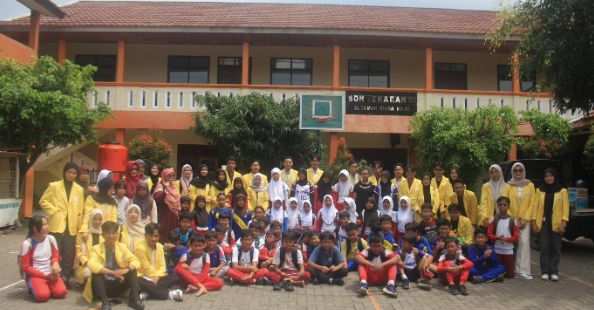
Students of the Physics Education Study Program, Faculty of Mathematics and Natural Sciences (FMIPA), Universitas Negeri Semarang (UNNES), successfully implemented the Environmental Physics for Sustainable Development (EPISODE) program as part of the Environmental Physics course. The activity took place at SDN 1 Sekaran, Gunungpati District, on Tuesday, 16 November 2025, under the supervision of course lecturer Dr. Ellianawati, M.Si.
The EPISODE program serves as a platform for students to apply the outcomes of their mini-research projects through the development of instructional teaching aids and learning products related to environmental sustainability and waste management. Through this initiative, students were encouraged to explore environmental physics concepts not only theoretically, but also through real-world applications that address everyday environmental challenges.
For two consecutive years, the EPISODE program has been strengthened through international collaboration with Universiti Teknologi MARA (UiTM), Malaysia. An academic partner, Mohammad Mubarrak Mohd. Yusof, M.Ed., contributed to the program by providing online reviews and evaluations of the students’ innovative products. This collaboration enhanced the academic quality of the program and broadened students’ global perspectives on environmentally based learning innovations.
During the activity, students showcased a variety of creative learning media, including a mini water turbine, a solar-powered stove, and a simple thermometer to support lessons on energy and temperature. In addition, they introduced environmentally friendly products derived from waste materials and local resources, such as banana stem chips, liquid fertilizer from orange peels, aromatherapy candles made from used cooking oil, and natural cleaning solutions from betel leaves.
These innovations demonstrate the application of the reduce, reuse, and recycle (3R) principles and contribute to the achievement of several Sustainable Development Goals (SDGs), particularly SDG 4 (Quality Education), SDG 7 (Affordable and Clean Energy), SDG 12 (Responsible Consumption and Production), and SDG 13 (Climate Action). The program also aligns with the UNNES Conservation Pillars, especially in promoting environmental conservation, character building, and the advancement of science and technology.
The EPISODE activity received positive responses from teachers at SDN 1 Sekaran. Fifth-grade teacher Ms. Isnona Arifdiyani, S.Pd., stated that the teaching aids developed by the students helped pupils understand science concepts more concretely and enjoyably. Meanwhile, Mr. Muhammad Arifin Baihaqi, S.Pd., M.Pd., highlighted that the program effectively nurtured students’ environmental awareness from an early age through contextual and hands-on learning.
Dr. Ellianawati, M.Si. explained that the EPISODE program represents an implementation of project- and research-based learning that integrates scientific knowledge, education, and conservation values. “Through this program, students not only learn environmental physics concepts, but also practice communicating science to elementary school students using simple, environmentally friendly, and meaningful learning media,” she said.
Through the EPISODE program, UNNES Physics Education students are expected to strengthen their competencies as future educators with strong scientific literacy, environmental awareness, and a commitment to sustainable development, in line with UNNES’s vision as a conservation-oriented university.