Branjang Village, September 27, 2024 – In a concrete effort to support the clean energy transition and circular economy, the Student Organizations (Ormawa) PPK Team from the Faculty of Economics and Business (HMPPE) of Semarang State University (UNNES) launched the “Metacow” biogas digester technology. This innovation not only solves the environmental problem of cow dung waste but also creates a renewable energy source and organic fertilizer that increases farmers’ incomes. This program strategically addresses three pillars of the SDGs: Affordable and Clean Energy (SDG 7), Responsible Consumption and Production (SDG 12), and Climate Change Management (SDG 13).
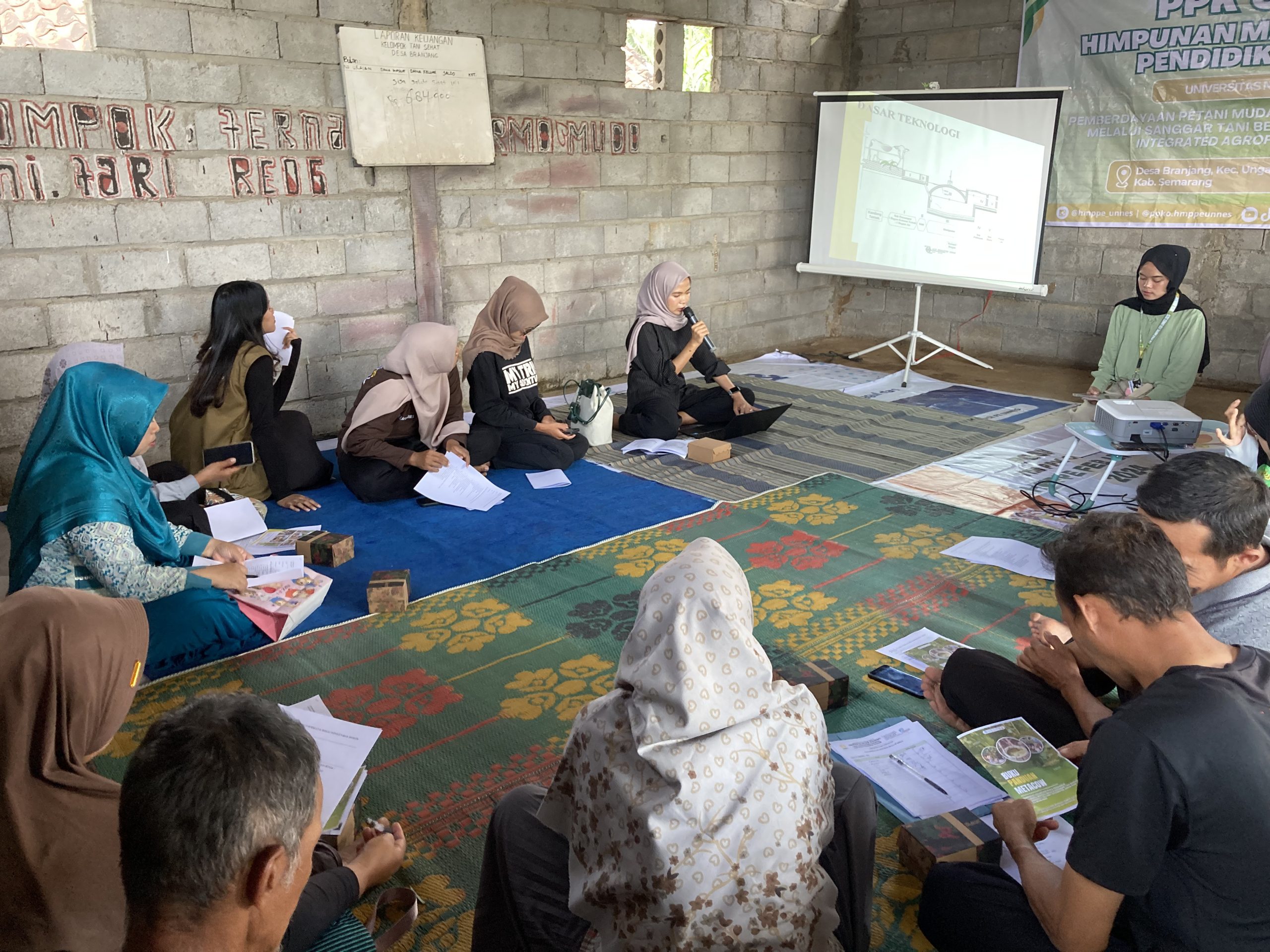
The training, held in a cow shed in Branjang Hamlet, featured speakers from the Central Java Provincial Environment and Forestry Office, demonstrating the strong synergy between academics, local government, and the community in realizing sustainable development at the village level.
“Metacow” is designed as a simple yet effective solution for processing cow dung through an anaerobic fermentation process. This technology produces biogas for daily cooking needs as well as solid and liquid organic fertilizer that can be directly applied to agricultural land. “Until now, cow dung waste has just piled up and caused odor and pollution problems. With ‘Metacow,’ we can transform it into something economically valuable. We’ve already tested the biogas produced for cooking and the fertilizer for vegetable gardens,” said Mr. Kholis, an enthusiastic member of the Gading Mayang Farmers’ Studio.
The implementation of ‘Metacow’ has had a dual impact that is immediately felt by the community. On the one hand, farmers save on LPG gas and chemical fertilizer costs. On the other hand, agricultural productivity has increased thanks to the use of the resulting organic fertilizer. Mr. Teguh Hardi Raharjo, M.Pd., Supervising Lecturer, explained, “This is a perfect example of a circular economy at the village level. What was previously considered a problem has now become a source of additional income. Communities are not just consumers of technology, but producers of energy and fertilizer for their own needs.”
The local government’s commitment to supporting this innovation was expressed by Rima Asri from the Central Java Provincial Environment and Forestry Agency (DLHK). “Programs like ‘Metacow’ are highly relevant to the government’s vision of integrated waste management and energy transition. This technology not only reduces methane emissions from livestock manure but also promotes energy independence in rural areas,” he explained. To ensure sustainability, the team not only provides practical training but also provides participants with comprehensive guidance modules and an ongoing mentoring plan. This comprehensive approach enables the community to operate and maintain the ‘Metacow’ system independently.
The successful implementation of ‘Metacow’ in Branjang Village opens up opportunities for replication in other villages. This innovation not only addresses environmental and energy challenges but also creates a new green economy-based business model in rural areas. “We are committed to continuing to assist the community until ‘Metacow’ can be truly adopted independently. In the future, we even envision every cattle farmer in Branjang Village becoming an energy and organic fertilizer producer,” added Ahmad Wafiq Rafi Ardani, Chair of the Student Organization HMPPE FEB UNNES.
With the implementation of “Metacow”, Branjang Village now has a strong foundation to become a sustainable, energy-independent village, while also becoming a pilot project for the application of appropriate technology based on a circular economy in Central Java.