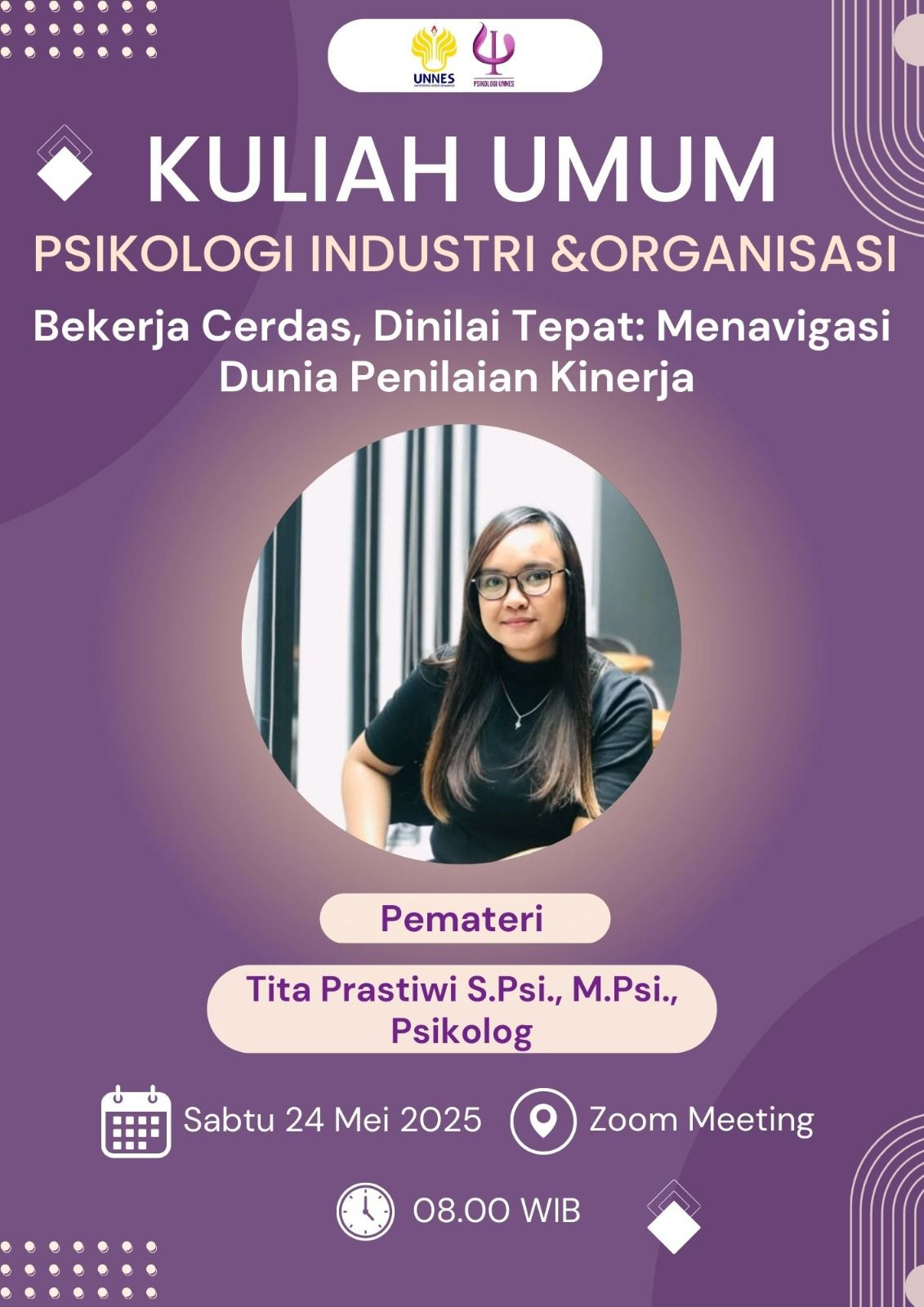
Semarang, May 24, 2025, The Psychology Study Program at Universitas Negeri Semarang (UNNES) held a public lecture titled “Work Smart, Be Assessed Right: Navigating the World of Performance Appraisal” for fourth-semester students taking the Industrial and Organizational Psychology (IOP) course. The event featured Tita Prastiwi, S.Psi., M.Psi., Psychologist, an experienced practitioner in human resource development and organizational psychology.
Conducted online via Zoom Meeting starting at 08.00 WIB, the lecture successfully captured students’ interest, especially those eager to understand the professional world and how performance appraisal is carried out and strategically interpreted.
In her presentation, Ms. Tita emphasized that performance appraisal is not merely about evaluating work results but serves as an important foundation for:
- Assessing whether employee performance meets established standards
- Determining training and development programs
- Providing coaching and mentoring
- Serving as the basis for promotion, rotation, transfer, or placement
She highlighted that appraisals must be conducted objectively, transparently, data-driven, and accompanied by constructive two-way feedback.
Furthermore, Ms. Tita stressed the importance of aligning appraisal processes with an organization’s vision and mission. Effective appraisals, she explained, should focus on competencies that can be developed—such as leadership, teamwork, and decision-making—rather than solely on innate abilities or potential.
Students were also introduced to tools commonly used in modern HR management, including:
- Key Performance Indicators (KPI): measurable success indicators derived from organizational business targets.
- Skill Matrix: a visual tool for mapping individual competencies within a team, useful for task distribution, training, and evaluation.
The ideal performance appraisal process, she added, consists of eight stages: determining indicators, system design, socialization, implementation, monitoring, evaluation, reporting, and follow-up. With a structured and standardized system, organizations can avoid subjective and unfair assessments.
The lecture was delivered in an engaging atmosphere filled with active discussions. Students appeared enthusiastic, attentively following the presentation and actively participating in the Q&A session. The material resonated strongly with the realities of the workplace they will encounter after graduation.
“At first, I thought performance appraisal was just a formality in offices, but it turns out there are so many considerations, and it can significantly affect our career paths. Now I feel it’s really important to understand this early so I won’t be surprised later when I start working.”
— Tiara Salsabilla
This public lecture reflects the Psychology Study Program’s strong commitment to preparing students for the professional world by equipping them with practical and relevant knowledge. It is hoped that similar activities will continue to bridge academic theory with real-world practices, especially in the field of Industrial and Organizational Psychology.