UNNES Implements Dual-Source Water Strategy to Support Sustainable Campus Operations
Semarang – Universitas Negeri Semarang (UNNES) continues to demonstrate its commitment to sustainability and conservation through an innovative dual-source water management strategy.
By optimizing the use of both groundwater and river water, UNNES ensures efficient resource utilization while maintaining essential campus operations in line with its vision as a World Reputable University and Pioneer of Excellence in Education.
Local Wells as the Primary Source of Clean Water
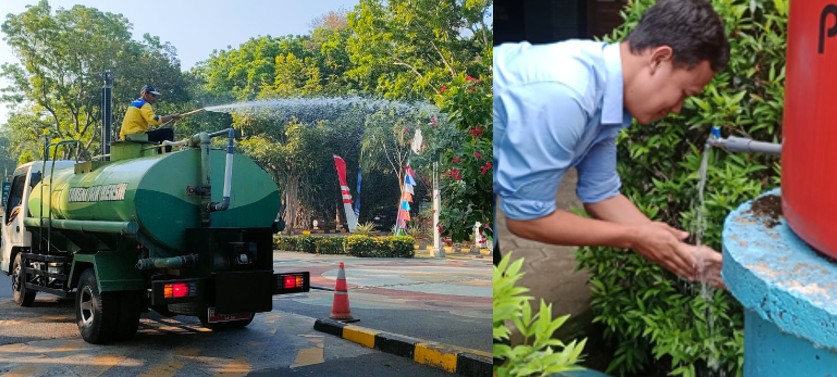
The availability of clean water on the UNNES campus is primarily supported by local wells, which provide water for essential sanitary needs such as toilets, ablution (wudhu), and other hygiene-related facilities.
These groundwater sources are maintained carefully to ensure a safe and consistent supply for daily campus activities.
Due to their limited capacity, UNNES ensures that well water is prioritized for domestic and hygienic purposes, reflecting responsible water management practices consistent with the university’s conservation-based principles.
River Water Utilization for Non-Potable Needs
Recognizing the importance of water conservation, UNNES has adopted a sustainable alternative water source for non-potable activities.
Water from the Contok River, located near the campus, is utilized for purposes such as watering plants, cleaning outdoor facilities, and maintaining green landscapes.
This river water is collected and transported using water tank vehicles to specific distribution points across campus, ensuring that environmental maintenance activities can continue efficiently without depleting groundwater reserves.
The approach also supports UNNES’s ongoing commitment to preserving vegetation, biodiversity, and campus aesthetics as part of its Conservation University identity.
A Model for Efficient and Responsible Resource Management
This dual-source water management system allows UNNES to separate water use based on its purpose — clean water from wells for hygienic and domestic use, and river water for landscape and environmental functions.
Such an integrated system not only optimizes limited resources but also minimizes ecological impact and supports long-term water security for the university community.
By aligning infrastructure development with conservation values, UNNES positions itself as a model for sustainable water governance in higher education.
Supporting the Sustainable Development Goals (SDGs)
UNNES’s dual-source water management contributes directly to several United Nations Sustainable Development Goals (SDGs):
- SDG 6: Clean Water and Sanitation – Ensuring availability and sustainable management of water for all.
- SDG 12: Responsible Consumption and Production – Promoting efficient and sustainable use of natural resources.
- SDG 13: Climate Action – Strengthening resilience through adaptive water management strategies.
- SDG 15: Life on Land – Supporting vegetation and biodiversity conservation through sustainable irrigation practices.