Semarang – Student research innovation from Semarang State University (UNNES) has once again achieved impressive national recognition. The Student Creativity Program (PKM-RE) team successfully developed a hydrogel wound dressing based on a quaternary alginate-chitosan biocomposite with the addition of propolis extract, which has the potential to accelerate the healing of second-degree burns more effectively, safely, and in an environmentally friendly manner. This research supports the realization of Sustainable Development Goals (SDG) 3 – Good Health and Well-being, by promoting innovative biomedical products that improve the quality of healthcare treatments.
This innovation is the result of a cross-faculty collaboration between students from the Pharmacy Study Program, Faculty of Medicine, and students from Chemistry and Biology Education, Faculty of Mathematics and Natural Sciences. The team consists of Iqbal Nugroho, Priskila Meliana Hutahaean, Melania Diu, and Aulya Indah Purwanty, with apt. Annisa Aulia Savitri, M.Clin.Pharm., as their supervisor. This activity was funded through a 2025 PKM grant from the Directorate of Learning and Student Affairs (Belmawa) of the Ministry of Education, Culture, Research, and Technology. Through this research, the students strive to integrate pharmaceutical science, chemistry, and biology to produce natural-based biomedical products that align with the Sustainable Development Goals (SDGs), particularly SDG 3 (Good Health and Well-being), SDG 9 (Industry, Innovation, and Infrastructure), and SDG 12 (Responsible Consumption and Production).
This research focuses on the use of natural and renewable materials such as alginate from seaweed, quaternary chitosan from shrimp shell waste, and propolis extract as natural antibacterials, making the product more biocompatible, sustainable, and environmentally friendly than conventional synthetic wound dressings. This aligns with SDG 12, which encourages sustainable production practices and the reduction of environmental waste through the utilization of local natural resources.
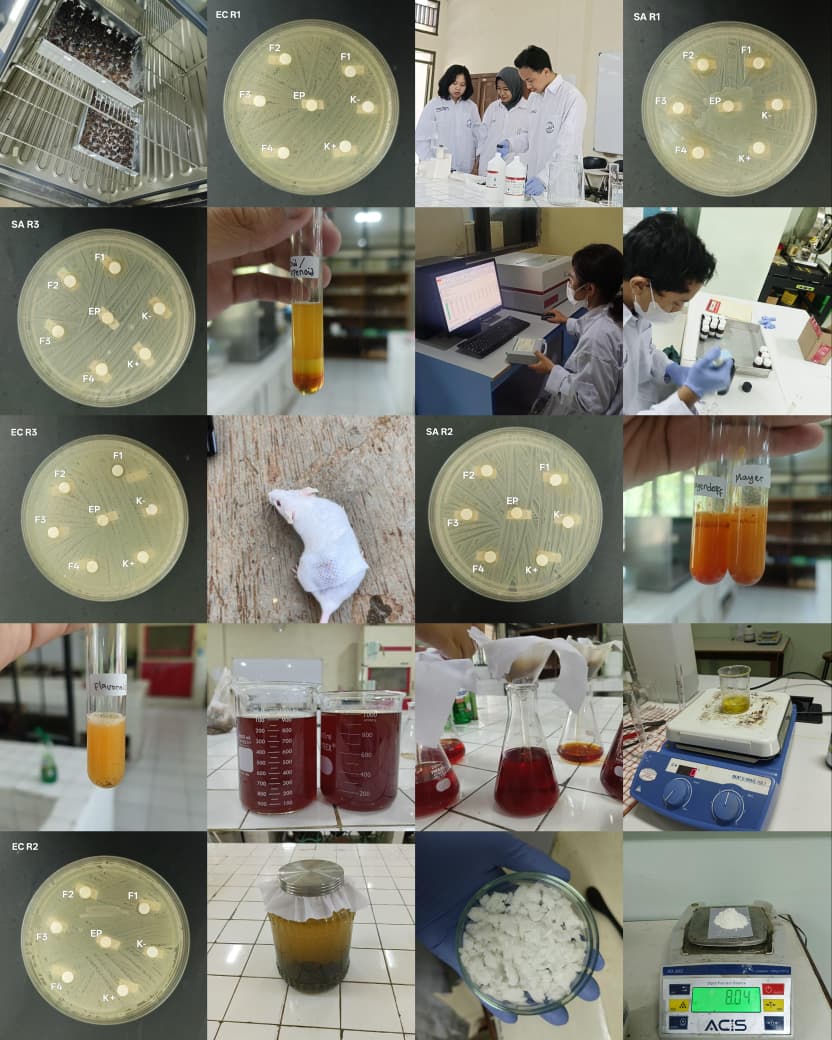
The research phase began with swelling and weight loss tests of the hydrogel at the UNNES Faculty of Mathematics and Natural Sciences Research Laboratory, followed by mechanical property tests (tensile strength and elongation) at the Pharmaceutical Preparation Technology Laboratory. Initial results demonstrated good physical stability and excellent wound moisture retention, both essential for accelerating tissue regeneration—an important contribution to achieving SDG 3, which focuses on ensuring healthy lives and promoting well-being for all.
Antibacterial activity tests were then conducted at the Microbiology Laboratory of the Faculty of Medicine, Diponegoro University (UNDIP) to assess the hydrogel’s ability to inhibit the growth of infection-causing microbes. The formulation with propolis extract proved to provide significant antibacterial activity, indicating its great potential for supporting biological wound healing and preventing infections—a crucial advancement in innovative healthcare technology that strengthens SDG 9 through applied scientific research.
The final stage of the research included in vivo testing on mice at the Animal Experimental Laboratory of the Faculty of Mathematics and Natural Sciences, UNNES, to test its effectiveness in healing second-degree burns. Preliminary observations showed faster wound healing and healthier skin tissue compared to the control group, further confirming its potential as a safe, effective, and eco-friendly biomedical innovation.
Supervising lecturer, apt. Annisa Aulia Savitri, M.Clin.Pharm., stated that this research is not only oriented towards scientific innovation but also towards a tangible contribution to sustainable development. “This research embodies the implementation of the SDGs through the use of sustainable natural materials (SDG 12), environmentally friendly biomedical innovation (SDG 9), and improvements in public health (SDG 3). We hope the results can be developed into products that benefit the wider community,” she explained.
Through this collaborative and interdisciplinary spirit, the UNNES PKM-RE team not only demonstrated superior research capabilities, but also strengthened the university’s commitment to UNNES’s vision as a conservation-minded campus, contributing actively to the achievement of the 2030 SDGs. This alginate-chitosan-propolis biocomposite hydrogel innovation is expected to be the first step towards the development of modern biomedical preparations that are sustainable, biocompatible, and based on Indonesia’s natural potential, while strengthening UNNES’s role in supporting the global agenda of sustainable development in the fields of health, innovation, and environmental responsibility.