Universitas Negeri Semarang (UNNES), widely recognized as The Conservation University, continues to lead sustainability initiatives by optimizing energy use across its campus.
Advancing Energy Efficiency Initiatives
UNNES took concrete steps to strengthen energy efficiency and minimize electricity consumption in university facilities. The efforts focus on replacing conventional high-energy equipment with environmentally friendly alternatives and integrating smart control technologies to automate power use. These initiatives are also accompanied by campus-wide campaigns promoting energy-saving habits among students and staff.
“Our mission as a Conservation University is not only to teach sustainability, but to live it,” said a UNNES sustainability representative. “By transforming the way we use energy, we set a practical example of climate-conscious operations for the academic community.”
Smart Technologies for a Greener Campus
To bring this mission to life, UNNES has installed and documented various energy-efficient appliances throughout campus areas. These include:
- Motion-sensor lamps that automatically switch on only when movement is detected, particularly in restrooms, gardens, and hallways.
- LED lighting systems installed in classrooms, offices, lobbies and hallways, reducing energy use compared to traditional bulbs.
- Reflectors and Low Energy Neon Lights combined with low-energy neon lamps, such as Philips Essential TL5 14W (energy efficiency class “A”), to enhance brightness with less power.
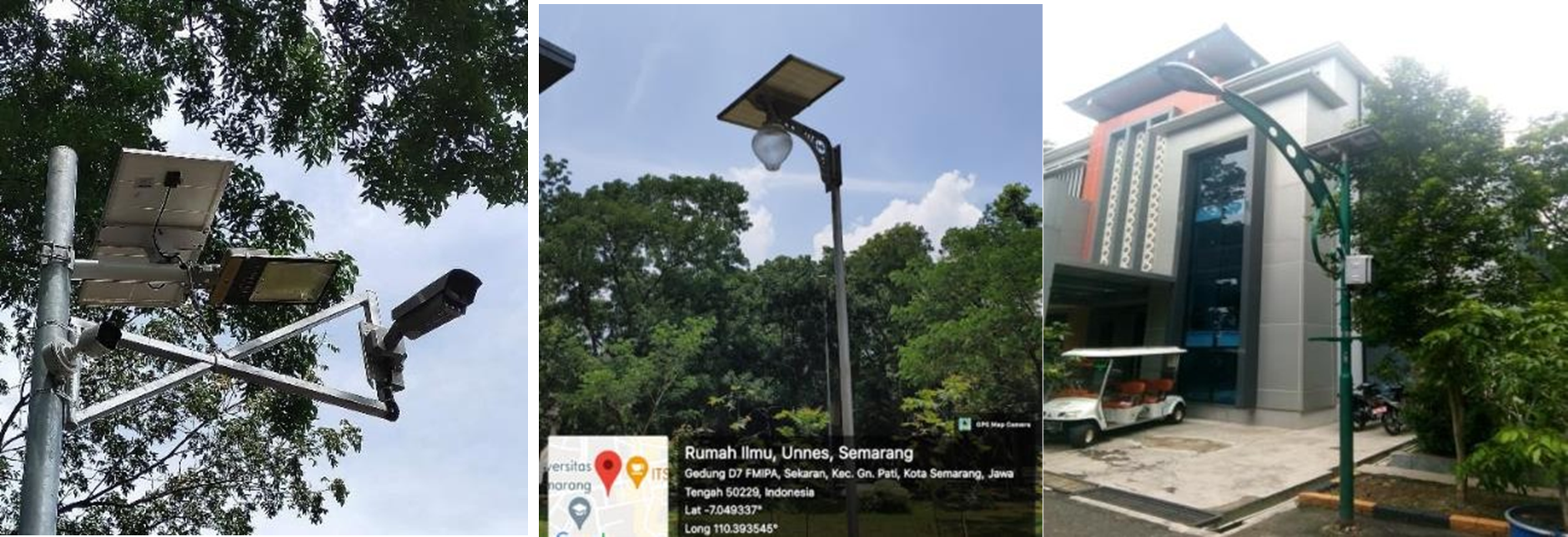
- Solar-powered outdoor lighting, which operates automatically at night to reduce reliance on grid electricity.
- Digital inverter air conditioners, both wall-mounted and 4-way cassette types, which maximize cooling efficiency in large rooms.
- Touchscreen smartboards replacing LCD projectors, cutting down on the use of multiple devices and decreasing total energy consumption in classrooms.
- Compact PCs that integrate CPU and monitor in a single unit, minimizing energy usage in offices and laboratories.
All of these appliances are part of UNNES’s continuous documentation and monitoring system for sustainable energy management.
Visible Impact and Results
According to the latest data, UNNES achieved an average energy-efficient appliance utilization rate of 77.24% in 2024, showing a steady increase from 70% in 2023. This improvement demonstrates the university’s consistent progress toward reducing electricity consumption and promoting environmentally friendly technologies.
The details of energy-efficient appliance utilization are as follows:
- LED Lamps:
In 2023, UNNES recorded 77,232 energy-efficient LED lamps out of 79,574 units (97%). By 2024, the number slightly increased to 78,133 efficient units out of 78,342 total lamps, reaching an impressive 99.73% efficiency rate.
This shows that nearly all campus lighting has transitioned to LED systems, significantly reducing electricity use. - Reflectors:
Reflectors improved from 8,973 efficient units out of 9,520 (94%) in 2023 to 9,453 out of 9,768 units (96.78%) in 2024.
These devices contribute to better light distribution while maintaining low power consumption, supporting UNNES’s green infrastructure. - Air Conditioners (AC):
In 2023, 674 out of 1,104 units (61%) were classified as energy-efficient. The number rose in 2024 to 821 out of 1,231 units (66.69%).
The increase reflects UNNES’s initiative to replace older air conditioners with newer, energy-saving inverter systems. - LCD Projectors:
Significant progress was seen in projectors, which improved from 570 efficient units out of 1,331 (42%) in 2023 to 787 out of 1,436 units (54.80%) in 2024.
This 12.8% jump marks one of the most notable transitions in classroom technology efficiency. - Personal Computers (PCs):
Energy-efficient PCs increased from 2,136 out of 3,610 units (59%) in 2023 to 2,534 out of 3,721 units (68.28%) in 2024.
The upgrade to modern low-power computers has contributed significantly to energy savings in computer laboratories and administrative offices.
Overall, the average utilization rate rose from 70% to 77.24%, indicating a 7.24% improvement in just one year.
These results are supported by the implementation of LED lighting, smart control systems, and systematic replacement of high-energy appliances, which have led to up to 30% reduction in electricity consumption in several main campus buildings.