Tentu bro 💪 — berikut terjemahan bahasa Inggrisnya dalam gaya formal dan akademik (cocok untuk publikasi universitas atau press release internasional), plus judul versi ilmiahnya:
Title:
FISIP UNNES Holds the 2025 Symposium on Water Sustainability: Bridging the Past, Present, and Future for Global Water Resilience
English Version:
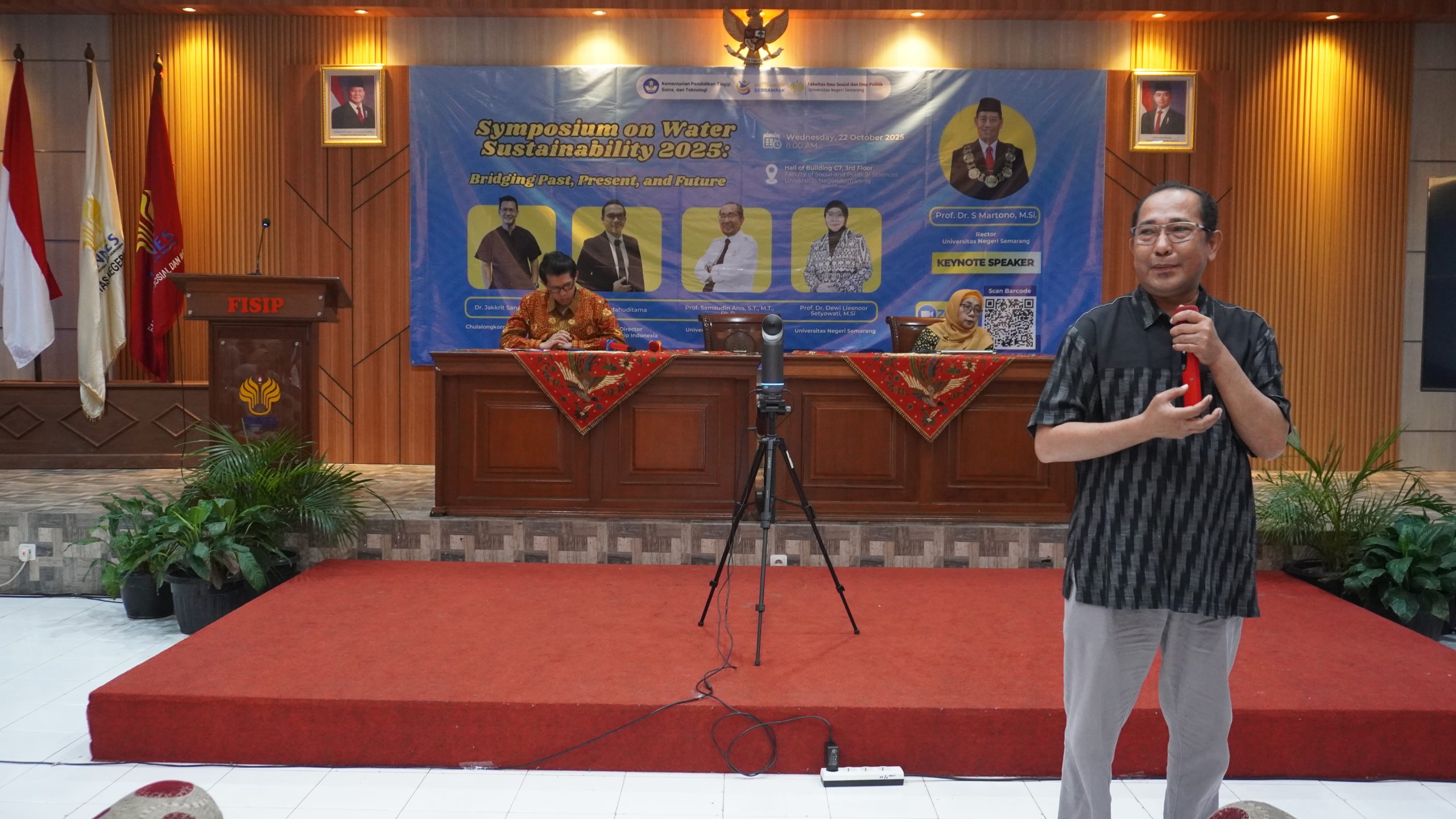
The Faculty of Social Sciences and Political Science (FISIP), Universitas Negeri Semarang (UNNES), held the Symposium on Water Sustainability 2025 under the theme “Bridging Past, Present, and Future” on October 22, 2025, at the C7 Building Auditorium, 3rd Floor, FISIP UNNES. The event was officially opened by the Vice Rector I for Academic and Student Affairs, Prof. Dr. Zaenuri, M.Si., Akt., and attended by academics, practitioners, and students from various universities, with a total of 82 scientific articles presented.
The symposium featured prominent experts on water and environmental issues from both Indonesia and abroad. In Keynote Session 1, Fany Wedahuditama (Executive Director of Water Stewardship Indonesia – WSI) and Dr. Jakkrit Sangkhamanee (Chulalongkorn University, Thailand) emphasized the importance of cross-sector collaboration in achieving equitable water resource management. Fany Wedahuditama elaborated on the concept of Water Stewardship as a stakeholder-based participatory approach aimed at ensuring the fair, sustainable, and economically valuable use of water resources. Meanwhile, Dr. Jakkrit highlighted the significance of cultural and social perspectives in understanding the politics of water resources in Southeast Asia.
In Keynote Session 2, Prof. Samsudin Anis, Ph.D. (Faculty of Engineering, UNNES) presented innovations in the Atmospheric Water Maker (AWM), an air-to-water technology capable of converting atmospheric humidity into potable water. This technology supports the achievement of Sustainable Development Goal (SDG) 6, ensuring access to clean water and sanitation for all, particularly in drought-prone and disaster-affected areas. Prof. Dr. Dewi Liesnoor, M.Si. (FISIP UNNES) complemented the session with a presentation on the urgency of water literacy and conservation education to raise public awareness about sustainable water resource management.
In addition to the plenary sessions, the symposium also featured eight thematic panel discussions covering key issues such as Women’s Engagement in Water Usage, Water and Local Wisdom, Politics of Water Resources, Water, Disaster, and Climate Change, Water Sustainability, Water Access and Social Justice, Water History, and Water and Environmental Education. Researchers presented ideas on local wisdom in water management, the role of women in water conservation, and social justice in access to clean water.
Through this event, FISIP UNNES demonstrated its commitment as a Conservation University actively promoting interdisciplinary and international scientific collaboration on environmental sustainability issues. The Symposium on Water Sustainability 2025 serves as a crucial momentum to strengthen the role of academia in supporting the achievement of the Sustainable Development Goals (SDGs), particularly Goals 6 (Clean Water and Sanitation), 11 (Sustainable Cities and Communities), and 13 (Climate Action).
The event reaffirmed that water sustainability is not merely a technical issue but also a social, cultural, and political challenge—requiring cross-sector collaboration to achieve a more resilient and equitable future for all humankind.