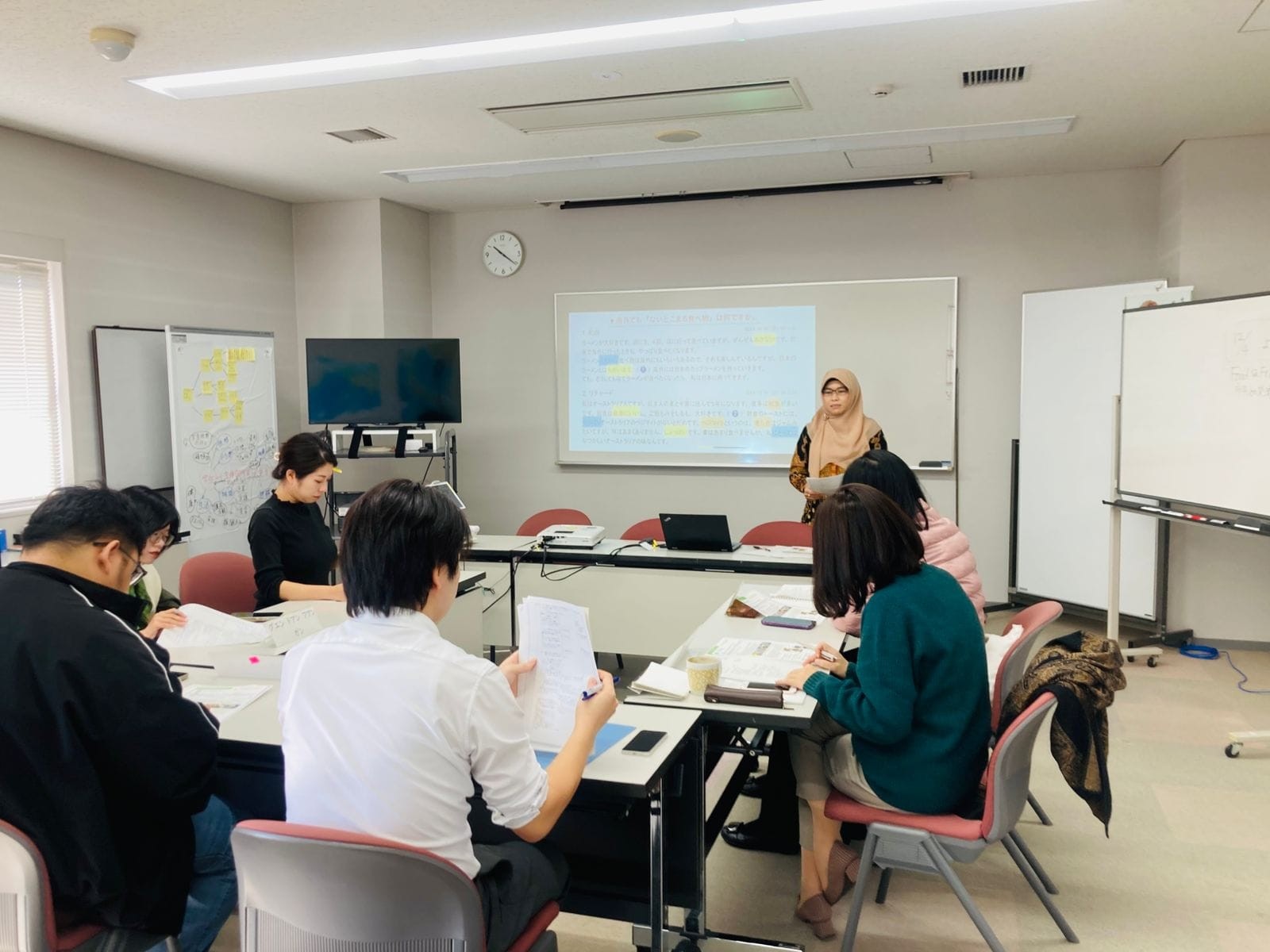
Quality education is one of the main pillars in achieving the Sustainable Development Goals (SDGs). This is reflected in academic development activities with materials on Jugyou kaizen (improvement of learning), Ryuugaku Sokushin (promotion and facilitation of further studies/studies abroad), and Sougou Enshuu: Nihongo Un’you, Bunpou, Dokkai (integrated exercises: Japanese language usage, grammar, and reading). This activity was organized by the Hiroshima Prefectural Government and took place from October 20 to December 17, 2025.
The activity was attended by six participants from Indonesia and Vietnam as part of international cooperation in the field of education. One of the participants from Indonesia was Heni Hernawati, a representative of Semarang State University (UNNES) from the Japanese Language Education Study Program.
The Jugyou kaizen (learning improvement) material emphasized the importance of improving the quality of the teaching and learning process through the application of communicative, reflective, and learner-centered methods. This approach is in line with SDG 4 (Quality Education), particularly in efforts to improve the quality of foreign language learning in higher education.
Meanwhile, the Ryuugaku sokushin (promotion of advanced studies and academic mobility) material aims to encourage cross-border exchanges of students and lecturers. This program supports the strengthening of global insight and international cooperation, which is in line with SDG 17 (Partnerships for the Goals).
The Sougou Enshuuu: Nihongo Un’you, Bunpou, Dokkai (integrated training in Japanese language use, grammar, and reading comprehension) material focuses on strengthening overall language proficiency. This activity trains communication skills, linguistic accuracy, and text comprehension, while also developing critical thinking and cross-cultural understanding. These aspects are related to SDG 8 (Decent Work and Economic Growth), as foreign language proficiency is an important asset in the global workplace.
Through this activity, it can be concluded that improving the quality of Japanese language learning not only has an impact on academic abilities but also contributes to the achievement of the SDGs. The participation of Heni Hernawati as a representative of the UNNES Japanese Language Education Study Program is expected to make a real contribution to the development of Japanese language learning in Indonesia and strengthen sustainable educational cooperation between Indonesia, Vietnam, and Japan.