Semarang, October 2025 – In support of the Sustainable Development Goals (SDGs)—particularly SDG 4 (Quality Education), SDG 13 (Climate Action), and SDG 17 (Partnerships for the Goals)—the Faculty of Mathematics and Natural Sciences (FMIPA) of Universitas Negeri Semarang (UNNES) has reaffirmed its leadership in advancing sustainability-oriented education through the successful organization of the 15th National Science Seminar.
Held online via Zoom on Saturday, May 24, 2025, this annual scientific event was a collaboration between the Science Education Study Program and the Environmental Science Study Program of UNNES, in partnership with the Indonesian Science Educators Association (PPII). Carrying the theme “The Role of Environmental Science for Excellence in Science Education Towards a Golden Indonesia,” the seminar served as a strategic platform to integrate science education with environmental awareness—aligning with Indonesia’s vision of Indonesia Emas 2045.
The seminar was officially opened by Prof. Dr. Edy Cahyono, M.Si., Dean of FMIPA UNNES, followed by remarks from Prof. Parmin, M.Pd., Chair of PPII, and Rizki Nor Amelia, M.Pd., Chair of the Committee. The event drew 465 participants, including 155 paper presenters and 310 non-presenting attendees, representing diverse professions such as students, teachers, lecturers, and educational practitioners from 13 provinces across Indonesia—spanning Sumatra, Java, Kalimantan, and Sulawesi. This wide participation demonstrates strong national enthusiasm toward education-based environmental sustainability.
Three distinguished speakers presented in-depth insights bridging science education and environmental action:
🔹 Prof. Dr. Sarwanto, M.Si. from Universitas Sebelas Maret (UNS), addressed global challenges such as climate change and population growth, emphasizing the SETS (Science, Environment, Technology, Society) approach. He highlighted how this interdisciplinary framework enables educators to connect scientific understanding with social responsibility and environmental sustainability—directly supporting SDG 13 (Climate Action) through education-driven awareness and mitigation.
🔹 Nathan Setyawan, M.Eng. from the Central Java Regional Development Planning Agency (Bappeda), delivered a session titled “The Problem-Solving Role of Science Education in Addressing Environmental Issues and the Impacts of Climate Change in Central Java.” He underscored the need for synergy between academia and local government to develop community-based solutions. Among his proposed initiatives were the Thematic Spatial Environmental Parenting, Sustainable Community Development Projects, and Local Adiwiyata Schools Sisterhood, which aim to build environmental resilience through education and local empowerment—a manifestation of SDG 17 (Partnerships for the Goals).
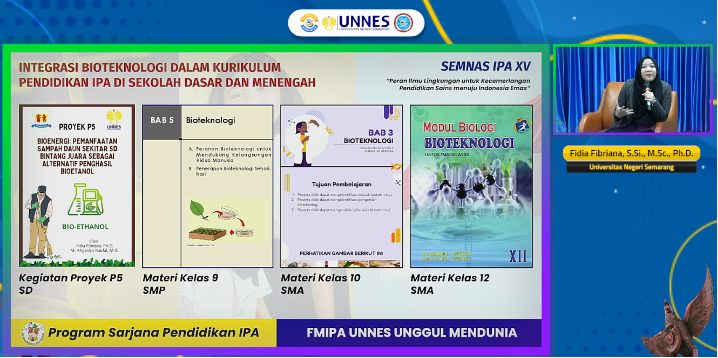
🔹 Dr. Fidia Fibriana, Ph.D. from UNNES, explored the role of biotechnology in science education and environmental management. She emphasized that contextual, inquiry-based science learning grounded in real-world environmental issues is essential to strengthening students’ environmental literacy—thereby realizing SDG 4 (Quality Education) through relevant and transformative teaching.
With hundreds of active participants and forward-looking discussions, the 15th National Science Seminar has evolved beyond an academic event—it has become a national movement promoting sustainable education, innovation, and collaboration. The discussions not only deepened understanding of how science education can address environmental challenges but also reinforced UNNES’s commitment as a Green and Sustainable University that integrates education, research, and community engagement to achieve the SDGs.
In his closing remarks, Prof. Dr. Edy Cahyono, M.Si., reaffirmed FMIPA UNNES’s dedication to advancing science education that empowers future generations to act for the planet.
“This seminar represents our ongoing commitment to link science education with environmental responsibility. Through partnerships and innovation, we aim to nurture a generation that is environmentally literate, resilient, and capable of leading Indonesia toward a sustainable and climate-resilient 2045,” he stated.
Through the 15th National Science Seminar, UNNES continues to champion the spirit of sustainable transformation, fostering collaborative, innovative, and inclusive science education that directly supports SDG 4, SDG 13, and SDG 17—paving the path toward a Golden and Green Indonesia 2045.