Strengthening Environmental Education for Sustainable Futures: UNNES Environmental Science FGD Supports SDGs Through Curriculum 2025

Universitas Negeri Semarang > Sustainable Development Goals Universitas Negeri Semarang > News > News > Strengthening Environmental Education for Sustainable Futures: UNNES Environmental Science FGD Supports SDGs Through Curriculum 2025

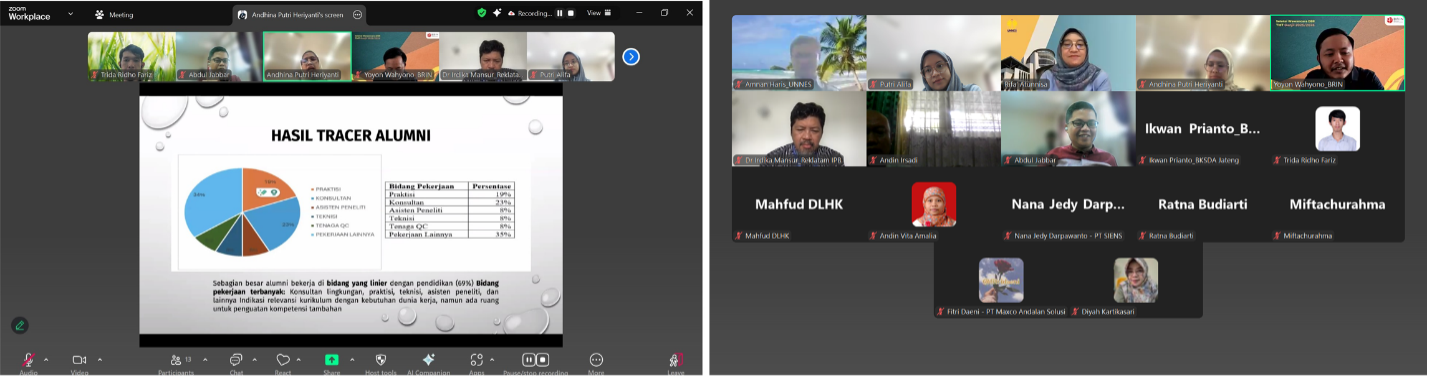
The Environmental Science Study Program, Faculty of Mathematics and Natural Sciences, Universitas Negeri Semarang (UNNES), continues to take progressive steps in strengthening its contribution to sustainable development and quality education in line with the Sustainable Development Goals (SDGs). On Tuesday, June 24, 2025, the program successfully held an online Focus Group Discussion (FGD) via Zoom, focusing on aligning its scientific vision and curriculum with the evolving needs of the job market in preparation for the implementation of the UNNES Curriculum 2025, which adopts the Outcome-Impactful Based Learning framework.

This FGD reaffirmed the program’s strong alignment with SDG 4 (Quality Education) and SDG 13 (Climate Action), as well as its contribution to SDG 12 (Responsible Consumption and Production) and SDG 15 (Life on Land). The initiative aims to ensure that environmental education at UNNES not only produces academically competent graduates but also individuals capable of driving sustainable solutions in society.

The discussion involved a diverse group of stakeholders—ranging from government agencies, environmental consultants, academics, NGOs, to alumni—ensuring a holistic perspective in the curriculum redesign. Key speakers included Dr. Mafut Munajat from the Central Java Provincial Office of Environment and Forestry (DLHK Jawa Tengah), Ir. Ratna Budiarti of PT Green Environesia Cendekia, Dr. Ir. Irdika Mansur from the Faculty of Forestry and Environment IPB University, Dr. Yoyon Wahyono, M.Ling from BRIN, and several practitioners and alumni from environmental industries and NGOs.

During the session, participants discussed graduates’ employability, identified competency gaps, and highlighted the importance of both soft and hard skills in today’s environmental sector. Emphasis was placed on enhancing critical thinking, systems thinking, communication, and academic writing—skills closely related to the demands of SDG 4 in ensuring inclusive and quality learning. Meanwhile, strengthening technical expertise in low-carbon development, climate resilience, circular economy, and triple planetary crisis mitigation reflects UNNES’s commitment to SDG 13 and SDG 12.

Another key insight from the FGD was the need to integrate foreign language proficiency and community-based environmental empowerment into the curriculum to prepare graduates for both global opportunities and local challenges. This aligns with SDG 17 (Partnerships for the Goals), emphasizing collaboration between universities, industries, and communities in achieving sustainable outcomes.

The Environmental Science Study Program reaffirmed its scientific vision—to advance environmental science through research and community service rooted in natural resource conservation and sustainable empowerment in rural, coastal, and industrial areas. This vision aims to produce innovative, adaptive, and globally competitive graduates capable of addressing complex environmental challenges.

Through this FGD, the Environmental Science Program at FMIPA UNNES demonstrated its concrete commitment to transforming environmental education into a force that supports the realization of the UNNES Sustainable University vision and global SDG agenda. The Curriculum 2025 is not only designed to enhance academic excellence but also to ensure that every learning outcome contributes directly to measurable environmental and societal impacts—creating graduates who are ready to make meaningful contributions to building a more sustainable and equitable world.
Related Posts

Leave a Reply

* Kode Akses Komentar:

* Tuliskan kode akses komentar diatas:

GDPR

  • Privacy Policy

Privacy Policy

At unnes.ac.id, the privacy of our visitors is of extreme importance to us. This privacy policy document outlines the types of personal information that is received and collected by unnes.ac.id and how it is used.

Log Files

Like many other Web sites, unnes.ac.id makes use of log files. The information inside the log files includes internet protocol (IP) addresses, type of browser, Internet Service Provider (ISP), date/time stamp, referring/exit pages, and number of clicks to analyze trends, administer the site, track user’s movement around the site, and gather demographic information. IP addresses and other such information are not linked to any information that is personally identifiable.

Cookies

unnes.ac.id uses cookies to store information about visitors’ preferences, to record user-specific information on which pages the site visitor accesses or visits, and to personalize or customize our web page content based upon visitors’ browser type or other information that the visitor sends via their browser.

Third-party ad servers or ad networks use technology in their respective advertisements and links that appear on unnes.ac.id and which are sent directly to your browser. They automatically receive your IP address when this occurs. Other technologies (such as cookies, JavaScript, or Web Beacons) may also be used by our site’s third-party ad networks to measure the effectiveness of their advertising campaigns and/or to personalize the advertising content that you see on the site.

unnes.ac.id has no access to or control over these cookies that are used by third-party advertisers.

You should consult the respective privacy policies of these third-party ad servers for more detailed information on their practices as well as for instructions about how to opt-out of certain practices. unnes.ac.id’s privacy policy does not apply to, and we cannot control the activities of, such other advertisers or web sites.

If you wish to disable cookies, you may do so through your individual browser options. More detailed information about cookie management with specific web browsers can be found at the browsers’ respective websites.

Consent

By using our website, you hereby consent to our privacy policy and agree to its terms.

Update

This Privacy Policy was last updated on: 2023-02-14. Should we update, amend or make any changes to our privacy policy, those changes will be posted here.

Contact Us

If you have any questions, comments, or concerns about our Privacy Policy or our practices with regards to your personal information, please feel free to contact us through the contact form on our website or by emailing us at humas[at]mail.unnes.ac.id.

This Privacy Policy is intended as a general guide to our practices in collecting and using information. If there is any inconsistency between this Privacy Policy and the terms of the Service Agreement or any other terms that may apply to specific services you use, then those specific service terms shall apply.

Terms of Use

By using our website, you agree to abide by this Privacy Policy. If you do not agree with this Privacy Policy, please do not use our website. We reserve the right to update this Privacy Policy from time to time without prior notice. Please review our Privacy Policy periodically to check for changes. Your continued use of our website following the posting of changes to this Privacy Policy means that you accept the changes.

Thank you for reading our Privacy Policy. We are committed to protecting the privacy of our website visitors and will continue to update our Privacy Policy to ensure optimal protection.