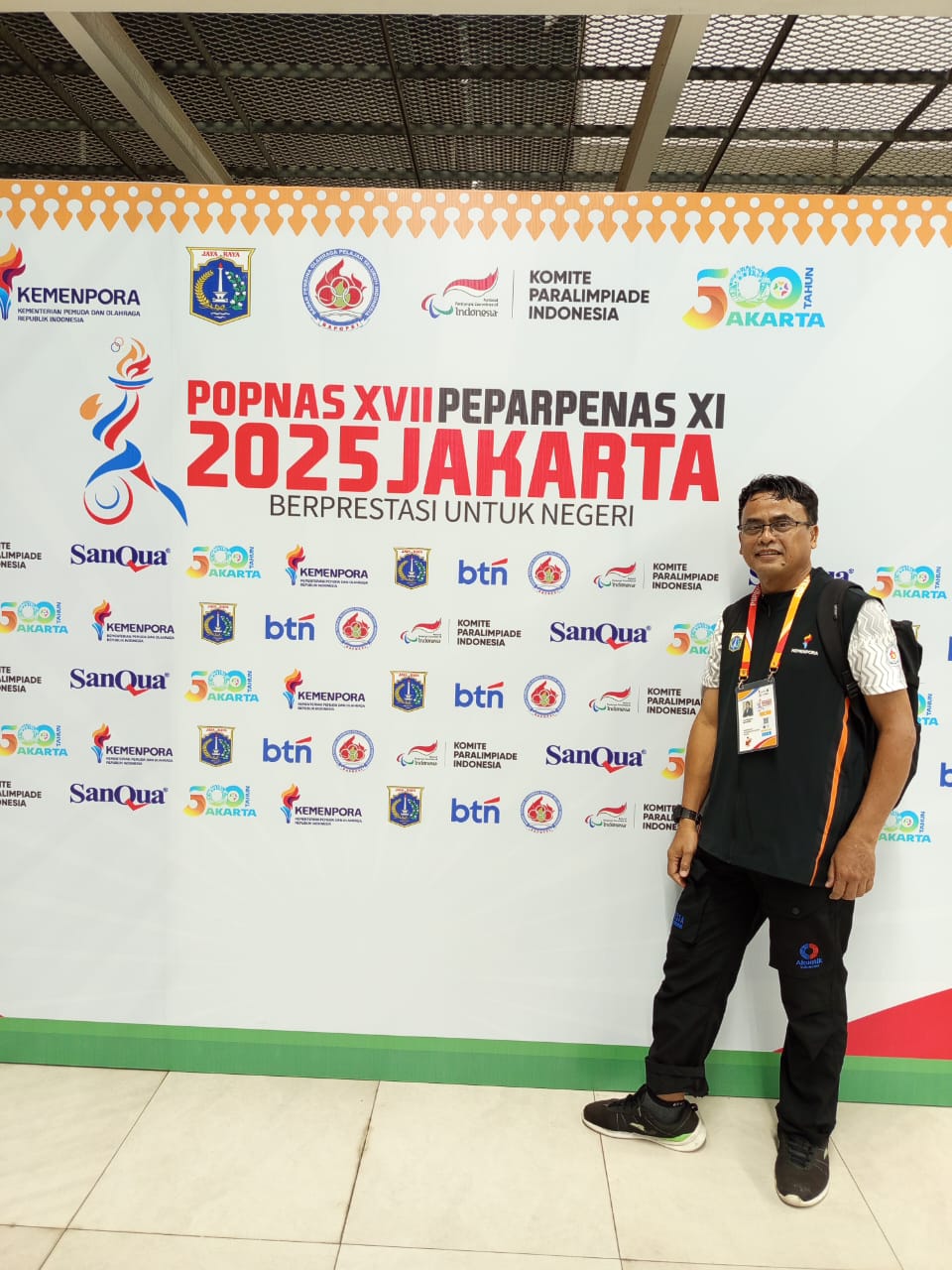
The dedication of an academic is not always visible in the lecture hall. For Tri Tunggal Setiawan, S.Pd., M.Kes., that dedication flows strongly at the edge of the swimming pool, as he has been entrusted with the role of Technical Official at the POPNAS XVII and PEPARPENAS XI 2025 events from November 2 to 8, 2025, at the Gelora Bung Karno Swimming Pool in Senayan, Jakarta. As both an academic and a practitioner, Tri Tunggal Setiawan’s presence embodies the integration of knowledge and dedication. He not only oversees the competition but also contributes to maintaining sportsmanship, providing technical guidance to the organizing committee, and ensuring that student athletes can compete in a safe and fair environment. Participating in national events like this is not just a professional duty but also a calling to make an impact on the development of student sports in Indonesia.
Tri Tunggal Setiawan’s activities as a Technical Official at POPNAS XVII and PEPARPENAS XI 2025 not only reflect professionalism in the field of sports but also have a strong connection with the goals of sustainable development or Sustainable Development Goals (SDGs). Through his role, he contributes directly to several important targets that drive community progress.
First, his involvement is in line with SDG 3: Good Health and Well-Being. The presence of a competent Technical Official ensures that the competition runs safely, orderly, and in accordance with sports health standards. By maintaining athlete safety, ensuring technical procedures are carried out correctly, and supporting a healthy competitive atmosphere, Tri Tunggal Setiawan encourages an active lifestyle while reinforcing the importance of physical and mental health for students. Events such as POPNAS and PEPARPENAS become real health education spaces, where sports are positioned as part of community welfare.
His role is also closely related to SDG 4: Quality Education. As an academic, his involvement in national events is a tangible form of integrating sports science into field practice. He is not only present as a technical professional, but also as an educator who brings the values of sportsmanship, discipline, and fair play into the competition ecosystem. The experience and technical guidance provided also become a source of contextual learning for students, committees, and the sports community. This enriches the educational process and ensures that the knowledge taught does not stop at theory but flows into relevant practice.
In addition, his contribution also supports SDG 17: Partnerships for the Goals. His involvement in national events demonstrates a strong partnership between universities—in this case, UNNES—and sports organizations such as Akuatik Indonesia. This synergy shows how cross-institutional collaboration can have a positive impact on the development of young talent, the improvement of sports events, and the strengthening of professionalism at the national level. This partnership is an example of how cooperation between various parties is the key to success in achieving sustainable development goals.