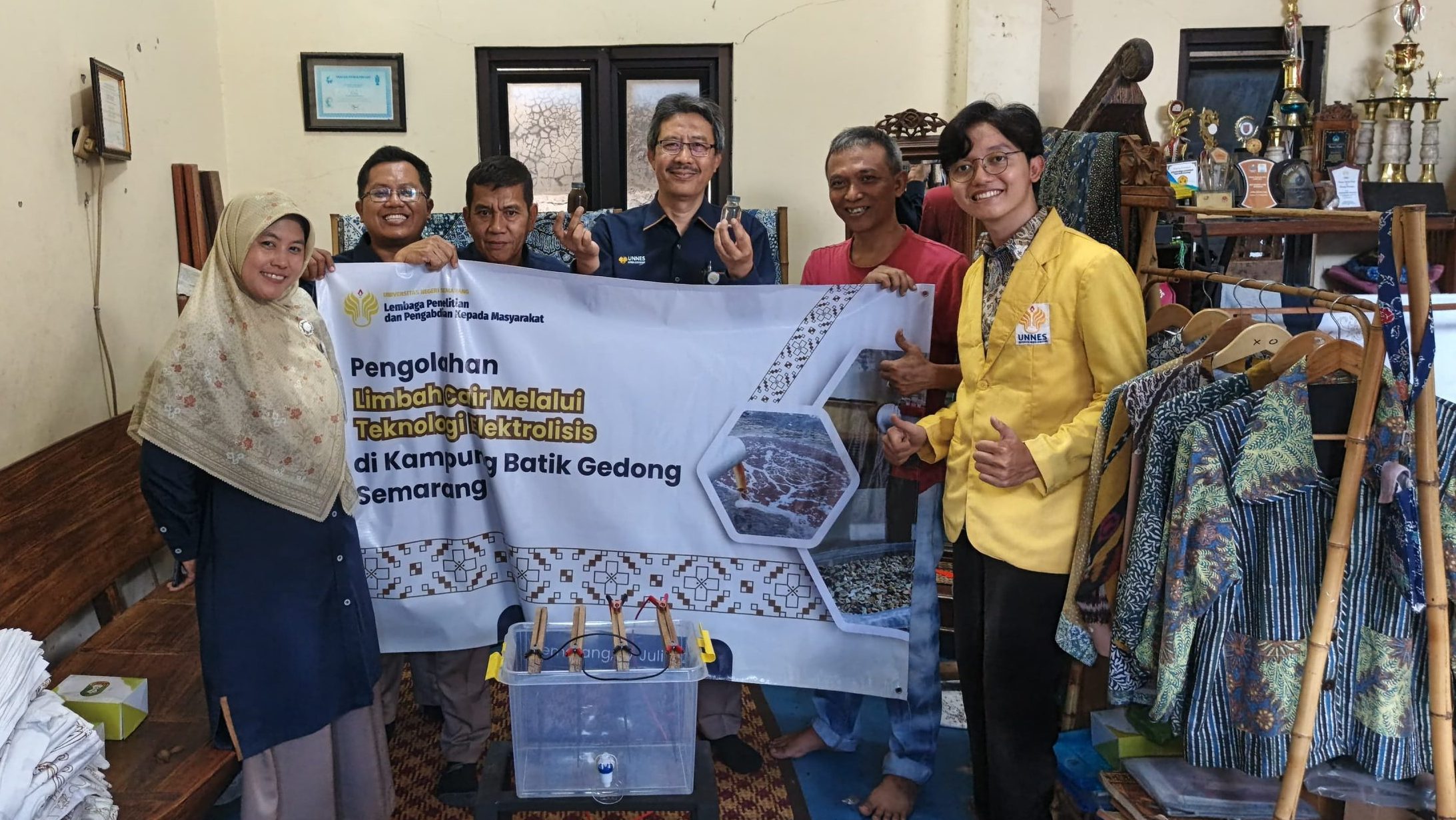
A community service team from Universitas Negeri Semarang (UNNES) conducted a community engagement program in Kampung Batik, Semarang, on Monday (July 7, 2025). This activity is part of a lecturer service program funded by the Institute for Research and Community Service (LPPM) UNNES, aiming to introduce appropriate technology for batik wastewater treatment.
Held at the residence of Mr. Eko Haryanto, a local batik artisan, the initiative introduced a household-scale electrolysis device. This tool is designed to purify batik wastewater through particle separation facilitated by electric current and electrodes, significantly reducing the color intensity and turbidity of the wastewater.
The program was led by Prof. Dr. Nur Qudus, M.T., IPM., and involved several interdisciplinary faculty members: Dr. Harianingsih, S.T., M.T. from Chemical Engineering, Drs. Bambang Sugiyarto, M.T. from Civil Engineering, and Virgiawan Adi Kristianto, S.Pd., M.Ed. from Building Engineering Education. Additionally, three students from the Chemical Engineering Department, Indra Sakti Pangestu, Isnina Noor Ubay, and Savira Rinda Erliana, supported the activity.
The session began with a presentation on the concept and operational principles of the electrolysis device, followed by a hands-on demonstration using the prototype developed by the team. The one-gallon capacity tool demonstrated promising results in purifying batik wastewater, effectively transforming dark, tea-colored water into clearer, cleaner effluent. Its small size and user-friendly operation make it highly suitable for household-scale batik industries.
An evaluation conducted with the partner artisan revealed that Mr. Eko Haryanto’s knowledge of wastewater treatment increased from 60% to 80%, while his practical skills in operating the device improved from 50% to 75%. He also expressed strong interest in integrating the device into his existing wastewater management practices.
“I now have a clear understanding of how this device works. We plan to apply and further develop it, integrating it with our current wastewater treatment methods. We are very grateful for this initiative,” stated Eko.
On the occasion, Prof. Dr. Nur Qudus expressed his hope that this community service effort would not remain a one-time academic activity but could evolve and be continuously applied in the field to address real-world environmental challenges.
“Innovations like this electrolysis device are expected to offer practical and affordable solutions for batik MSMEs, many of which still lack adequate wastewater treatment systems,” said Prof. Nur Qudus.
This initiative also contributes to the achievement of the Sustainable Development Goals (SDGs), particularly SDG 6 (clean water and sanitation), SDG 12 (responsible consumption and production), SDG 13 (climate action), and SDG 14 (life below water).
As part of the Diktisaintek Berdampak program, this initiative exemplifies the tangible application of science and technology in addressing environmental issues within communities. By delivering impactful, research-based innovations, UNNES reaffirms its commitment to bridging academic knowledge and practical solutions in support of inclusive and participatory sustainable development.