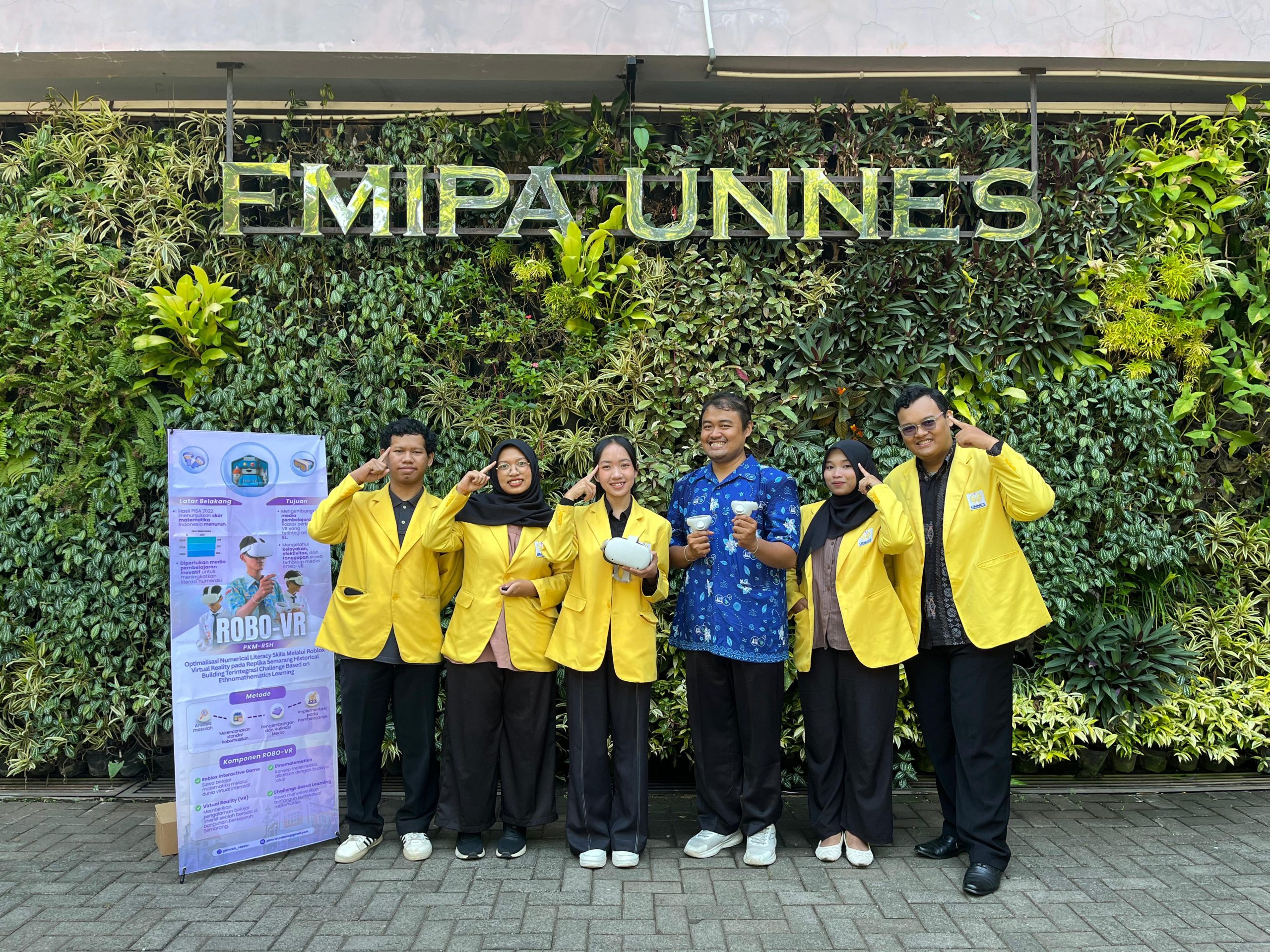
The Student Creativity Program–Research and Social Humanities (PKM-RSH) team from Universitas Negeri Semarang (UNNES) has introduced an innovative breakthrough in education through the development of a technology-based learning medium called ROBO-VR. This innovation is designed to optimize students’ numerical literacy skills through immersive learning experiences.
The initiative was developed by a team from the Mathematics Education Study Program, led by Mey Tri Anggraheni, with team members Hasna’ Azzah Yumna, Nisirna Paramita Hanifah, Farhan Ashidiqi, and Muhammad Rafi’ul Annam, under the supervision of Adi Satrio Ardiansyah, S.Pd., M.Pd.
Mey explained that ROBO-VR is a learning medium that integrates the Roblox platform with virtual reality (VR) technology. The learning design adopts a challenge-based model grounded in ethnomathematics, featuring Semarang’s historical landmarks such as Gereja Blenduk, Lawang Sewu, and Marba Building. Through this innovation, students not only learn mathematical concepts but also gain knowledge about the city’s cultural heritage.
“We aim to create an engaging and interactive learning atmosphere where students do not merely grasp the concept of surface area in three-dimensional shapes abstractly, but can also relate it to real-life contexts,” Mey stated.
The innovation was inspired by the low level of numerical literacy skills in Indonesia. Through ROBO-VR, the team seeks to help teachers provide more contextual, engaging, and relevant mathematics learning suited to the characteristics of today’s digital generation while simultaneously enhancing students’ numerical literacy skills.
Furthermore, this educational innovation aligns with the Sustainable Development Goals (SDGs), specifically Goal 4 – Quality Education, which emphasizes inclusive and equitable quality education and the promotion of lifelong learning opportunities for all. By integrating Roblox and VR into mathematics learning, the subject is expected to no longer be perceived as difficult or monotonous, but rather as an immersive and enjoyable learning experience.
Based on implementation at SMP Negeri 23 Semarang, ROBO-VR has proven to be feasible, effective, and well-received in optimizing students’ numerical literacy skills. Students reported finding it easier to understand the concept of surface area in three-dimensional shapes, which they previously considered abstract. Mathematics teachers at the school also praised the medium, expressing enthusiasm to adopt it in their teaching practices.