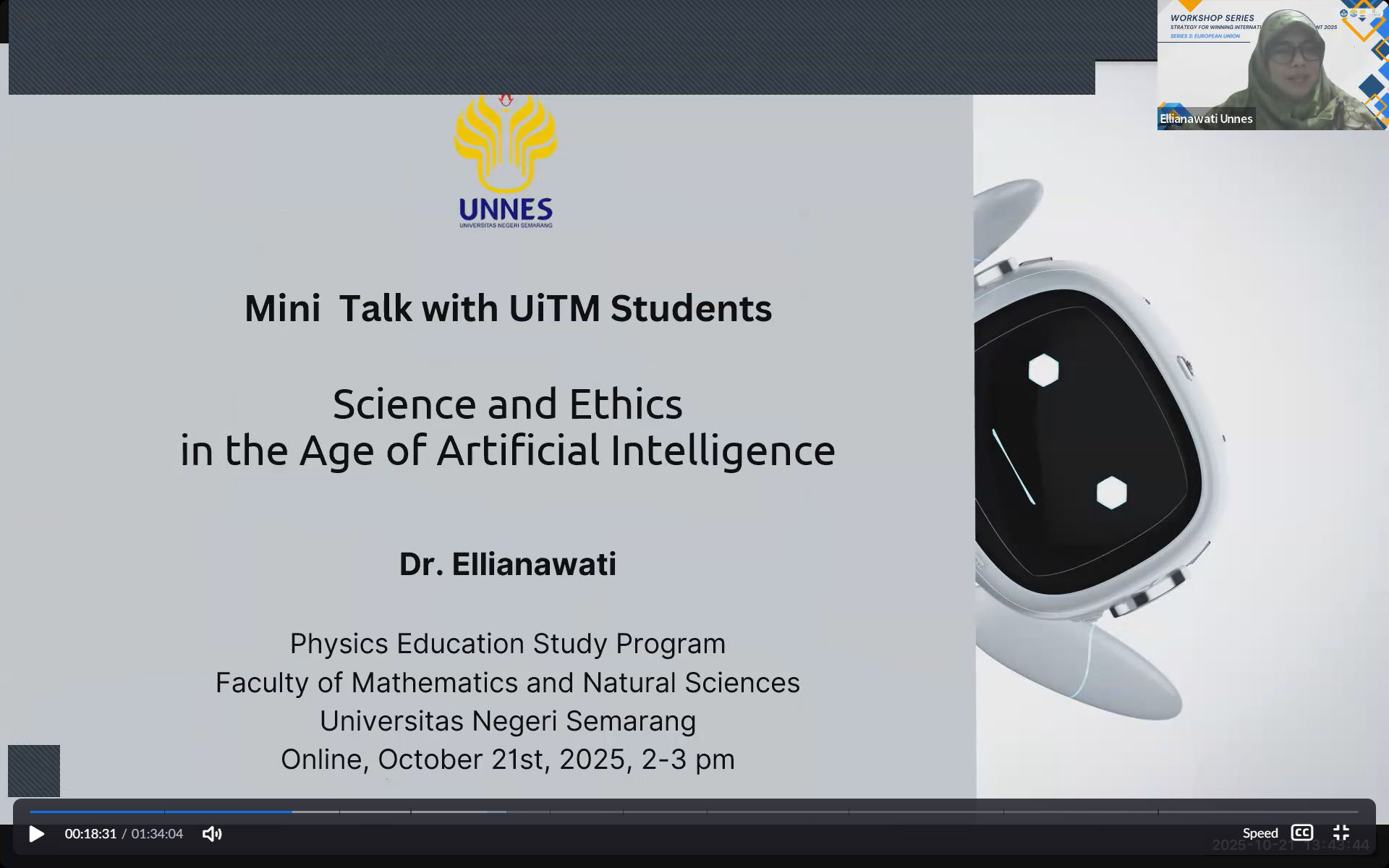
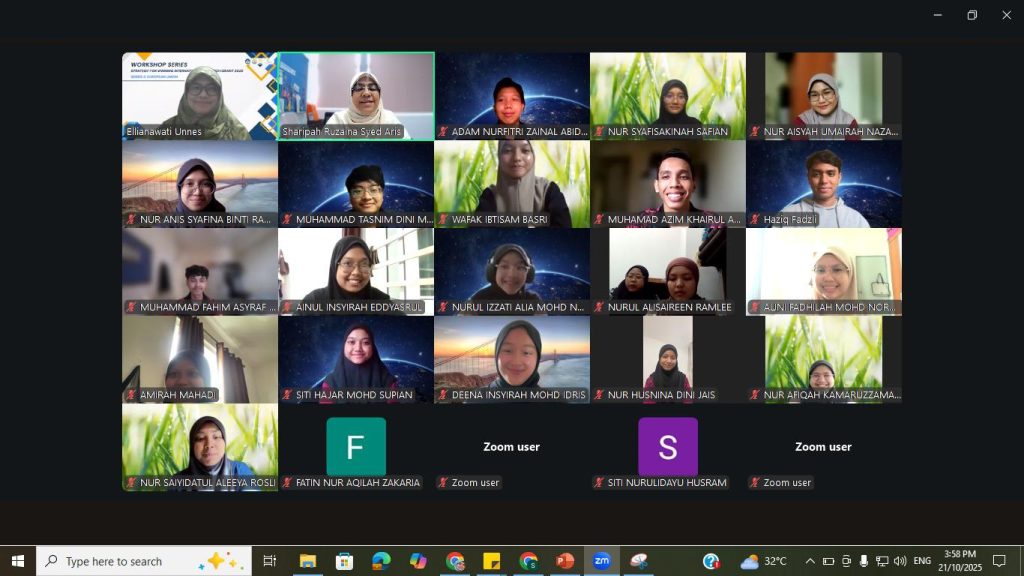
Universitas Negeri Semarang (UNNES) continues to strengthen its international academic collaboration through a Mini Talk with students from Universiti Teknologi MARA (UiTM), Malaysia. The event, held virtually via Zoom, featured Dr. Ellianawati, lecturer at the Physics Education Study Program, Faculty of Mathematics and Natural Sciences (FMIPA) UNNES, who presented a talk on “Artificial Intelligence (AI) in Education: Benefits, Challenges, and Ethical Considerations.”
This activity is part of a series of international collaborative research initiatives under the Matching Grant Scheme, involving six universities from six countries, with UiTM Malaysia as one of the participating institutions. The research collaboration, led by Dr. Ellianawati and funded by the 2025 DPA Research and Community Service Institute (LPPM) UNNES, aims to strengthen international research collaboration in science and technology education and to promote ethical digital literacy in the era of artificial intelligence. This aligns with the goals of Sustainable Development Goal (SDG) 4: Quality Education and SDG 9: Industry, Innovation, and Infrastructure, which emphasize the integration of technology and ethics to support inclusive, equitable, and innovative education.
Participants of the Mini Talk were Mathematics Education students from UiTM, who are currently taking STEM (Science, Technology, Engineering, and Mathematics) and STS (Science, Technology, and Society) courses under the supervision of Prof. Dr. Sharipah Ruzaina Syed Aris. This academic event served as an interactive international forum connecting scientific issues with human values and ethical responsibilities among future scientists and educators, embodying the spirit of SDG 17: Partnerships for the Goals through meaningful cross-border academic engagement.
In her presentation titled “Science and Ethics in the Age of Artificial Intelligence,” Dr. Ellianawati explained the development of AI from the 1950s to the present. She discussed how algorithmic bias emerged as AI systems began learning from human-generated data, which often reflects social bias. One notable example she highlighted was the research conducted by Joy Buolamwini from the MIT Media Lab, who found that facial recognition systems from major companies, such as IBM and Microsoft, were less accurate in recognizing women and individuals with darker skin tones. Buolamwini’s study, titled “Gender Shades,” became a global milestone in raising awareness about algorithmic fairness and responsible innovation — a key aspect of SDG 9.
Another topic that drew strong interest from participants was data privacy and the concept of the “data shadow” — the invisible digital footprint left by technology users in their online activities. Dr. Ellianawati emphasized that, “Your data shadow is like your digital fingerprint — invisible, permanent, and powerful. If you don’t protect it, someone else will use it to shape your world.” The message served as a powerful reminder for students to be more cautious, responsible, and ethical in managing their personal information online, reinforcing digital literacy and ethical awareness as components of SDG 4.
The discussion also covered ethical issues in genetic engineering, including the case of Chinese scientist Dr. He Jiankui, who edited human embryos using CRISPR technology without proper ethical approval. This case was presented as an extreme example of how science without ethics can threaten the essence of humanity — emphasizing the need for education systems that integrate technological advancement with moral responsibility.
The session concluded with an interactive quiz and reflective discussion on AI ethics and scientific responsibility, which the UiTM students joined enthusiastically. Through this Mini Talk, UNNES and UiTM not only strengthened their international research network but also fostered critical awareness, ethical responsibility, and digital literacy among students across nations.
This initiative supports SDG 4 (Quality Education) by promoting ethical and inclusive learning, SDG 9 (Industry, Innovation, and Infrastructure) by integrating AI and technological innovation into education, and SDG 17 (Partnerships for the Goals) by building sustainable academic collaboration between institutions. It also aligns with UNNES’s vision as a University with a Conservation Perspective and International Reputation, committed to advancing knowledge that enlightens society while upholding human values and global cooperation.