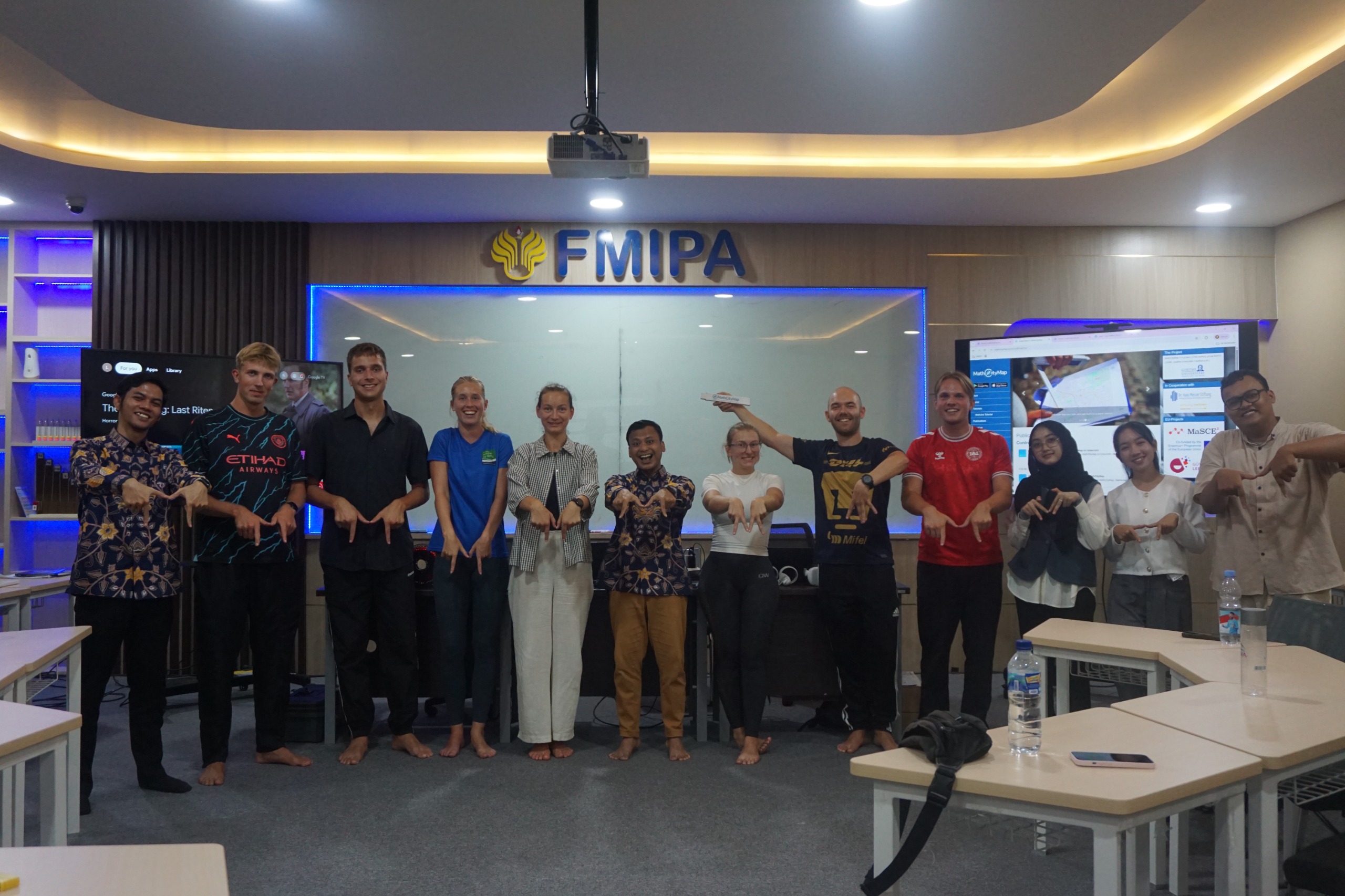
Semarang, October 28, 2025 – The Mathematics Laboratory of the Faculty of Mathematics and Natural Sciences (FMIPA), Universitas Negeri Semarang (UNNES), warmly welcomed seven students from Denmark on Tuesday (October 28, 2025). The visit was part of the Summer Camp Batch 2 program organized by Universitas Negeri Semarang, which aims to strengthen international academic cooperation and supports the achievement of Sustainable Development Goals (SDGs) point 17.
During the visit, the Mathematics Laboratory team — Wakhid Fitri Albar, S.Pd., M.Sc., Ahmad Badawi, S.Pd., M.Pd., Farhan Ashidiqi, Mey Tri Anggraheni, and Resty Kartika Sari — introduced a range of innovative mathematics learning approaches, including Math City Map, VR Math Trails, and 3D Printing Math Trails. These technology-based learning innovations reflect UNNES’s commitment to advancing SDG 9, particularly in the development of digital and creative educational infrastructure.
The students from VIA College Denmark showed great enthusiasm throughout the program. Following the presentation, they were invited to experience Math City Map activities firsthand through a series of field challenges designed to connect mathematical concepts with real-world contexts around the campus environment. This experiential learning model strongly supports SDG 4, as it promotes active learning, critical thinking, and contextual understanding among future educators.
The session was highly interactive, with participants demonstrating strong curiosity and engagement in exploring how contextual mathematics learning can be applied effectively in classroom settings. Interestingly, five out of the seven Danish students, who are future mathematics teachers, expressed their interest and commitment to implementing the Math City Map approach in their schools.
This activity not only strengthened the international collaboration between UNNES and overseas educational institutions, in line with SDG 17, but also reaffirmed the role of the Mathematics Laboratory of FMIPA UNNES as a hub for developing creative, contextual, and technology-driven innovations in mathematics education that contribute to SDG 4 and SDG 9.