SEMARANG – Semarang State University (Unnes) law expert Ali Masyhar Mursyid highlighted the phenomenon of flying the straw hat pirate flag from the anime One Piece, which began to flourish on the 80th anniversary of the Republic of Indonesia.
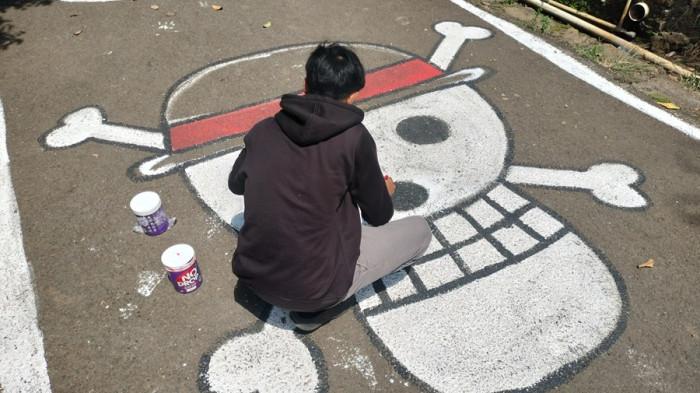
The image of a skull wearing a straw hat, an iconic symbol of fictional pirates in the One Piece series, was seen decorating several corners of villages, mural walls, and even flying as a flag on poles.
This then sparked curiosity and public debate.
Some people consider it a harmless expression of pop culture, but others view the flying of non-state symbols during a sacred moment such as August as a form of disrespect towards the state symbol.
Ali Masyhar Mursyid emphasized that the flying of fictional flags or non-state symbols such as pirate flags from anime must be viewed from three main aspects.
The context of time, the intent of the perpetrator, and the intensity of the event.
“If it is done outside of the independence moment and is not massive, I think it’s okay.”
“But if it happens in August, when the community is enthusiastic about flying the Red and White flag, and another symbol appears, this can be considered demeaning,” he explained to Tribunjateng.com, Sunday (3/8/2025).
Ali referred to Law No. 24 of 2009 on the National Flag, Language, and Anthem.
Article 24 (a) explicitly states that no one may commit acts intended to defile, insult, or degrade the honor of the national flag.
From a criminal law perspective, the most critical factor is the mens rea — the intent or internal attitude of the person.
“If the purpose is to rival, weaken, or diminish the authority of the national symbol, that could be legally problematic,”
“It could even fall under Article 66 of Law No. 24 of 2009, with criminal penalties,” he added.
Mural vs Flag
Ali also clarified the important difference between a mural (wall art) and a flag.
According to him, murals featuring anime characters or pirate symbols are still considered part of artistic expression, which enjoys broader freedom and doesn’t directly compete with the official national symbols.
“A mural is not the same as a flag.”
“Mural is a more open form of artistic expression.”
“As long as it’s not meant to mock or destroy, it’s generally acceptable,” he said.
However, when a symbol like the Jolly Roger is printed in flag format, raised on a pole — especially if it’s placed near or in place of the Red and White — it begins to enter the realm of legal and national ethics.
“The issue isn’t with the character, but the form and timing of the display.”
“The Red and White is the only official symbol of the nation.”
“Raising another flag during a time like Independence Day can be seen as creating a rival symbol,” he emphasized.
Misguided Social Critique?
Some netizens have claimed that raising the One Piece flag is a form of social critique — a statement that the Red and White is “too sacred” to be flown amid social inequality and governmental policies that are seen as distancing from the people.
Ali doesn’t dismiss the importance of critique, but says the method must be appropriate.
“Criticism is allowed — even essential — in a democracy.”
“But the national symbol is a unifier; it should not become the target of mockery or satire.”
“The government can be criticized, but the nation is bigger than its officials,” he emphasized.
Some netizens have claimed that raising the One Piece flag is a form of social critique — a statement that the Red and White is “too sacred” to be flown amid social inequality and governmental policies that are seen as distancing from the people.
Ali doesn’t dismiss the importance of critique, but says the method must be appropriate.
“Criticism is allowed — even essential — in a democracy.”
“But the national symbol is a unifier; it should not become the target of mockery or satire.”
“The government can be criticized, but the nation is bigger than its officials,” he emphasized.
Even though there is potential for legal violations, Ali advised that law enforcement should not act repressively at first.
Government and authorities should prioritize education and persuasion.
“We should first educate people that such actions could be seen as degrading the national flag.”
“If after being informed they still do it in a widespread manner, then legal steps may be necessary,” he said.
Ali also suggested that local governments and security forces begin drafting guidelines or circular letters to regulate the display of symbols in public spaces ahead of national celebrations.
The Limits of Expression and the Dignity of the Nation
Ultimately, the One Piece flag phenomenon opens the door for public discussion.
Legally, the line is clear: The Red and White cannot be rivaled, especially during the sacred atmosphere of independence celebrations.
The national flag is not just a piece of red and white cloth.
It represents history, struggle, and shared identity — a symbol that cannot be replaced by fictional characters, no matter how beloved they are by younger generations.