Learning Conservation from Local Wisdom: UNNES Social Studies Students Conduct a Community-Based Study on Rainwater Management

Universitas Negeri Semarang > Sustainable Development Goals Universitas Negeri Semarang > News > News > Learning Conservation from Local Wisdom: UNNES Social Studies Students Conduct a Community-Based Study on Rainwater Management

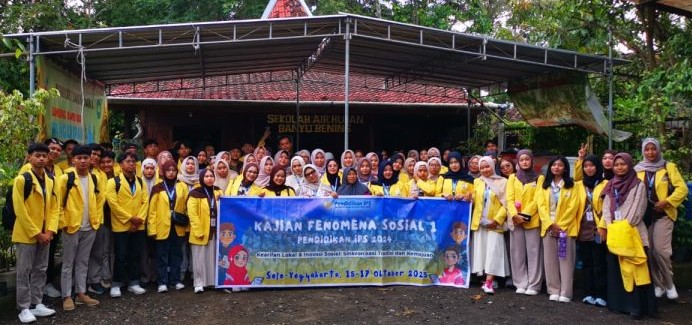
As part of a community-based learning program, 91 students and four lecturers from the Social Studies Education Program, Faculty of Social Sciences, Universitas Negeri Semarang (UNNES), conducted a field study titled “Kajian Fenomena Sosial I” at the Banyu Bening Rainwater School in Yogyakarta on October 15, 2025. This activity served as an experiential learning platform emphasizing environmental conservation and the preservation of local wisdom.

The group was warmly welcomed by the founder of the Rainwater School, who introduced the concept of “A school by the people, for the people” — a community-based educational initiative that utilizes rainwater as a source of life and a symbol of human–nature harmony. The accompanying lecturers expressed appreciation for the reception, emphasizing that the activity aligns with UNNES’s identity as a conservation-oriented university. “Students are encouraged to learn directly from communities that practice water conservation in simple yet impactful ways,” one lecturer explained.

The event commenced with the singing of the national anthem Indonesia Raya, followed by a collective prayer and an introduction to the rainwater management system developed by the Banyu Bening community. Students then participated in interactive discussions on rainwater utilization, covering topics such as purification processes, community acceptance, and the socio-cultural aspects of sustainable water use. The hosts explained that the success of rainwater conservation is not merely technological but also rooted in ecological awareness and a transformative mindset toward nature.

During the practical session, students learned about the stages of rainwater therapy — including collection, filtration, and quality testing — and had the opportunity to taste and apply the processed water in daily contexts. Many students expressed surprise that rainwater can be transformed into clean, fresh water through proper management and knowledge.

The activity concluded with a group photo and the collective chant “Salam Air Hujan — Berkah, Berkah, Berkah!” (“Rainwater Greetings — Blessings, Blessings, Blessings!”), symbolizing the spirit of collaboration between students and the local community. Through this initiative, UNNES students not only expanded their socio-ecological understanding but also practiced the core values of environmental conservation that define the university’s vision.

This field study contributes directly to the achievement of several Sustainable Development Goals (SDGs):

  • SDG 6 (Clean Water and Sanitation): by promoting sustainable rainwater management and community-based clean water access.
  • SDG 13 (Climate Action): by fostering ecological awareness and adaptive behavior toward climate change.
  • SDG 14 (Life Below Water): indirectly, by reducing land-based pollution and runoff that affect marine ecosystems through responsible freshwater management.

Ultimately, the activity reflects the integration of education, community empowerment, and environmental stewardship — embodying the spirit of sustainability and local wisdom in action.
Related Posts

Leave a Reply

* Kode Akses Komentar:

* Tuliskan kode akses komentar diatas:

GDPR

  • Privacy Policy

Privacy Policy

At unnes.ac.id, the privacy of our visitors is of extreme importance to us. This privacy policy document outlines the types of personal information that is received and collected by unnes.ac.id and how it is used.

Log Files

Like many other Web sites, unnes.ac.id makes use of log files. The information inside the log files includes internet protocol (IP) addresses, type of browser, Internet Service Provider (ISP), date/time stamp, referring/exit pages, and number of clicks to analyze trends, administer the site, track user’s movement around the site, and gather demographic information. IP addresses and other such information are not linked to any information that is personally identifiable.

Cookies

unnes.ac.id uses cookies to store information about visitors’ preferences, to record user-specific information on which pages the site visitor accesses or visits, and to personalize or customize our web page content based upon visitors’ browser type or other information that the visitor sends via their browser.

Third-party ad servers or ad networks use technology in their respective advertisements and links that appear on unnes.ac.id and which are sent directly to your browser. They automatically receive your IP address when this occurs. Other technologies (such as cookies, JavaScript, or Web Beacons) may also be used by our site’s third-party ad networks to measure the effectiveness of their advertising campaigns and/or to personalize the advertising content that you see on the site.

unnes.ac.id has no access to or control over these cookies that are used by third-party advertisers.

You should consult the respective privacy policies of these third-party ad servers for more detailed information on their practices as well as for instructions about how to opt-out of certain practices. unnes.ac.id’s privacy policy does not apply to, and we cannot control the activities of, such other advertisers or web sites.

If you wish to disable cookies, you may do so through your individual browser options. More detailed information about cookie management with specific web browsers can be found at the browsers’ respective websites.

Consent

By using our website, you hereby consent to our privacy policy and agree to its terms.

Update

This Privacy Policy was last updated on: 2023-02-14. Should we update, amend or make any changes to our privacy policy, those changes will be posted here.

Contact Us

If you have any questions, comments, or concerns about our Privacy Policy or our practices with regards to your personal information, please feel free to contact us through the contact form on our website or by emailing us at humas[at]mail.unnes.ac.id.

This Privacy Policy is intended as a general guide to our practices in collecting and using information. If there is any inconsistency between this Privacy Policy and the terms of the Service Agreement or any other terms that may apply to specific services you use, then those specific service terms shall apply.

Terms of Use

By using our website, you agree to abide by this Privacy Policy. If you do not agree with this Privacy Policy, please do not use our website. We reserve the right to update this Privacy Policy from time to time without prior notice. Please review our Privacy Policy periodically to check for changes. Your continued use of our website following the posting of changes to this Privacy Policy means that you accept the changes.

Thank you for reading our Privacy Policy. We are committed to protecting the privacy of our website visitors and will continue to update our Privacy Policy to ensure optimal protection.