Culture plays an important role in shaping the character of society and serves as a means of learning global values. One concrete example of the application of these values can be seen in the Cultural Experience and Japanese Life program organized by the Hiroshima Prefectural Government. This program runs from October 20 to December 17, 2025, and aims to introduce Japanese culture and society in relation to the Sustainable Development Goals (SDGs).
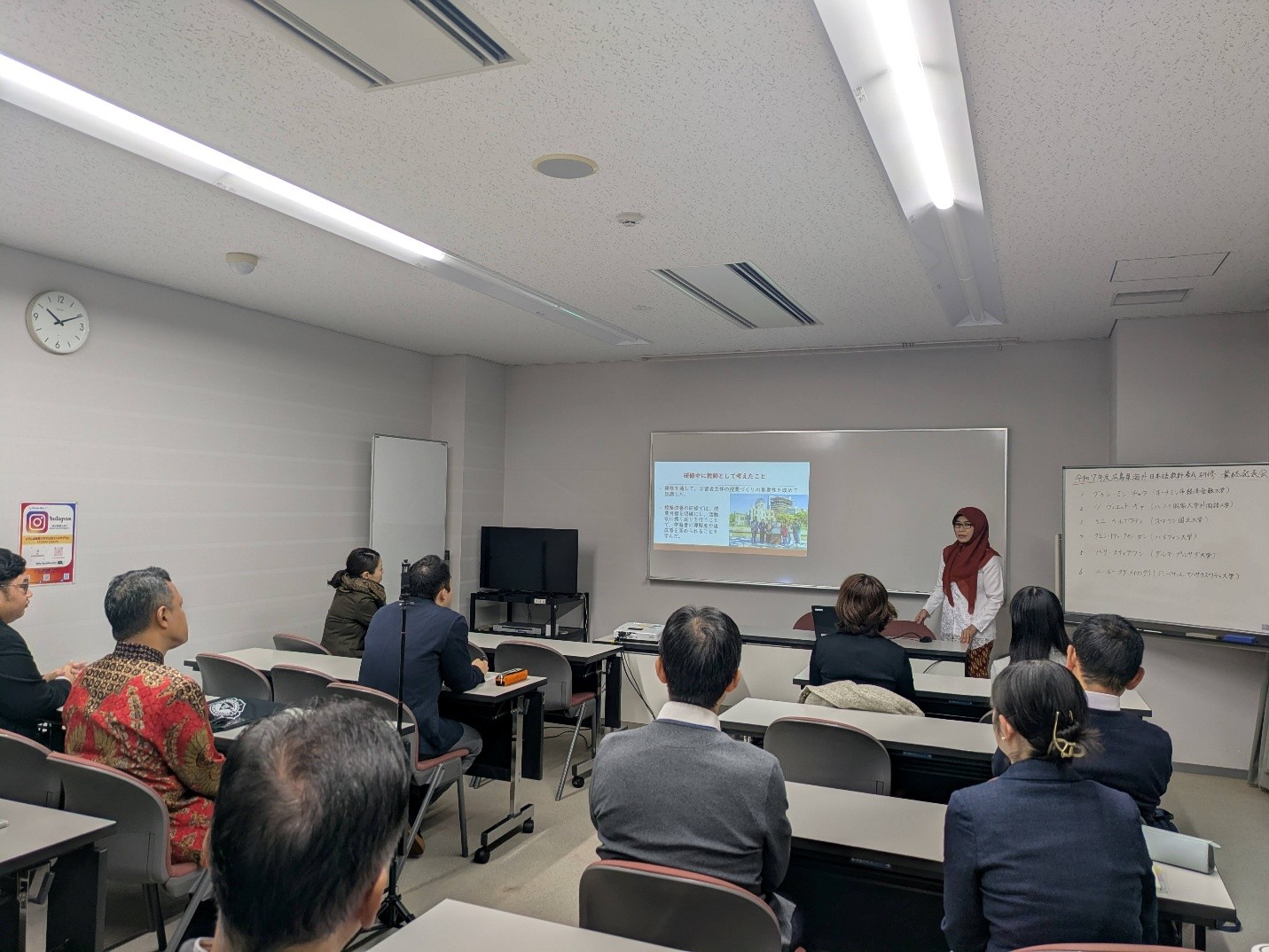
This activity was attended by six participants from Indonesia and Vietnam as a form of international cooperation and cultural exchange. One of the participants from Indonesia was Heni Hernawati, a representative of Semarang State University (UNNES) from the Japanese Language Education Study Program.
One of the main activities was a visit to the Genbaku Dome in Hiroshima. This historic site has become a symbol of world peace and a means of educating people about the impact of war on humanity. This activity is in line with SDG 16, which is to create peaceful, just, and inclusive societies. Participants also visited Miyajima Island, which is known for its natural beauty and cultural heritage. The local community’s way of life demonstrates a balance between nature conservation and tourism activities. This reflects the implementation of SDG 11 (Sustainable Cities and Communities) and SDG 15 (Life on Land). The next activity was a home visit. Participants had the opportunity to interact directly with Japanese families and understand their daily lives. This activity provides meaningful social and cultural learning, in line with SDG 4 (Quality Education) and SDG 17 (Partnerships for the Goals).
The activity of making okonomiyaki and bento serves as a learning tool about Japanese food culture, which emphasizes simplicity, nutritional balance, and reducing food waste. These values are in line with SDG 12 (Responsible Consumption and Production).
These values are in line with SDG 12 (Responsible Consumption and Production).
In addition, participants also wore yukata, traditional Japanese clothing, as a form of preserving local culture. This activity shows that modernization does not eliminate cultural identity, but can coexist with tradition, in line with SDG 11 in terms of preserving cultural heritage.
The experience of participating in the Japanese Tea Ceremony provides an understanding of the importance of tranquility, self-awareness, and mutual respect. One of the philosophies in the Japanese Tea Ceremony, Ichi go Ichi e, which means “Every encounter or moment in life happens only once and will never be repeated in the same way, so it should be appreciated wholeheartedly,” provides a deep understanding for each individual to appreciate every moment and every person. This ceremony not only has aesthetic value, but also supports SDG 3 (Good Health and Well-being), particularly in terms of mental health and life balance.
Through the Cultural Experience and Japanese Life activity, participants gained comprehensive cultural experiences while understanding the application of Sustainable Development Goals (SDGs) in Japanese society. This activity proves that culture can be an effective medium in supporting sustainable development and strengthening international cooperation. The participation of Heni Hernawati as a representative of the UNNES Japanese Language Education Study Program in this activity is expected to make a positive contribution to the development of Japanese language education and learning in Indonesia, as well as strengthen global understanding of the importance of culture in achieving sustainable development goals.