The rapid advancement of digital technology demands early introduction and literacy, including for students at the junior high school level. One of the modern manufacturing technologies now being introduced at the basic education level is the 3D Printer, also known as three dimensional printing technology.
This initiative became the focus of a community service program conducted by the Faculty of Engineering at Universitas Negeri Semarang (FT UNNES) at SMP Negeri 1 Margasari, Tegal Regency. During the opening ceremony on Saturday (28/06/2025), the Dean of FT UNNES, Prof. Dr. Wirawan Sumbodo, M.T., who is also an alumnus of the school, expressed his hope that technological developments, particularly in the field of digital manufacturing, could be introduced as early as junior high school.
“Technology literacy, such as 3D printing, should be introduced as early as junior high school. It is essential to foster students’ learning enthusiasm, innovative capacity, and future technology-based entrepreneurship,” stated Prof. Wirawan.
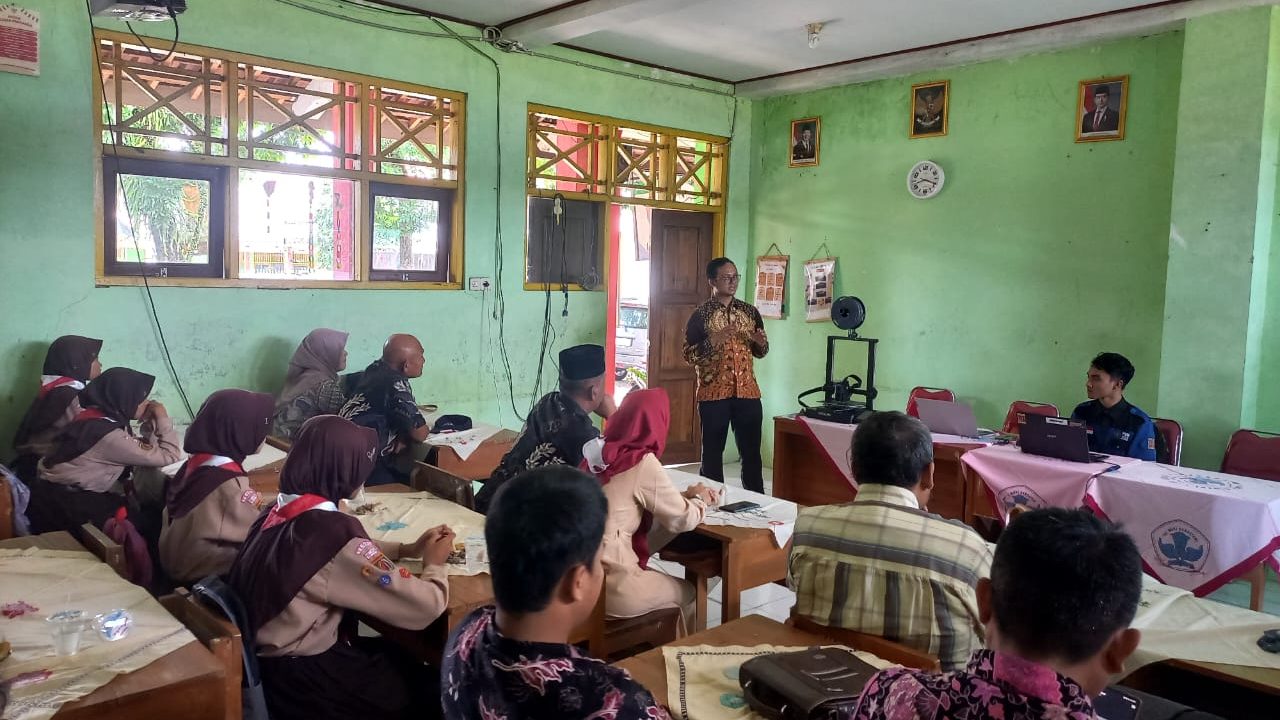
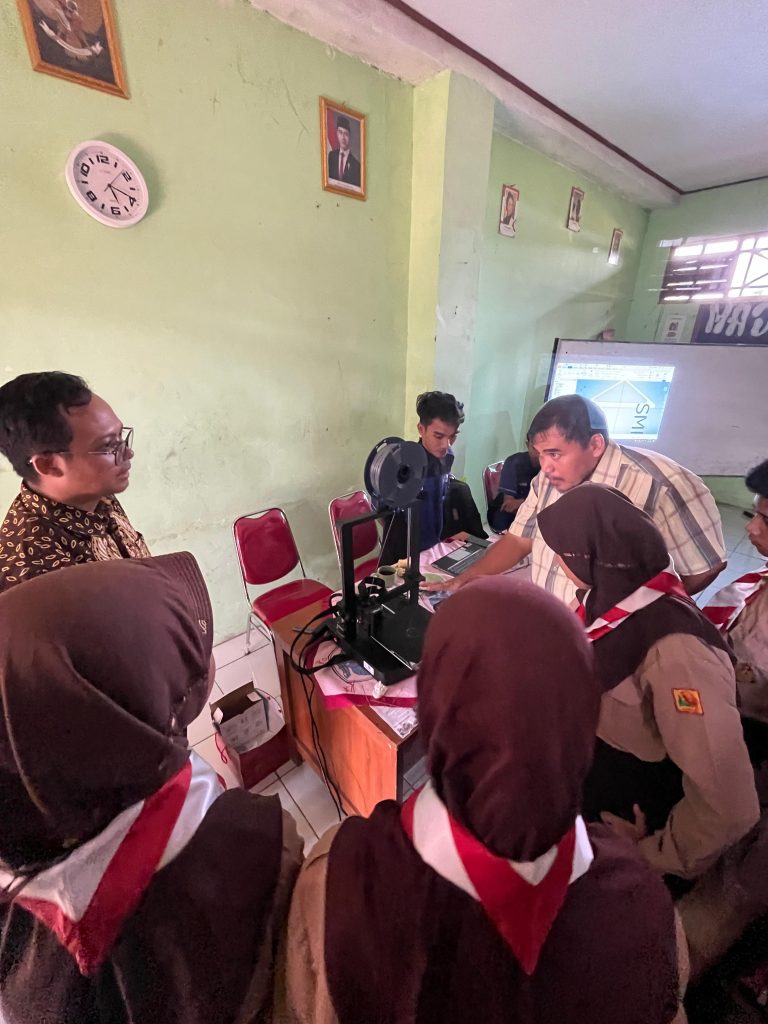
The training activity at SMP N 1 Margasari featured hands-on practice in operating an FDM (Fused Deposition Modeling) 3D printer, involving students, teachers, and alumni. The training was led by Rizki Setiadi, S.Pd., M.T., a lecturer from FT UNNES, supported by student assistants including Habib Bunajar (Automotive Engineering Education), Muhammad Khoirul Anam, and Rofex Pambudi (Mechanical Engineering Education).
The training began with an introduction to the 3D printer, followed by a usage demonstration, and continued with hands-on practice. One of the products created by the participants was a keychain made using filament recycled from discarded plastic bottles.
This environmentally friendly filament technology was developed by FT UNNES researcher M. Irfan Nuryanta, M.Eng., who successfully transformed waste plastic bottles (rPET) into functional 3D printing material. The process involved shredding, melting, and extruding the plastic bottles into filament, serving as a tangible example of circular economy innovation in education.
The Principal of SMP N 1 Margasari, Drs. Winarko, M.Pd., welcomed the program positively. In his remarks, he expressed appreciation for the training and the donation of a 3D printer unit by the FT UNNES team. He hoped the equipment would support practical and creative learning activities and encourage the emergence of technopreneurship products within the school environment.
“We hope students can utilize this technology to create original works and turn plastic waste into economically and educationally valuable materials,” he said.
This program also received support from alumni, including Sugeng Triyono, SE, MM, and his team, who joined the collaborative initiative as a form of commitment to the development of technology-based education in their hometown.
This program aligns with the following Sustainable Development Goals (SDGs):SDG 4-Quality Education: Enhancing inclusive and equitable quality education by integrating digital literacy and technology into early education, SDG 9-Industry, Innovation, and Infrastructure: Promoting inclusive and sustainable industrialization and fostering innovation through the use of advanced manufacturing technologies like 3D printing, and SDG 12-Responsible Consumption and Production: Encouraging the recycling of plastic waste and demonstrating principles of the circular economy through educational practices.
Through this activity, FT UNNES aims to ensure that technology-based learning approaches are not limited to higher education but can also be sustainably applied at the secondary school level, equipping younger generations to face future industrial challenges.