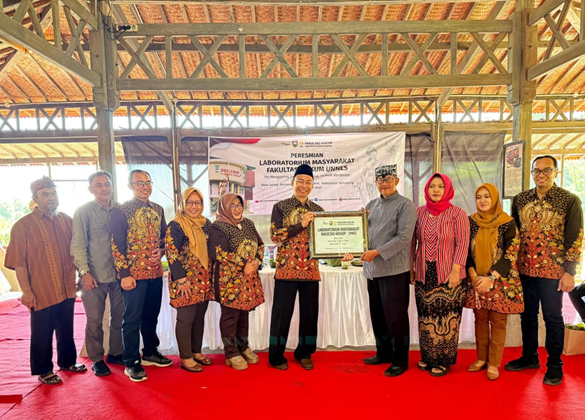
The Dean and the Faculty of Law leadership of UNNES, led by Dean Prof. Dr. Ali Masyhar, SH. MH., along with his staff, namely Vice Dean for Academic Affairs Dr. Indah Sri Utari, SH.MHum., Vice Dean for Resources and Planning Aprila Niravita SH. MKn., and Vice Dean for Business, Research, and Cooperation M. Azil Maskur., SH. MH., held an inauguration ceremony for the Community Laboratory located in Lerep Village, West Ungaran District, Semarang Regency, Central Java.
The Community Laboratory was established in response to the increasingly complex social, economic, technological, and environmental challenges in society. In this case, universities not only serve as centers of knowledge but also as drivers of social innovation capable of providing real solutions. The Community Laboratory is not merely an academic experimentation space, but a collaborative forum that brings together universities, village governments, and local communities to jointly identify problems, explore local potential, and formulate practical, contextual, and sustainability-oriented solutions for village development.
The purpose of the UNNES Faculty of Law Community Laboratory is to develop research and community service and to become a learning space with the main objective of increasing legal awareness and empowerment in the community, especially the community in the Lerep Village area. The presence of the UNNES Faculty of Law Community Laboratory is an innovative breakthrough that functions as a center for shared learning, a medium for research, and a forum for participatory empowerment. In addition to being a center for innovation, the UNNES Faculty of Law Community Laboratory also functions as a means of public education and a space for discussion within the community.
Furthermore, the socialization activities carried out in Lerep Village instilled a common understanding that village development cannot rely solely on government intervention, but requires the involvement of all parties, including the community itself. The socialization is also expected to encourage critical, innovative, and collaborative thinking among the community in facing various social, economic, and environmental challenges. Thus, the Community Laboratory can truly function as a shared platform to create local solutions to village problems while optimizing existing potential.
Lerep Village was chosen for a reason. This village is known as a tourist village with a wealth of culture, traditions, and local wisdom that are still preserved today. In addition, its natural and cultural potential, as well as the village government’s commitment to promoting development and empowerment programs, make Lerep Village a suitable and strategic location to serve as a pilot project for the implementation of the Community Laboratory concept.
With the socialization and presence of the Community Laboratory, it is hoped that the community will better understand that the program is not only for academic research purposes but is also aimed at providing tangible benefits for improving the quality of life of the village community.
The successful implementation of the Community Laboratory socialization program has been made possible thanks to the collaboration that has been established between the Faculty of Law at UNNES, the Head of Lerep Village, Mr. Sumariyadi, S.T., all village officials, especially the Village Secretary, Mrs. Sri Lestari, and the community of Lerep Village, West Ungaran District, Semarang Regency, Central Java.