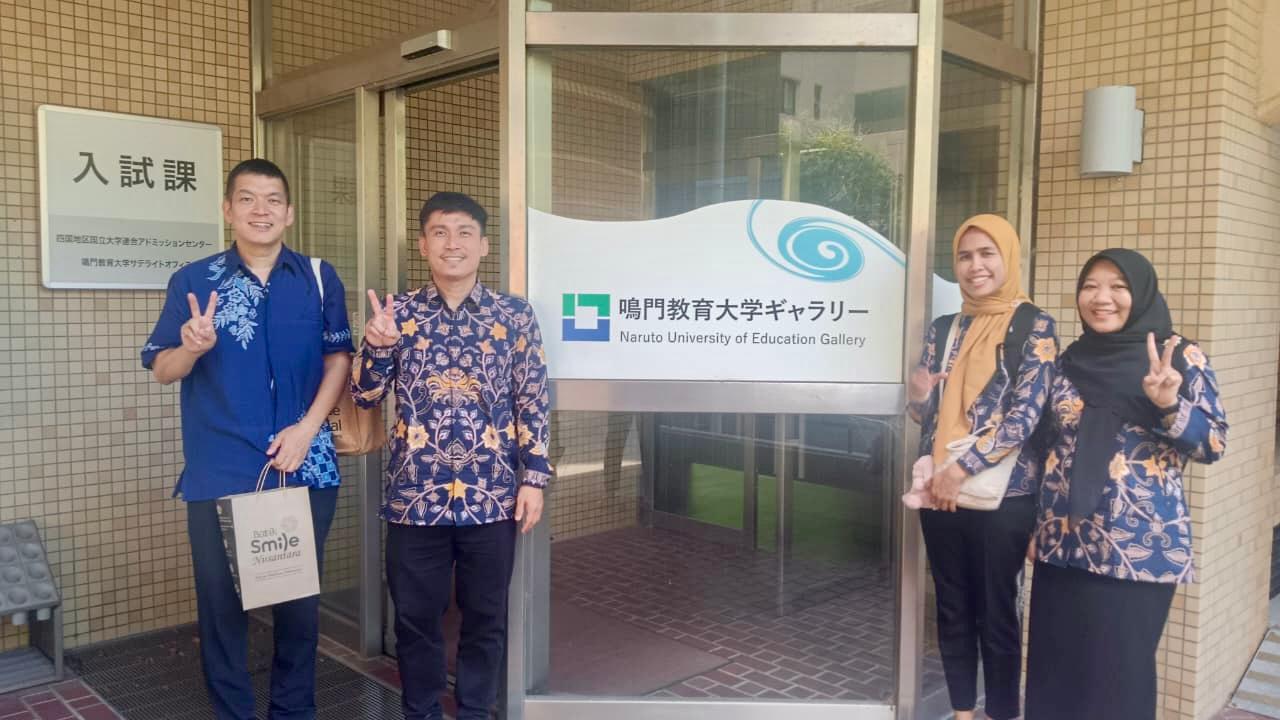
In an effort to strengthen academic collaboration and promote international knowledge exchange, the Naruto University of Education, Japan, hosted a guest lecture featuring a speaker from the Faculty of Mathematics and Natural Sciences (FMIPA), Universitas Negeri Semarang (UNNES), Indonesia. The event invited Dr. Arif Widiyatmoko, Ph.D. as the keynote speaker, who delivered a lecture on “Synthesizing STEM and ICT Education”, a theme that resonates with the pressing needs of 21st-century education.
In his presentation, Dr. Arif emphasized the importance of integrating STEM (Science, Technology, Engineering, and Mathematics) with ICT (Information and Communication Technology) in science learning. This integration, he explained, not only enriches students’ learning experiences but also nurtures critical thinking, creativity, collaboration, and communication skills essential for the digital era. Beyond theory, he also engaged participants in hands-on STEM practices.
During the practical session, participants were divided into small groups to join two activities: building a straw bridge and the egg drop challenge. These activities provided participants with firsthand experiences of applying scientific, engineering, and problem-solving concepts into practice. The enthusiasm was evident as participants strategized, collaborated, and communicated across cultures, highlighting that STEM learning can be applied in simple yet impactful ways, even within a short lecture.
Alongside the activities, a collaborative discussion was held between Dr. Arif Widiyatmoko, Ph.D., Dr. Fidia Fibriana, Ph.D., and Dr. Andhina Putri Heriyanti, which concluded with an agreement to invite Kusaka Sensei as a guest lecturer in Indonesia. Moreover, this collaboration opened opportunities for the UNNES STEM Education team to engage in international research partnerships with Japan, Singapore, and Taiwan on STEM Literacy and Collaborative Learning.
This guest lecture is also strongly aligned with the United Nations Sustainable Development Goals (SDGs), particularly SDG 4 (Quality Education) by advancing education quality through innovative STEM and ICT learning, SDG 9 (Industry, Innovation, and Infrastructure) by fostering creativity and technological innovation, and SDG 17 (Partnerships for the Goals) by strengthening international collaborations in research and education.