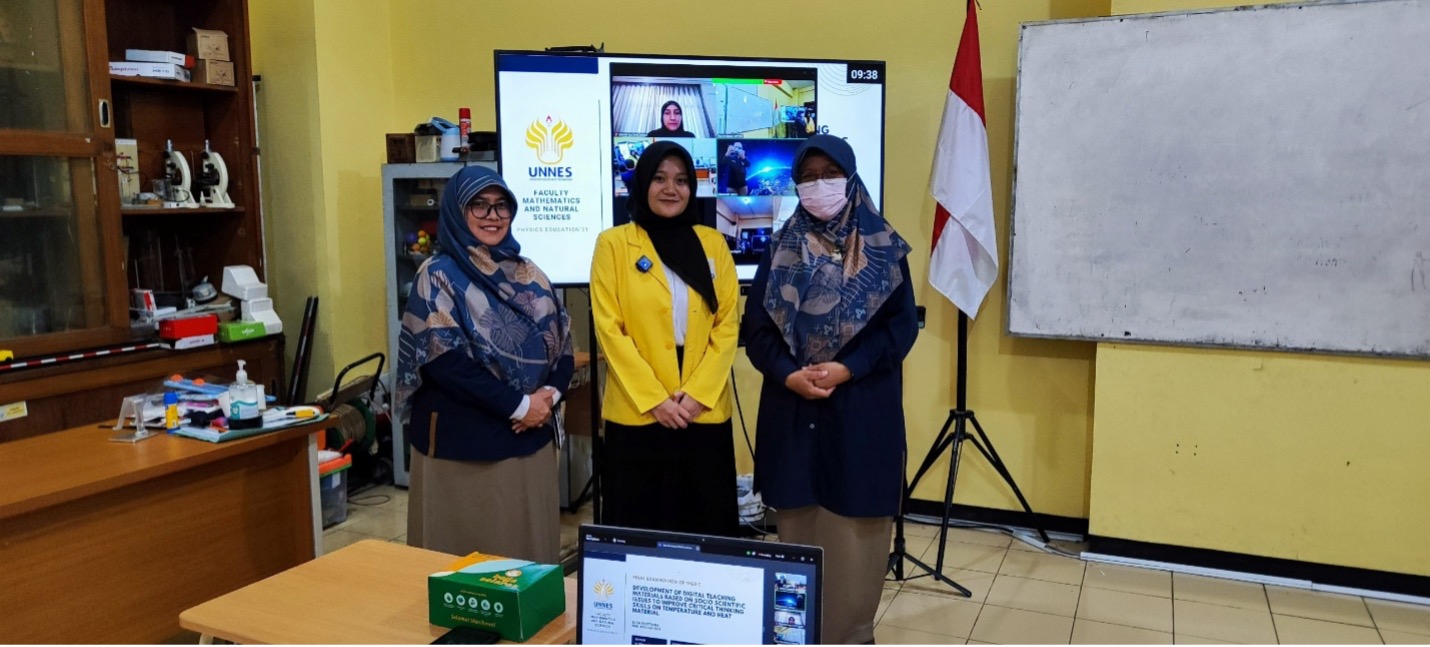
Semarang, June 30, 2025 – Student of the Physics Education Study Program, Semarang State University (UNNES), Elsa Destiana, successfully completed her thesis exam in a hybrid manner with the title “Development of Digital Teaching Materials Based on Socio-Scientific Issues (SSI) to Improve Critical Thinking Skills on the Topic of Temperature and Heat.”
This exam presented two examiners, namely Puan Zulinda Ayu Zulkipli, M.Ed. from Universiti Teknologi MARA (UiTM), Malaysia as an external examiner who attended online, and Dr. Langlang Handayani, M.App.Sc. from UNNES as an internal examiner who attended directly on campus.
In the session, Puan Zulinda gave high appreciation for Elsa’s concern in raising viral issues that are widely discussed on social media as a learning context. She considered this approach very effective in bridging the concept of temperature and heat with realities that are close to students’ lives, especially Generation Z who are familiar with digital technology. In addition, Puan Zulinda also encouraged the development of these teaching materials to be integrated more explicitly with the Education for Sustainable Development (ESD) and Sustainable Development Goals (SDGs) frameworks—particularly SDG 4 (Quality Education)—because the substance of Elsa’s research shows a strong connection with these concepts.
Dr. Langlang Handayani added the importance of including local issues from the school environment in the developed teaching materials. This is considered to enrich students’ learning experiences while fostering social sensitivity and the ability to make science-based decisions regarding problems around them—an essential component of achieving inclusive and equitable quality education as emphasized in SDG 4.
This thesis, supervised by Dr. Ellianawati, M.Sc., is part of an umbrella research funded by DPA UNNES through the Matching Grant scheme. Elsa’s research also contributes to the work program of the UNNES Child-Friendly Science and Technology Center (PUI), where Dr. Ellianawati is actively involved as a team member.
With a contextual SSI-based approach and digital learning media aligned with the characteristics of today’s students, Elsa’s research embodies the spirit of SDG 4: Quality Education, promoting innovative and inclusive learning that enhances critical thinking, sustainability values, and social responsibility among students.