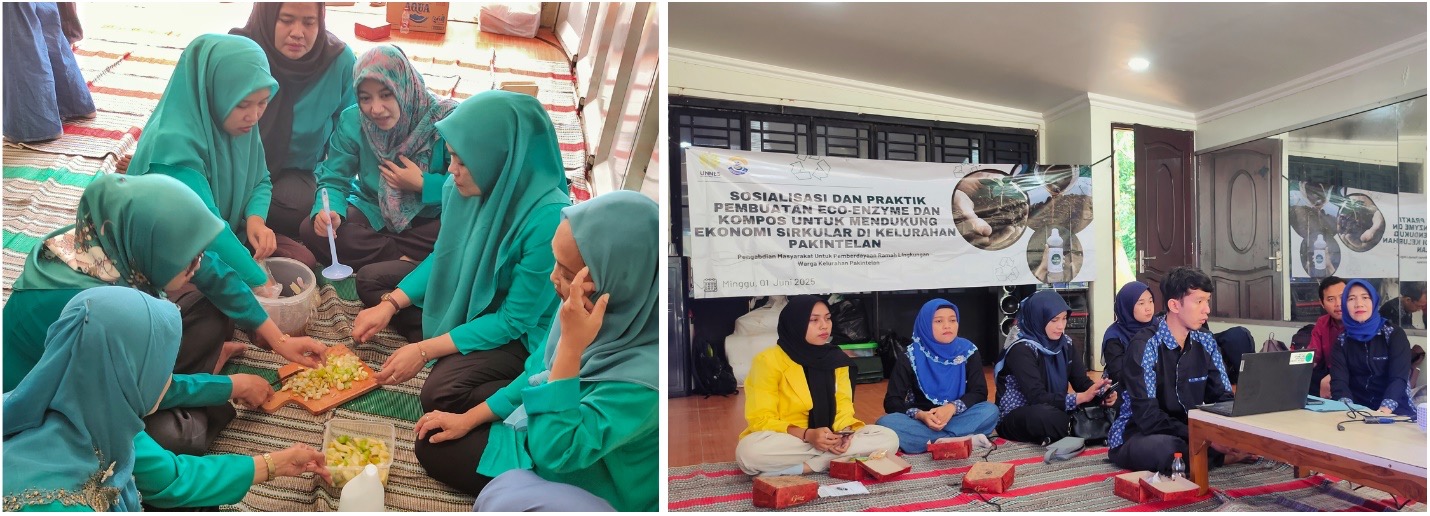
Semarang, October 2025 — In line with its commitment to supporting the Sustainable Development Goals (SDGs), particularly SDG 12 (Responsible Consumption and Production), SDG 11 (Sustainable Cities and Communities), and SDG 13 (Climate Action), the Community Service Team of the Faculty of Mathematics and Natural Sciences (FMIPA), Semarang State University (UNNES) carried out a socialization and hands-on training on household organic waste processing in RW 5, Pakintelan Village, on Sunday, June 1, 2025.
The event was attended by more than 30 members of the local PKK women’s organization and aimed to provide knowledge and practical skills in transforming household organic waste into valuable, eco-friendly products such as ecoenzymes and compost.
The UNNES FMIPA Community Service Team—consisting of Trida Ridho Fariz, S.Si., M.Sc., Dr. Aditya Marianti, M.Sc., Dr. Bambang Eko Susilo, S.Pd., M.Pd., Dr. Siti Wahyuni, M.Sc., Dr. Nuni Widiarti, S.Pd., M.Sc., Dr. Sri Sukaesih, S.Pd., M.Pd., M. Faris Al Hakim, S.Pd., M.Cs., and Virgania Sari, S.Pd., M.Si.—delivered materials on the benefits and techniques of producing ecoenzymes and compost from daily organic waste.
Ecoenzyme, a fermented liquid made from fruit and vegetable peels, can be used as a natural cleaning agent, liquid fertilizer, and organic pesticide. Meanwhile, compost serves as an organic fertilizer that improves soil health and reduces dependence on chemical fertilizers.
After the theoretical session, participants practiced making ecoenzymes using simple materials such as brown sugar, water, and fruit waste. They also learned how to sort organic waste for composting. The training received an enthusiastic response, as participants saw firsthand how easy and beneficial it is to process household waste into useful products.
This community service initiative also supports SDG 3 (Good Health and Well-Being) and SDG 15 (Life on Land), while indirectly contributing to SDG 5 (Gender Equality) through the empowerment of PKK women and SDG 17 (Partnerships for the Goals) through collaboration between the university and local communities.
Through this program, FMIPA UNNES reinforces its role as a pioneer in conservation-based education and research that creates real impact for society. The team hopes this initiative will grow beyond socialization and evolve into a sustainable community-driven movement in Pakintelan Village, fostering a cleaner, healthier, and more sustainable environment for all.