Semarang, October 2025 – As part of its continuous commitment to the Sustainable Development Goals (SDGs), particularly SDG 4 (Quality Education) and SDG 9 (Industry, Innovation, and Infrastructure), the Faculty of Mathematics and Natural Sciences (FMIPA), Universitas Negeri Semarang (UNNES), successfully conducted a training program to Improve Science Teacher Digital Literacy through an Artificial Intelligence (AI)-Based STEM Approach to Realize Deep Learning.
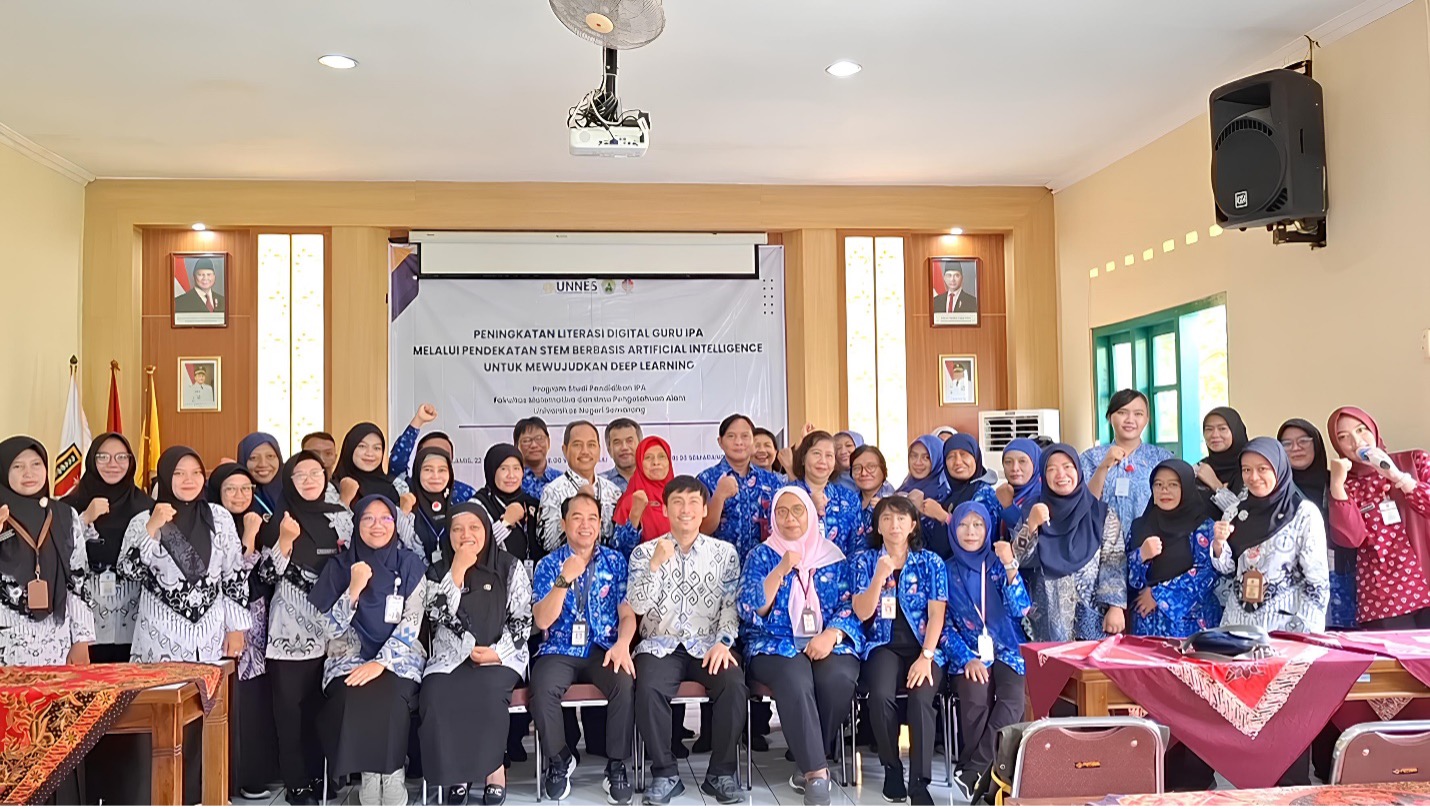
The activity, held at SMP Negeri 36 Semarang, brought together 38 science teachers from various junior high schools across Semarang City. This initiative, organized by the FMIPA UNNES Community Service Team, took place on Thursday (May 22, 2024) and received enthusiastic participation from the local teaching community.
The event began with the singing of Indonesia Raya, followed by welcoming remarks from the Principal of SMP Negeri 36 Semarang, Mrs. Nur Laily, S.Pd., M.Pd., the Head of MGMP IPA Semarang City, Mr. Sukimin, M.Pd., and the Head of the Community Service Team, Dr. Arif Widiyatmoko, Ph.D. The activity concluded with a prayer and a shared spirit of collaboration in advancing digital transformation in education.
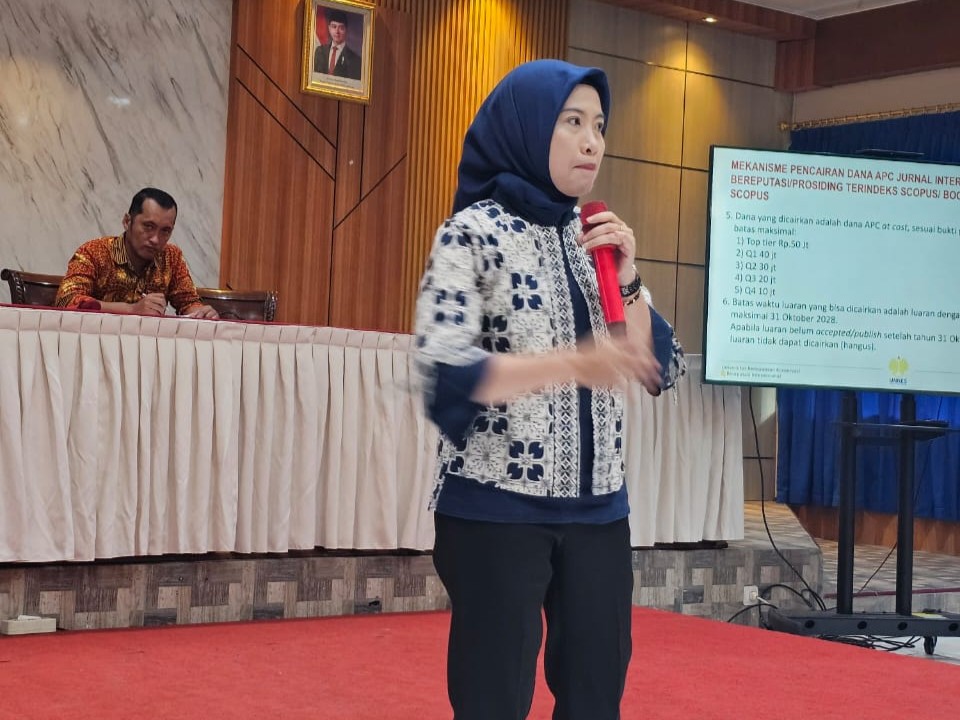
The training featured a team of expert speakers, including Dr. Arif Widiyatmoko, Ph.D., Septico Aji, M.Pd., Dr. Fidia Fibriana, Ph.D., Tiara Dwi Wulandari, S.Pd., Siti Nursulistari, S.Pd., Alfiana Nur Rosita Mayanti, S.Pd., and Nadia Eka Ardhani. Participants received comprehensive materials on digital literacy, the use of AI in science education, and the integration of the STEM approach with Deep Learning concepts.
One of the highlights was a hands-on experiment on determining acid-base indicators using natural substances such as bougainvillea, butterfly pea flowers, and dragon fruit, assisted by the AI Color Detector application. Teachers practiced detecting color changes digitally—an activity that bridges traditional science experimentation with modern AI technology, reflecting innovation in teaching and learning practices in line with SDG 9.
During the session, some teachers faced challenges in using the AI Color Detector correctly, but the FMIPA UNNES team promptly provided assistance, ensuring all participants could complete the activity effectively.
In his statement, Dr. Arif Widiyatmoko emphasized that this program is not only about introducing technology but also building educators’ readiness to integrate AI into science learning meaningfully and ethically.
“The goal of this AI-based STEM training is to equip science teachers with insights and practical skills in applying AI to create contextual, curriculum-aligned, and engaging learning experiences. Through this, we also support teachers in preparing students for various competitions—such as STEM, OPSI, coding, and robotics—while realizing the concept of Deep Learning,” he explained.
Meanwhile, the Head of MGMP IPA Semarang City, Mr. Sukimin, M.Pd., expressed appreciation for FMIPA UNNES’s initiative.
“This training has broadened our understanding of how AI can be implemented in science learning. The direct practice and discussions about AI ethics and data security were particularly valuable for us,” he said.
In addition to lectures and practice, participants engaged in a Focus Group Discussion (FGD) on integrating Deep Learning frameworks into classroom practice, including how to adapt lesson plans (RPP) that adopt AI and STEM principles. This approach aligns with SDG 4, which promotes inclusive and quality education while fostering lifelong learning opportunities for all.
The activity concluded with an open discussion session, where participants shared critical reflections and innovative ideas about the future of AI-assisted science education. A group photo session wrapped up the day, marking the success of another impactful community service initiative by FMIPA UNNES.
Through this program, FMIPA UNNES reaffirms its role in advancing sustainable education and technological innovation. By empowering teachers to integrate AI and STEM in the classroom, this initiative not only strengthens educator capacity and student engagement but also contributes directly to achieving SDG 4 (Quality Education) and SDG 9 (Industry, Innovation, and Infrastructure) — paving the way for a more inclusive, innovative, and future-ready education system in Indonesia.