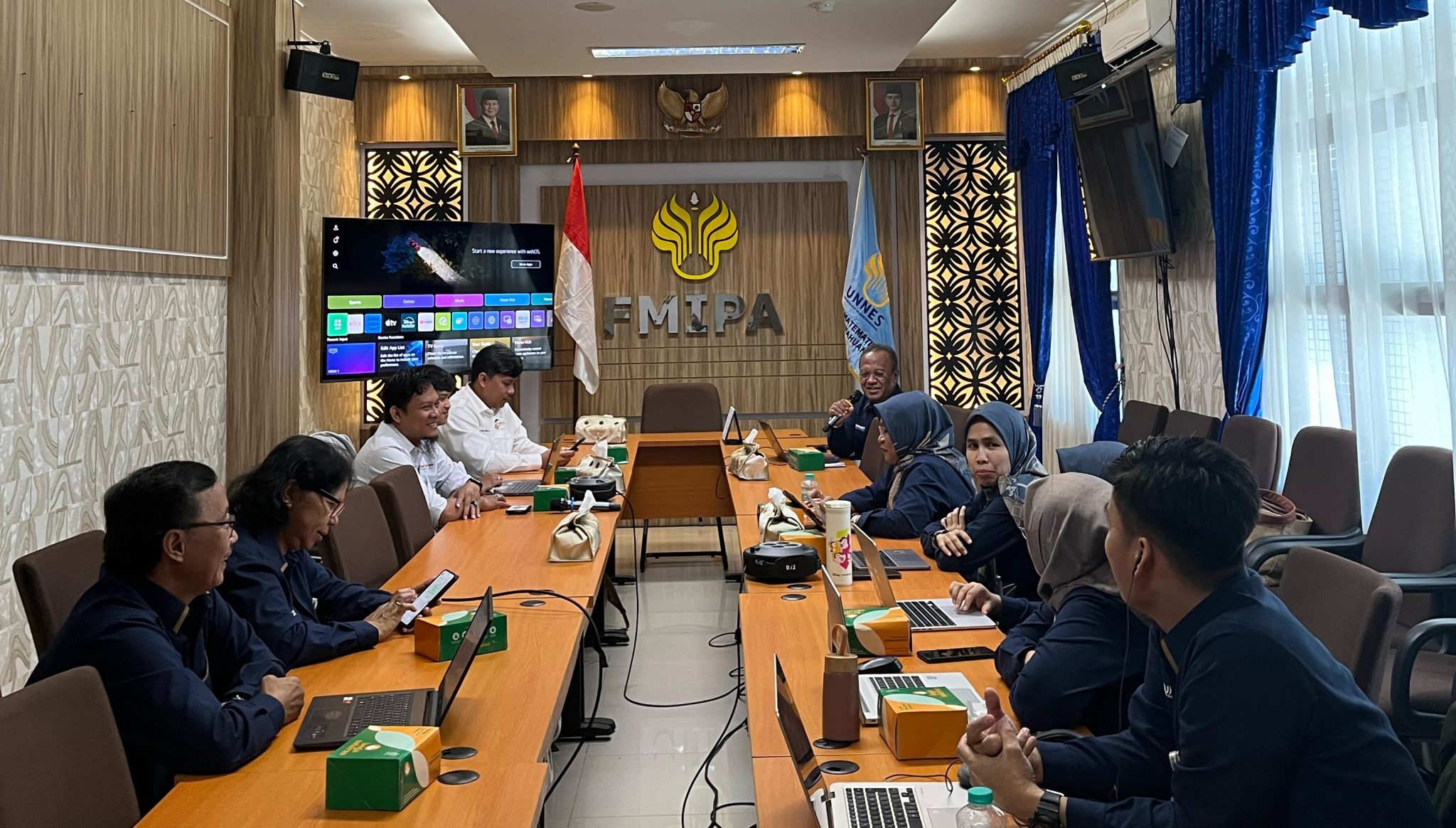
Semarang, October 2025 — On Monday, April 28, 2025, the Faculty of Mathematics and Natural Sciences (FMIPA) of Semarang State University (UNNES) officially signed a cooperation agreement with Jagat Satwa Taman Mini Indonesia Indah (TMII). The event took place in the Meeting Room on the 2nd floor of Building D12, FMIPA Deanery, and was attended by FMIPA leadership, along with the coordinators of the Bachelor of Biology, Bachelor of Biology Education, Bachelor of Environmental Science, Bachelor of Science Education, and Master of Science Education programs.
This collaboration marks an important milestone in FMIPA UNNES’s commitment to implementing Sustainable Development Goals (SDGs)—particularly SDG 4 (Quality Education) and SDG 15 (Life on Land)—by promoting high-quality education, biodiversity research, and community engagement for sustainable environmental management.
In his address, Deputy Dean I of FMIPA, Dr. Zaenal Abidin, Ph.D., emphasized that this partnership will create new opportunities for both students and lecturers to develop educational innovations and conduct joint research projects.
“This cooperation opens new pathways for FMIPA to strengthen its role as a center of excellence in science education and environmental studies. Students will gain valuable experiential learning through research and conservation-based education,” said Dr. Zaenal.
Meanwhile, Deputy Dean III, Prof. Sutikno, highlighted that this collaboration extends beyond academic benefits—it also fosters community awareness about environmental conservation and biodiversity protection.
“Through this partnership, we aim to engage the public in understanding the importance of protecting ecosystems and biodiversity. This is an integral step in realizing sustainability goals and nurturing environmental responsibility among the younger generation,” he stated.
The cooperation between FMIPA UNNES and Jagat Satwa TMII encompasses joint activities in education, research, and community service, particularly in the fields of biology, ecology, and environmental education. The collaboration also aims to integrate field-based learning with conservation practices, allowing students to apply scientific knowledge directly to real-world environmental challenges.
Looking ahead, both institutions are optimistic that this partnership will evolve into a long-term and sustainable collaboration, driving innovation and awareness in science and conservation education.
Through this initiative, FMIPA UNNES reaffirms its dedication to advancing SDG 4 and SDG 15—ensuring inclusive and quality education while promoting the sustainable use and protection of terrestrial ecosystems for future generations.