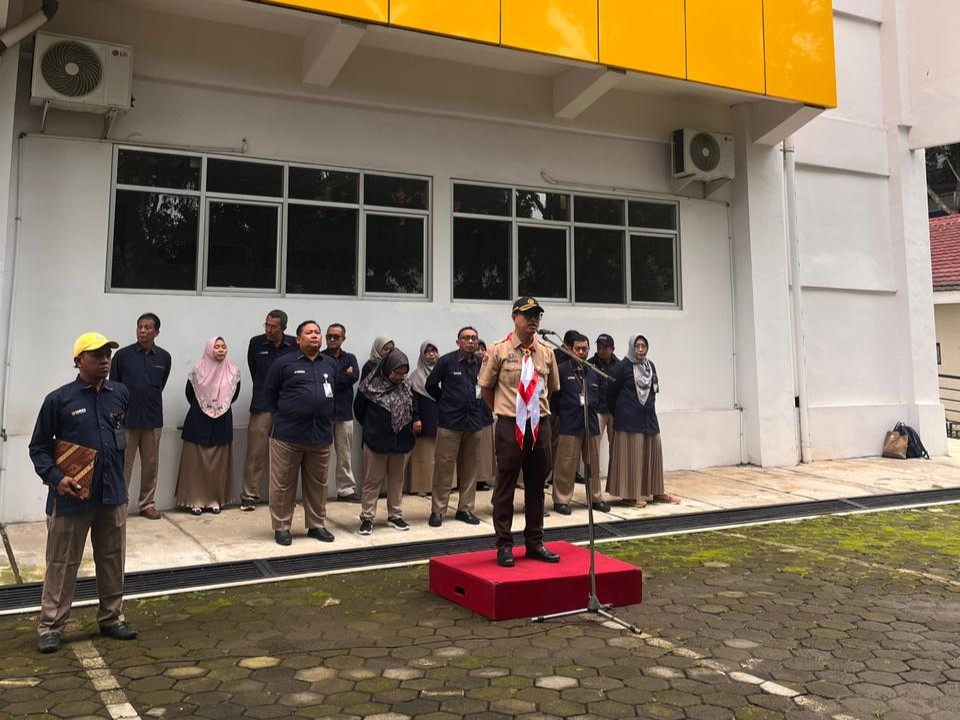
The process of entering student grades into the system by January 16, 2026, at the latest, is a serious concern for the Faculty of Social and Political Sciences (FISIP) UNNES. This affirmation was conveyed by the Vice Dean I of FISIP, Dr.scient.med. Fadly Husain, S.Sos., M.Si., during a roll call on Monday, January 12, 2026, at the FISIP UNNES parking lot, Sekaran, Gunungpati, Semarang.
According to Dr.scient.med. Fadly Husain, grade entry is not merely an administrative obligation, but part of academic services that reflect the quality of higher education.
“Students have the right to receive grades for every course they take. Therefore, integrity, timeliness, and accountability in grading must be maintained by every lecturer,” he emphasized.
He added that commitment to transparent and responsible academic services is a tangible form of FISIP UNNES’s contribution to supporting the Sustainable Development Goals (SDGs), particularly SDG 4 on Quality Education. Through professional academic management, FISIP strives to ensure that the educational process is inclusive, fair, and oriented towards improving the quality of learning.
As the head of the faculty, Dr.scient.med. Fadly Husain emphasized that FISIP UNNES places students at the center of educational services, in line with the university’s vision of developing superior and competitive human resources.
“The quality of education is not only measured by the learning process in the classroom, but also by the certainty of academic services received by students,” he said.
In addition to grade entry, FISIP UNNES is also carrying out a number of strategic academic agendas, including the preparation of the lecture schedule for the Diploma and Bachelor’s Degree Programs for the Even Semester of the 2025/2026 Academic Year, which will take place on January 12-16, 2026.
In the same week, 6th semester students will participate in an online internship briefing on Tuesday, January 13, 2026, at 08.30 WIB. This activity is part of FISIP’s efforts to equip students with the necessary competencies before entering the world of work, while also supporting continuous learning achievements.
The series of academic agendas in early January 2026 also includes study plan consultations with academic advisors on January 2–16, 2026, the preparation of the MKU/MKDK lecture schedule on January 2–6, 2026, and the preparation of the Master’s and Doctoral Program schedules on January 7–9, 2026.
Through this consistent academic management, FISIP UNNES reaffirms its role as a higher education institution committed to quality governance and the achievement of SDG 4, aiming to create a quality, equitable, and sustainable educational environment.