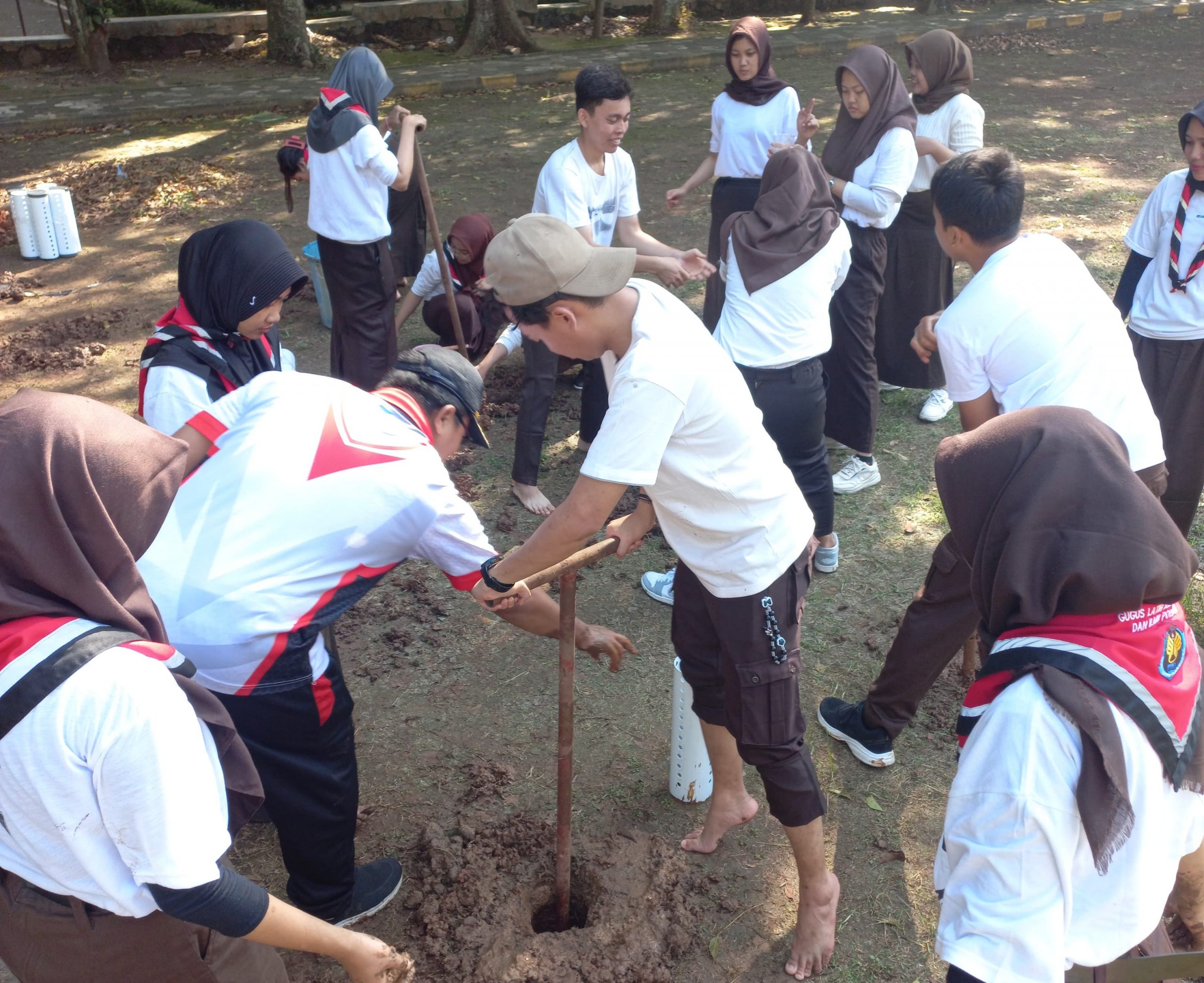
The Dean of the Faculty of Social and Political Sciences at Universitas Negeri Semarang (FISIP UNNES), together with the Conservation Task Force and Scout students from Scout Group 3, created biopore holes on the FISIP campus field in Sekaran, Gunungpati, on Saturday (June 14). The biopore-making activity was chosen as it aligns with the vision of FISIP UNNES to participate in environmental conservation efforts.
FISIP Dean Prof. Arif Purnomo stated that creating biopore holes is actually very simple. Biopores can be made in drainage bases, waterlogged areas, or garden borders and paving areas. However, not everyone is aware of their significant benefits.
Rudi Salam, the event coordinator, explained that this activity highlights environmental issues, in line with UNNES’s vision as a conservation university. Environmental concerns are one of the pillars of conservation. UNNES has already implemented a “one student, one tree” program, requiring each new student to plant and care for a tree. Now, this initiative is complemented by “one student, one biopore hole” to support groundwater recharge and transform organic waste into compost that benefits soil fauna and plant roots.
“Biopore infiltration holes are an appropriate and eco-friendly technology to tackle both floods and drought,” said Wazifun, Head of the FISIP Scout Unit. The benefits of biopore holes during the rainy season include increasing water absorption capacity. If groundwater is sufficient, drought problems can be mitigated.
This initiative aligns with the principles of the Sustainable Development Goals (SDGs), not only Goal 6 (Clean Water and Sanitation), but also Goal 13 (Climate Action) and Goal 15 (Life on Land). Through this activity, FISIP UNNES reaffirms its role in integrating environmental action into campus life and shaping student character to care about the sustainability of the planet.