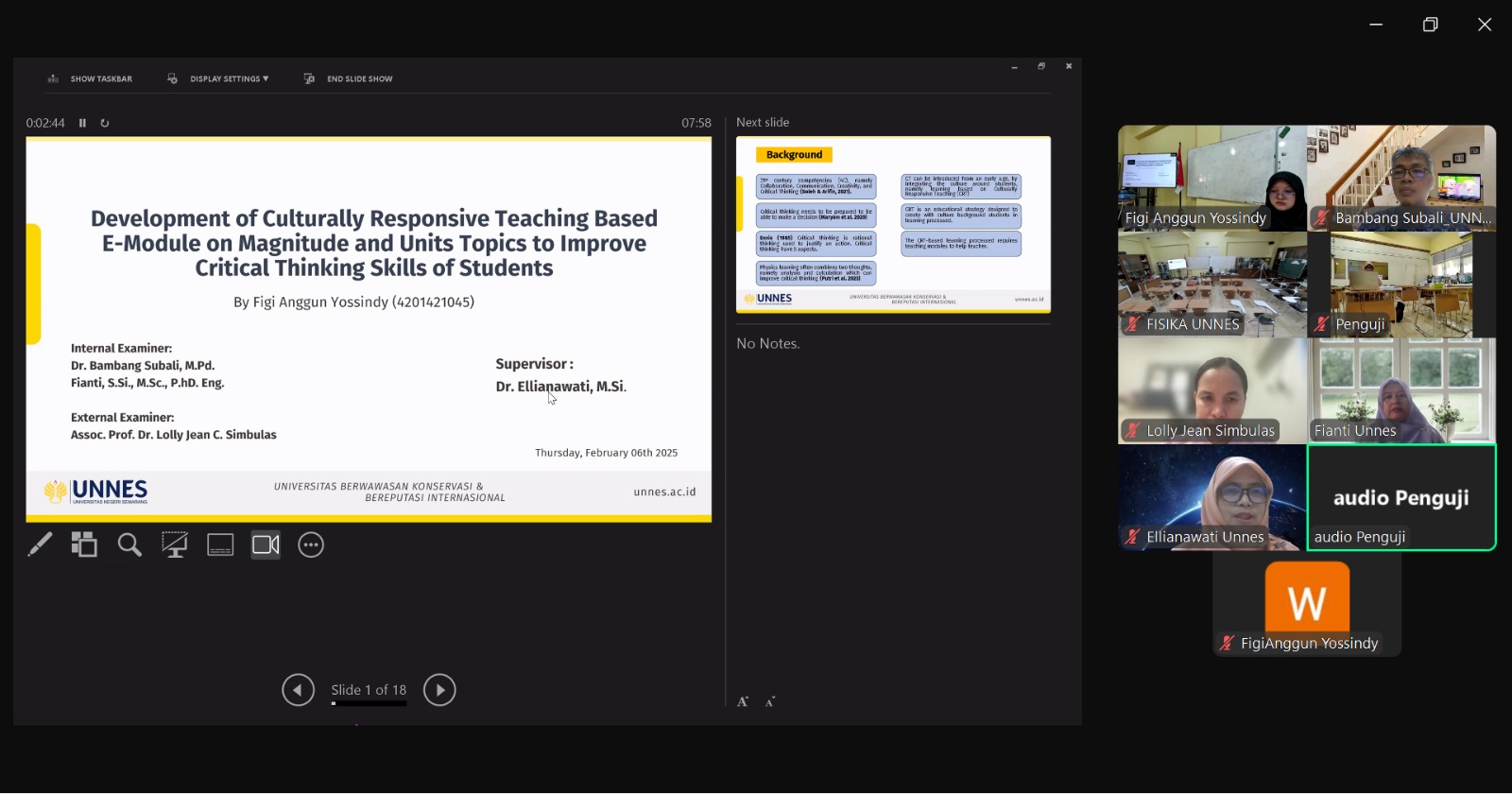
Semarang, October 2025 — A few months ago, on Thursday, February 6, 2025, Physics Education student Figi Anggun Yossindy successfully defended her undergraduate thesis before a panel of examiners consisting of Dr. Bambang Subali, M.Pd. and Fianti, S.Si., M.Sc., Ph.D. Eng. as internal examiners, and Dr. Lolly Jean C. Simbulas from the University of the Immaculate Conception (UIC), Philippines, as the external examiner.
Under the supervision of Dr. Ellianawati, M.Sc., Figi conducted an innovative study titled “Development of a Flipbook E-Module Based on Culturally Responsive Teaching (CRT) on Quantity and Unit Material to Improve Critical Thinking Skills for Class X Students.” Her research exemplifies the integration of local wisdom with digital learning innovation, aligning strongly with Sustainable Development Goal (SDG) 4: Quality Education.
Dr. Lolly expressed deep admiration for Figi’s unique approach, which incorporated traditional measuring tools—such as cubits, spans, and fathoms—into physics learning. Students were encouraged to compare these indigenous measurement systems with international standard units. This culturally grounded approach not only deepened students’ understanding of physics concepts but also enhanced their critical thinking skills and appreciation of Indonesia’s rich cultural heritage.
The use of the Culturally Responsive Teaching (CRT) framework allowed learners to explore how traditional communities practiced measurement in daily life—be it in trade, crafts, or architecture. By connecting modern science with ancestral wisdom, the study provided a meaningful learning experience that celebrates cultural diversity while reinforcing conceptual mastery.
The examining committee commended Figi’s composure and clarity in responding to all academic inquiries. Her work was praised as a model of inclusive and context-based learning innovation, bridging the gap between culture and science. The study further recommends the integration of Augmented Reality (AR) to visualize traditional measuring tools in three dimensions, making learning more interactive and technology-driven.
Through this research, Figi Anggun Yossindy has contributed not only to the advancement of physics education but also to the realization of SDG 4 — ensuring inclusive and equitable quality education and promoting lifelong learning opportunities for all. Her project demonstrates how education rooted in local culture and supported by digital innovation can inspire sustainable, globally minded learning practices.