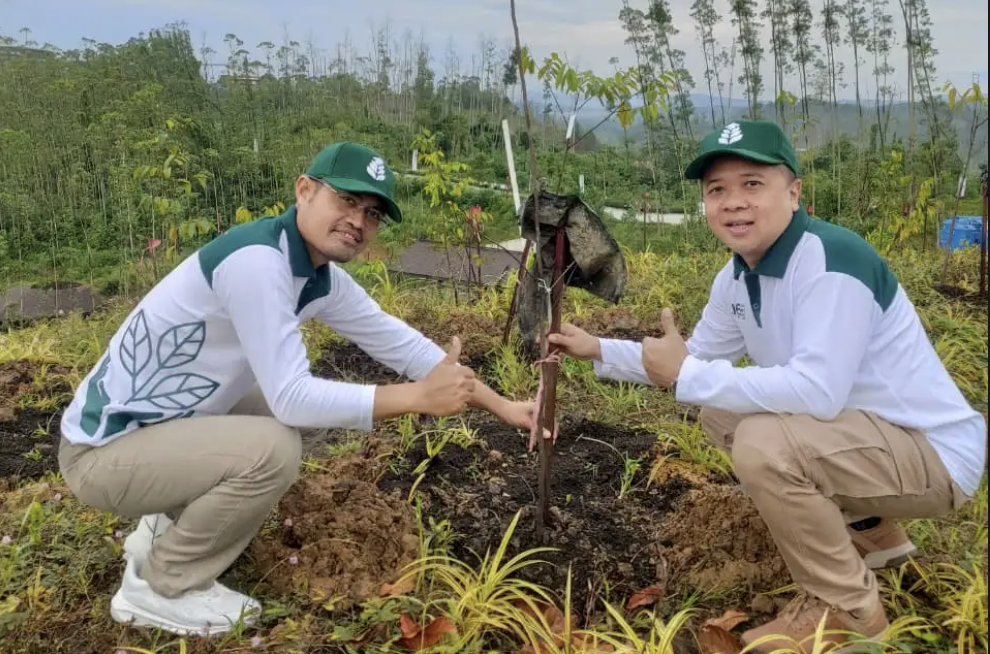
In a bold move to reinforce its commitment to sustainable development, the Faculty of Economics and Business at Universitas Negeri Semarang (FEB UNNES) organized a tree planting program titled “Konservasi Hijau” at Indonesia’s new capital city (IKN Nusantara) on 25–26 August 2025.
Led by Dean Prof. Dr. Amir Mahmud, S.Pd., M.Si, and supported by the faculty leadership, this initiative directly contributes to several key Sustainable Development Goals (SDGs), especially SDG 13 (Climate Action) and SDG 15 (Life on Land). The activity also saw the participation of Vice Deans Dorojatun, S.E., M.M., Ph.D., and Prihandono, S.E., M.M., Ph.D., who joined students and staff in planting trees at the designated location in the IKN green development area.
“Tree planting is not merely ceremonial—it is our tangible step towards integrating sustainability and green economy values into real action,” said Dean Prof. Amir.
This initiative aligns with Indonesia’s national strategy for reducing carbon emissions and restoring terrestrial ecosystems, positioning the university as an active player in climate change mitigation. Moreover, the integration of this environmental mission within a future-focused development area like IKN underscores the importance of balancing infrastructure growth with ecological preservation.
The tree planting program also supports SDG 4 (Quality Education) by engaging students in experiential learning on environmental stewardship and sustainable economics. As stated by the faculty leadership, such field activities deepen students’ understanding beyond classroom theory.
In addition, the program reflects the spirit of SDG 17 (Partnerships for the Goals) through its collaboration between academia, local government, and IKN authorities. This joint action sends a strong message that sustainable development can only be achieved through multi-stakeholder synergy.
Looking ahead, FEB UNNES plans to establish IKN as a living laboratory for future research, student fieldwork, and academic collaboration focused on sustainable urban development and green economy practices.
“We hope this will be the starting point for a continuous conservation agenda and collaborative research that benefits not just IKN but also serves as a model for other universities in Indonesia,” added Vice Dean Dorojatun.