Faculty of Engineering UNNES Students Innovate Eco-Friendly Photocatalytic Material from Orange Peels

Universitas Negeri Semarang > Sustainable Development Goals Universitas Negeri Semarang > News > News > Faculty of Engineering UNNES Students Innovate Eco-Friendly Photocatalytic Material from Orange Peels

Faculty of Engineering UNNES Students Develop NCQDS/TIO2 Photocatalytic Material from Orange Peels

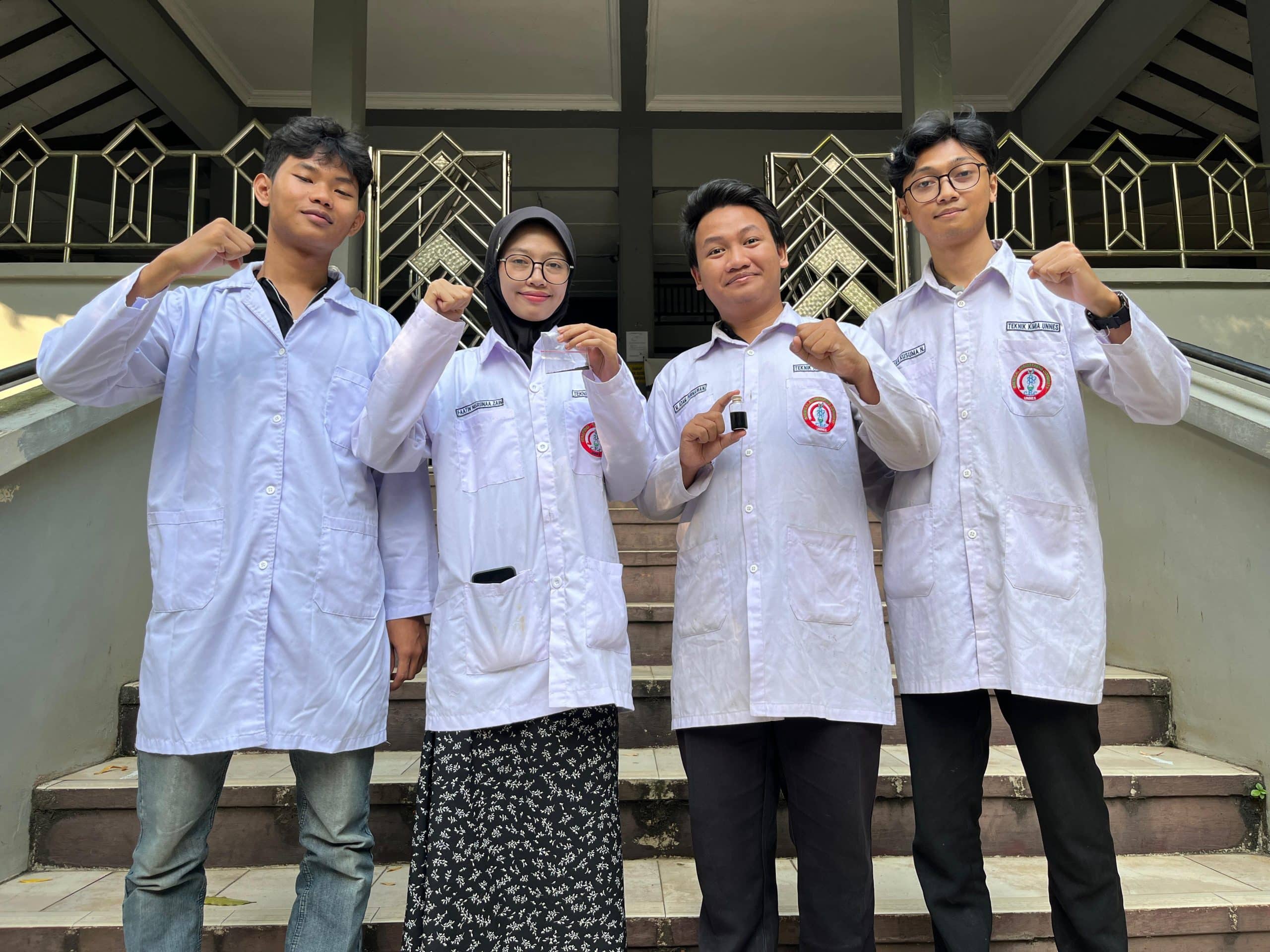
Students from Semarang State University (UNNES) have successfully developed an environmentally friendly material based on orange peel waste to help clean water contaminated with textile dye waste. This innovation is one of the students’ contributions to the development of green technology in Indonesia.

This innovation was developed by the Cqure team, consisting of Muhammad Adam Purnawan (Chemical Engineering 2022), Shaka Kusuma Nurjati (Chemical Engineering 2022), Fakhri Ahmad Kurniawan (Environmental Science 2023), and Faatin Nisriinaa Zain (Chemical Engineering 2023), under the guidance of Dr. Eng. Maulida Zakia, S.T., M.Eng. from the UNNES Department of Chemical Engineering. Their research also successfully qualified for the 2025 Student Creativity Program for Exact Research (PKM RE) organized by the Ministry of Education, Culture, Research, and Technology.

This research arose from concerns about textile industry wastewater, which still contains many hazardous synthetic dyes, such as methyl orange, which is difficult to decompose naturally. Using a nanomaterial technology approach, the Cqure team attempted to utilize carbon-rich orange peel waste to produce a new material that can function as a photocatalyst.

Orange peel was processed using a one-step hydrothermal synthesis method to create a nitrogen-doped carbon quantum dots titanium dioxide (NCQDs/TiO₂) nanocomposite. This material has the ability to absorb visible light and accelerate the breakdown of hazardous compounds in water. This technology makes the water purification process more efficient and eliminates the generation of new waste.

Based on laboratory tests, the developed material demonstrated high performance in decomposing synthetic dyes. FTIR and SEM EDX analyses revealed a uniform material structure with a stable distribution of carbon, nitrogen, and titanium elements. Meanwhile, photodegradation tests demonstrated that this material was able to significantly reduce the concentration of methyl orange under visible light irradiation.

In addition to producing new findings, this research also contributes to the Sustainable Development Goals (SDGs), particularly point 6 on Clean Water and Adequate Sanitation and point 12 on Responsible Consumption and Production. It also addresses point 9 on Industry, Innovation, and Infrastructure. Through this scientific approach, UNNES students hope to inspire other young people to innovate using Indonesia’s natural resources.

The Cqure team also actively shares their research journey and testing results through the Instagram account @pkmre_cqure_unnes. This effort aims to introduce applied science to the public and raise awareness of the importance of sustainable research in the environmental field.

This innovation proves that simple ideas can develop into major solutions. Using often-wasted orange peels, UNNES students have successfully developed a new technology that can help maintain clean water and support a greener future.
Related Posts

Leave a Reply

* Kode Akses Komentar:

* Tuliskan kode akses komentar diatas:

GDPR

  • Privacy Policy

Privacy Policy

At unnes.ac.id, the privacy of our visitors is of extreme importance to us. This privacy policy document outlines the types of personal information that is received and collected by unnes.ac.id and how it is used.

Log Files

Like many other Web sites, unnes.ac.id makes use of log files. The information inside the log files includes internet protocol (IP) addresses, type of browser, Internet Service Provider (ISP), date/time stamp, referring/exit pages, and number of clicks to analyze trends, administer the site, track user’s movement around the site, and gather demographic information. IP addresses and other such information are not linked to any information that is personally identifiable.

Cookies

unnes.ac.id uses cookies to store information about visitors’ preferences, to record user-specific information on which pages the site visitor accesses or visits, and to personalize or customize our web page content based upon visitors’ browser type or other information that the visitor sends via their browser.

Third-party ad servers or ad networks use technology in their respective advertisements and links that appear on unnes.ac.id and which are sent directly to your browser. They automatically receive your IP address when this occurs. Other technologies (such as cookies, JavaScript, or Web Beacons) may also be used by our site’s third-party ad networks to measure the effectiveness of their advertising campaigns and/or to personalize the advertising content that you see on the site.

unnes.ac.id has no access to or control over these cookies that are used by third-party advertisers.

You should consult the respective privacy policies of these third-party ad servers for more detailed information on their practices as well as for instructions about how to opt-out of certain practices. unnes.ac.id’s privacy policy does not apply to, and we cannot control the activities of, such other advertisers or web sites.

If you wish to disable cookies, you may do so through your individual browser options. More detailed information about cookie management with specific web browsers can be found at the browsers’ respective websites.

Consent

By using our website, you hereby consent to our privacy policy and agree to its terms.

Update

This Privacy Policy was last updated on: 2023-02-14. Should we update, amend or make any changes to our privacy policy, those changes will be posted here.

Contact Us

If you have any questions, comments, or concerns about our Privacy Policy or our practices with regards to your personal information, please feel free to contact us through the contact form on our website or by emailing us at humas[at]mail.unnes.ac.id.

This Privacy Policy is intended as a general guide to our practices in collecting and using information. If there is any inconsistency between this Privacy Policy and the terms of the Service Agreement or any other terms that may apply to specific services you use, then those specific service terms shall apply.

Terms of Use

By using our website, you agree to abide by this Privacy Policy. If you do not agree with this Privacy Policy, please do not use our website. We reserve the right to update this Privacy Policy from time to time without prior notice. Please review our Privacy Policy periodically to check for changes. Your continued use of our website following the posting of changes to this Privacy Policy means that you accept the changes.

Thank you for reading our Privacy Policy. We are committed to protecting the privacy of our website visitors and will continue to update our Privacy Policy to ensure optimal protection.