Faculty of Engineering UNNES Students Develop NCQDS/TIO2 Photocatalytic Material from Orange Peels
Students from Semarang State University (UNNES) have successfully developed an environmentally friendly material based on orange peel waste to help clean water contaminated with textile dye waste. This innovation is one of the students’ contributions to the development of green technology in Indonesia.
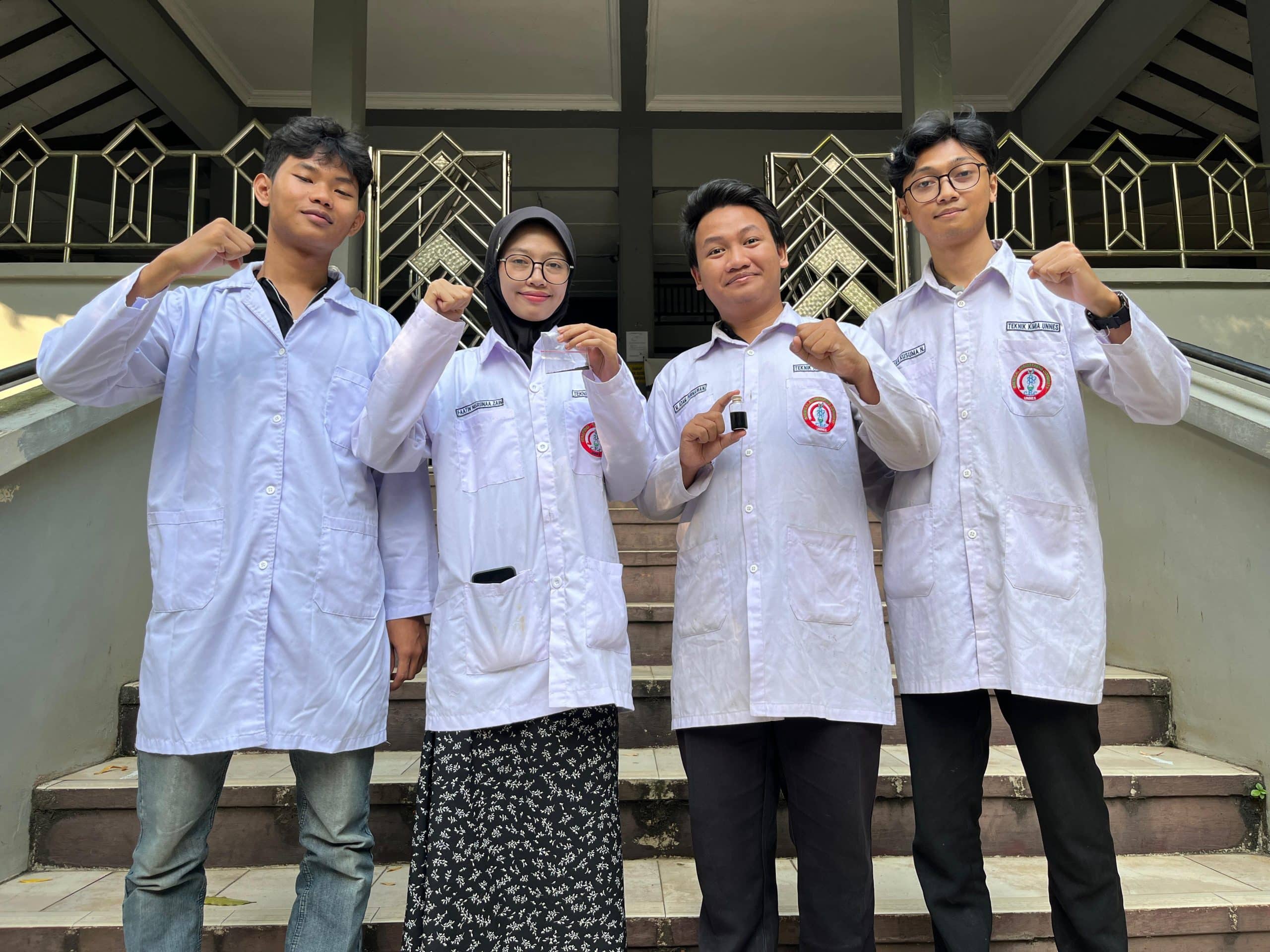
This innovation was developed by the Cqure team, consisting of Muhammad Adam Purnawan (Chemical Engineering 2022), Shaka Kusuma Nurjati (Chemical Engineering 2022), Fakhri Ahmad Kurniawan (Environmental Science 2023), and Faatin Nisriinaa Zain (Chemical Engineering 2023), under the guidance of Dr. Eng. Maulida Zakia, S.T., M.Eng. from the UNNES Department of Chemical Engineering. Their research also successfully qualified for the 2025 Student Creativity Program for Exact Research (PKM RE) organized by the Ministry of Education, Culture, Research, and Technology.
This research arose from concerns about textile industry wastewater, which still contains many hazardous synthetic dyes, such as methyl orange, which is difficult to decompose naturally. Using a nanomaterial technology approach, the Cqure team attempted to utilize carbon-rich orange peel waste to produce a new material that can function as a photocatalyst.
Orange peel was processed using a one-step hydrothermal synthesis method to create a nitrogen-doped carbon quantum dots titanium dioxide (NCQDs/TiO₂) nanocomposite. This material has the ability to absorb visible light and accelerate the breakdown of hazardous compounds in water. This technology makes the water purification process more efficient and eliminates the generation of new waste.
Based on laboratory tests, the developed material demonstrated high performance in decomposing synthetic dyes. FTIR and SEM EDX analyses revealed a uniform material structure with a stable distribution of carbon, nitrogen, and titanium elements. Meanwhile, photodegradation tests demonstrated that this material was able to significantly reduce the concentration of methyl orange under visible light irradiation.
In addition to producing new findings, this research also contributes to the Sustainable Development Goals (SDGs), particularly point 6 on Clean Water and Adequate Sanitation and point 12 on Responsible Consumption and Production. It also addresses point 9 on Industry, Innovation, and Infrastructure. Through this scientific approach, UNNES students hope to inspire other young people to innovate using Indonesia’s natural resources.
The Cqure team also actively shares their research journey and testing results through the Instagram account @pkmre_cqure_unnes. This effort aims to introduce applied science to the public and raise awareness of the importance of sustainable research in the environmental field.
This innovation proves that simple ideas can develop into major solutions. Using often-wasted orange peels, UNNES students have successfully developed a new technology that can help maintain clean water and support a greener future.