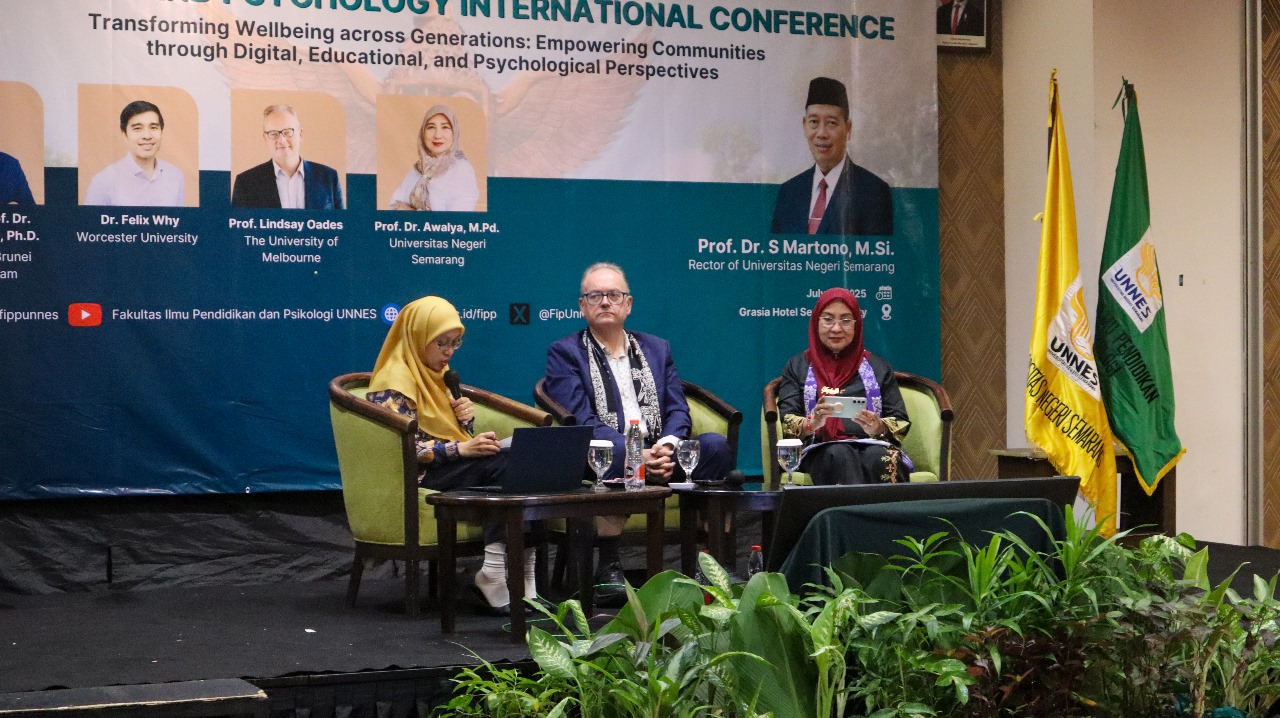
The critical issue of intergenerational wellbeing took center stage at the inaugural Education and Psychology International Conference (EPIC) 2025, held at Grasia Hotel Semarang on Wednesday, 16 July 2025. This international conference was initiated by the Faculty of Education and Psychology (FIPP), Universitas Negeri Semarang (UNNES).
The Secretary of UNNES, Prof. Dr. Sugianto, M.Si., formally opened EPIC 2025, which carried the theme “Transforming Wellbeing across Generations: Empowering Communities through Digital, Educational, and Psychological Perspectives.”
Conference Chair, Dr. Decky Avrilianda, S.Pd., M.Pd., explained that the event was conducted in a hybrid format to facilitate broad participation from experts. A total of 141 researchers from various universities took part, deliberating on how digital, educational, and psychological perspectives can serve as key drivers for community empowerment and wellbeing enhancement.
Dr. Avrilianda emphasized that these discussions align with the Sustainable Development Goals (SDGs), particularly Goal 3 on Good Health and Wellbeing and Goal 4 on Quality Education.
Dean of FIPP UNNES, Prof. Edy Purwanto, M.Si., in his remarks, underscored the relevance of wellbeing as a topic, especially amid the growing concern over suicide cases among students. “I hope this conference will serve as a platform for knowledge exchange and skill enhancement in promoting wellbeing,” he said.
Four Experts Present New Perspectives on Wellbeing
EPIC 2025 featured four distinguished speakers who shared their insights and latest research findings.
Assoc. Prof. Dr. Rizki Edmi Edison, Ph.D., from Universiti Brunei Darussalam, discussed “The Neuroscience of Leadership in Nurturing Generational Well-Being.” He highlighted that neuroleadership,rooted in brain science and behavior,is the art of mobilizing people toward goals, innovation, and progress.
Dr. Edison also outlined a framework linking leadership, cognitive functions, brain mapping (EEG), and neurofeedback, stressing the necessity of bias-free approaches in understanding human behavior. His research on “Faking Good Among Porn-Addicted Adolescents” further examined the role of the Frontal Lobe and the Limbic System.
Meanwhile, Dr. Felix Why, Senior Lecturer at Worcester University, presented on “System 1 for Health Behavior Change.” He explained the distinction between System 1 pathways (automatic, unconscious) and System 2 pathways (deliberate, controlled) in behavior change. He noted that nudge interventions leveraging System 1,such as placing healthy options within easier reach or setting them as defaults,have proven increasingly effective and vital, especially in the age of social media and the “Reverse Flynn Effect” (declining intelligence).
Prof. Lindsay Oades from The University of Melbourne introduced the concept of Wellbeing Literacy, which he defined as the ability to understand and compose wellbeing-related language to maintain or enhance the wellbeing of oneself, others, or the world. His Wellbeing Literacy Capability Model encompasses vocabulary, comprehension, composition, context awareness, and intentionality for wellbeing. Early studies indicate that wellbeing literacy is a distinct construct with unique variance.
Lastly, Prof. Dr. Awalya, M.Pd., Kons., Professor of Guidance and Counseling Management at UNNES, addressed teacher wellbeing as central to achieving quality education. Drawing on research conducted in 48 senior high schools across Central Java (2022-2024), she found that teacher wellbeing does not directly influence students’ literacy and numeracy scores, but has an indirect effect through student character development. Furthermore, teacher wellbeing directly impacts teaching methods, classroom management, and psychological support,highlighting the importance of support systems and professional development programs for teachers.