Universitas Negeri Semarang (UNNES) continues to demonstrate its strong commitment to sustainability by empowering a wide range of student-led organizations that actively engage in environmental conservation, biodiversity protection, and community resilience. As a conservation-oriented university, UNNES places students at the center of sustainability initiatives, positioning them as key drivers of change both on campus and in surrounding communities.
UNNES provides various platforms for students to initiate and lead sustainability-focused activities through diverse communities. These include Mahapala UNNES (Mahasiswa Pecinta Alam), Pelatuk BSC (Bird Study Club), Iling Project, Green Community, and KSG Social Adventure Club. Each of these organizations operates independently as student-led societies while contributing to the broader sustainability agenda of the university.
These communities are actively involved in real-world environmental actions. Activities range from biodiversity conservation, wildlife monitoring, environmental education, reforestation, mangrove planting, waste management campaigns, and climate awareness programs, to disaster preparedness and emergency response. Through these initiatives, students gain hands-on experience in addressing environmental challenges while contributing directly to sustainable development efforts.
For instance, Mahapala UNNES plays a significant role in environmental conservation through nature expeditions, survival training, and ecosystem preservation programs. The organization has also received recognition at the provincial level for its contribution to environmental conservation, reflecting its impact beyond the campus.
The Green Community, based in the Faculty of Mathematics and Natural Sciences, focuses on biodiversity research and conservation. Students conduct field studies, ecological surveys, and environmental campaigns aimed at protecting flora and fauna. Similarly, Pelatuk BSC specializes in bird conservation and biodiversity monitoring, contributing to species protection and environmental awareness.
Meanwhile, KSG Social Adventure Club integrates environmental activism with social engagement, organizing community-based programs that combine sustainability education with social service. SAR UNNES, on the other hand, contributes to sustainability through disaster risk reduction, emergency response, and resilience-building activities, which are increasingly important in the context of climate change.
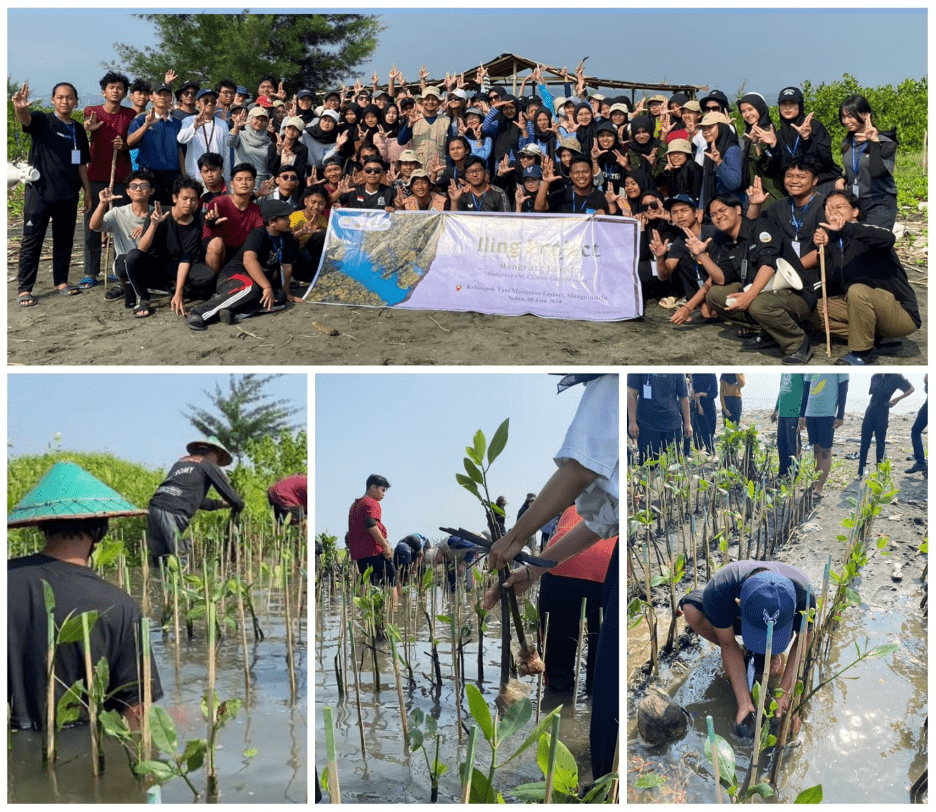
One of the prominent student-led initiatives at UNNES is the Iling Project, a sustainability-driven community initiated by Environmental Science students. Since 2021, the project has focused on coastal ecosystem restoration through large-scale mangrove planting and environmental action. The initiative involves interdisciplinary and international student participation, as well as collaboration with industry partners and local communities.
Through activities such as planting thousands of mangrove seedlings, conducting regular ecological monitoring, and engaging coastal communities, the Iling Project contributes to mitigating coastal abrasion, enhancing biodiversity, and supporting climate action. The program demonstrates a strong example of student leadership in sustainability, combining research, community engagement, and real-world environmental impact.
In addition to university-level organizations, UNNES also strengthens sustainability engagement through faculty-based student initiatives, such as the Kader Konservasi FEB (Faculty of Economics and Business). This program promotes environmental awareness and sustainable practices among students at the faculty level, ensuring that sustainability values are embedded across academic disciplines.
These student-led communities are supported by institutional frameworks that provide training, mentoring, and opportunities for collaboration. However, the initiatives themselves are driven by students, who design, implement, and lead sustainability programs. This approach fosters leadership, innovation, and a strong sense of environmental responsibility among students.
Through this comprehensive ecosystem of student-led organizations, UNNES not only promotes sustainability awareness but also builds practical competencies and long-term commitment to environmental stewardship. The active involvement of students in sustainability initiatives reflects the university’s holistic approach to integrating conservation values into campus life and beyond.