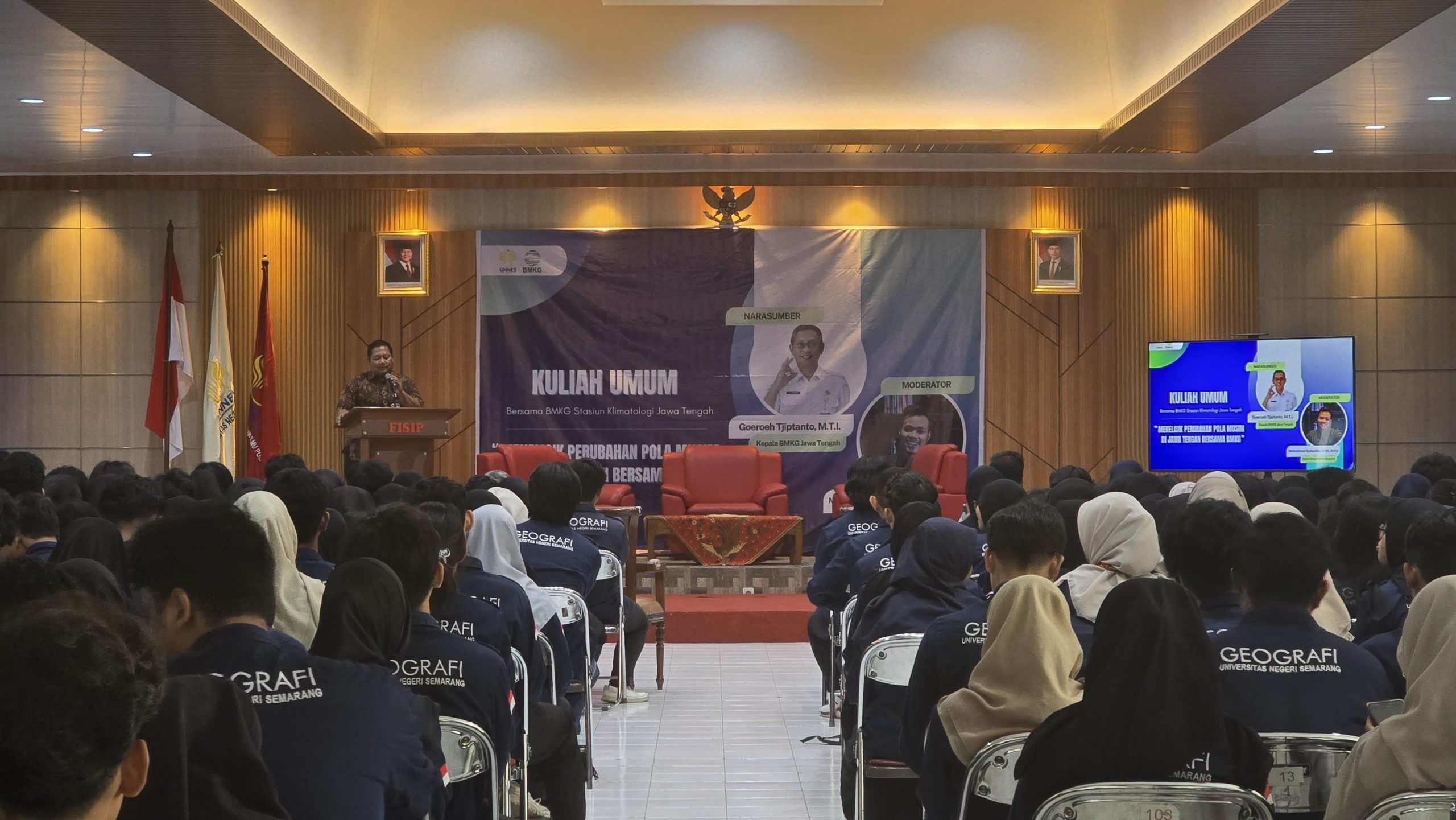
In an effort to enrich students’ understanding of climate dynamics and strengthen academic insights in the field of climatology, the Geography Student Association (KM Geografi) of Universitas Negeri Semarang (UNNES) organized a public lecture themed “Exploring Changes in Seasonal Patterns in Central Java.”
The event took place on Wednesday (June 25, 2025) at the 3rd floor of Building C7, Faculty of Social Sciences (FISIP) UNNES. It featured Goeroeh Tjiptanto, M.T., Head of the Central Java Climatology Station of the Meteorology, Climatology, and Geophysics Agency (BMKG), and was attended by Geography faculty members and students from various cohorts.
This public lecture served as both an end-of-semester learning enrichment activity and a platform for dialogue between climate science practitioners and the academic community. In his presentation, Goeroeh Tjiptanto explained that changes in seasonal patterns across Central Java result from complex interactions among monsoon winds, sea surface temperatures (SST), and global phenomena such as El Niño, La Niña, and the Indian Ocean Dipole (IOD).
Asian monsoons typically bring the rainy season, while Australian monsoons lead to dry periods. However, anomalies in sea surface temperatures along with ENSO and IOD conditions can alter the intensity and duration of rainfall, resulting in seasonal shifts from the standard climatological patterns based on a 30-year average. This underscores the dynamic nature of climate, which is highly susceptible to atmospheric and oceanic interactions.
The event strongly aligns with the Sustainable Development Goals (SDGs), particularly SDG 13 (Climate Action) and SDG 4 (Quality Education).
By deepening their understanding of regional climate dynamics such as seasonal shifts, students prospective educators, spatial planners, and community leaders can become key agents in climate change mitigation and adaptation efforts at the local level.
This lecture also reinforces UNNES’s commitment as a conservation minded university, consistently integrating environmental issues into academic and community engagement activities.