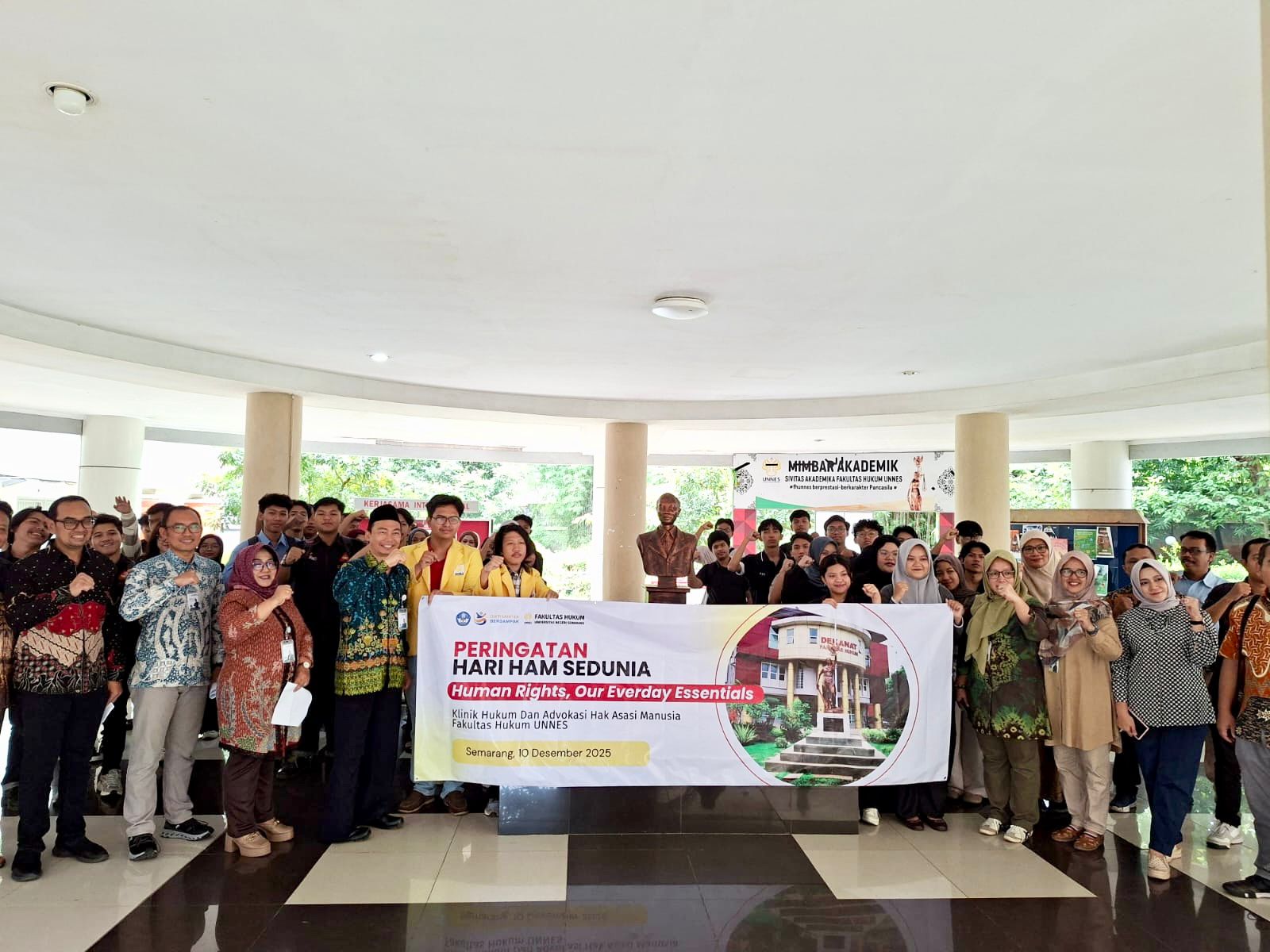
Semarang, December 10, 2025 — The Faculty of Law at Semarang State University (FH UNNES) commemorated World Human Rights Day by calling for a joint movement to protect environmental rights. The event was led by FH UNNES Dean Prof. Dr. Ali Masyhar, S.H., M.H., accompanied by faculty leaders, namely Vice Dean for Academic Affairs Dr. Indah Sri Utari, S.H., M.Hum., Deputy Dean for Resources and Planning Aprila Niravita, S.H., M.Kn., and Deputy Dean for Business, Research, and Cooperation M. Azil Maskur, S.H., M.H.
On the occasion of World Human Rights Day, FH UNNES issued a firm statement that the protection of human rights cannot be separated from the protection of environmental rights. The environment is considered the main foundation of human life, so negligence in caring for and protecting it is tantamount to threatening the survival of humanity itself.
The Faculty of Law at UNNES emphasizes that caring for the environment is a form of gratitude to God Almighty. All forms of environmental destruction—from irregular mining permits, excessive groundwater exploitation, deforestation, illegal logging, to spatial planning violations—are considered forms of ecological injustice that must be stopped. Awareness of equitable spatial planning is key to preserving land, water, and space as gifts from God that must be utilized to the fullest for the prosperity of the people.
From an academic and human rights perspective, FH UNNES also promotes the Life-Oriented Ethics (LOE) approach, an ethical paradigm that places the intrinsic value of all life at the center of moral considerations. This ethics rejects narrow anthropocentrism and encourages respect for biodiversity, ecosystem integrity, and the rights of future generations. This approach demands the application of the Precautionary Principle, the strengthening of local wisdom, and ecological awareness as part of holistic human rights protection.
From a religious perspective, FH UNNES emphasizes the role of humans as caliphs on earth, who are not only responsible for protecting human rights, but also the rights of all living creatures and the environment. Observing the increase in natural disasters in recent times, FH UNNES sees a strong correlation between the environmental crisis and low human awareness of behavior towards nature.
This call also affirms FH UNNES’ contribution to the Sustainable Development Goals (SDGs), particularly SDG 16: Peace, Justice, and Strong Institutions through strengthening environmental justice and integrity governance, SDG 13: Climate Action through encouraging ecosystem protection and environmental damage mitigation, and SDG 15: Life on Land in maintaining biodiversity sustainability.
Through this World Human Rights Day commemoration, FH UNNES reaffirms its identity as a faculty that echoes critical thinking and academic advocacy, producing powerful graduates with character, ethics, and environmental awareness, as well as a commitment to sovereign law for ecological justice and sustainability of life. The movement to safeguard Environmental Rights is expected to become a shared moral call for the academic community and the wider public to protect the future of the earth and the dignity of humanity.